

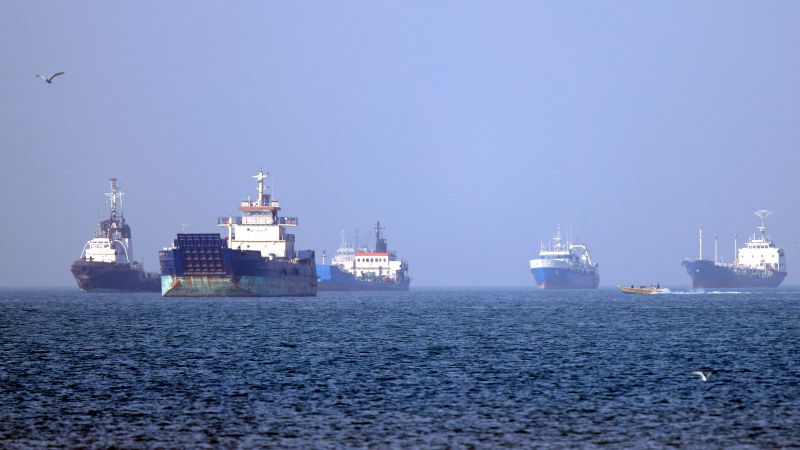
Iran is trying to force compliance with a new protocol for transiting the Strait of Hormuz, one that risks shippers risking attack.
The Iranian government has set out a new set of rules for ships attempting to transit the Strait of Hormuz, ignoring U.S. warnings and moving forward with efforts to formalize control of the waterway, according to documents obtained by CNN.
The document, titled “Ship Information Declaration,” is an application issued by Iran’s newly established Persian Gulf Straits Authority (PGSA) and must be filled out by all vessels passing through to ensure safe navigation. The information was shared with CNN by Lloyd’s List and another shipping industry official who requested anonymity.
Until the US and Israeli operation against Iran began in late February, the strait was open to ships leaving the country. But since the conflict began, Iran has threatened to attack ships passing through Hormuz without permission from the Islamic Revolutionary Guards Corps (IRGC) navy. Although many ships have been attacked, the majority of ship owners and operators have chosen not to risk allowing their vessels to pass in defiance of Iran.
The move to establish an authority over the strait underscores Iran’s determination to tighten its control over what it views as the spoils of war, despite repeated warnings from the United States and the region. Control of the waterway, through which one-fifth of the world’s oil and liquefied natural gas flows, would give the Islamic Republic immense influence over its neighbors and the global economy.

The closure of the Strait of Hormuz caused the largest oil supply shock in history, causing energy prices to rise sharply. On Wednesday, U.S. gasoline prices exceeded $4.50 per gallon for the first time in four years.
“A new regional and global order”
On Wednesday, Supreme Leader Mojtaba Khamenei’s account on the social media app Telegram posted a message explaining his vision for the Persian Gulf.
The leader called for a “new regional and global order based on a strong Iranian strategy” that would leave no place for “foreigners and their mischief.” He specifically pointed to “using the leverage of the strait closure” as one way to achieve that vision.
At the end of April, a statement attributed to Ayatollah Khamenei suggested that Iran create a mechanism to monitor traffic on the waterway.
The statement said Iran has introduced a “new legal framework and management of the Strait of Hormuz,” which will benefit neighboring countries and be economically beneficial.
He added: “Foreigners who come from thousands of miles away and act with greed and malice have no place but at the bottom of the ocean.”
The PGSA document, currently available to shippers, consists of more than 40 questions and requires vessels to declare their name and identification number, “previous name”, country of origin and country of destination.
We will also ask for the registered owner and operator, the nationality of the crew on board, as well as cargo details.
According to the PGSA, ships must email information to the authorities before they can transit the strait.

An email from PGSA shared with CNN includes a warning that “complete and accurate information is essential” to process a vessel’s transit request and that “further instructions will be communicated via email.”
“If the information provided is inaccurate or incomplete, the applicant shall be solely responsible and the resulting consequences shall be borne accordingly,” the email reads.
It is unclear whether any shipping companies have asked the PGSA for permission. Analysts say doing so could result in U.S. sanctions.
CNN sent a letter to the PGSA’s published email address on Wednesday seeking further information, but has not received a response.
CNN has reached out to the White House and the U.S. Treasury Department for comment.
Iran had previously refused to allow ships with ties to the United States or Israel to pass through the waterway, and said other vessels could only pass with Iranian consent. India and Pakistan are among the governments negotiating with Iran to secure passage for their flagged ships.
The IRGC uses emergency radio communications frequencies to alert ships that it has control of waterways.
The new requirements are “quite similar to the questions Iranian authorities are already known to be asking shipowners,” said Richard Meade of maritime data analysis service Lloyds Intelligence. However, this “appears to be a formalization of the structure and a maneuver by Iran to normalize Iran’s authority over transit.”
It is unclear from the document whether there will be a fee for transit. The Iranian government has touted the strait as a potential source of revenue that could help the country rebuild after the destruction caused by American and Israeli attacks. It reportedly charges up to $2 million per vessel to sail.
Last week, the Treasury Department’s Office of Foreign Assets Control added guidance to its FAQ page clarifying that such payments are not permitted to U.S. individuals or entities.
“Direct or indirect payments to the Iranian government or the Islamic Revolutionary Guards Corps (IRGC) for safe passage through the Strait of Hormuz are not authorized by U.S. persons, including U.S. financial institutions, or foreign entities owned or controlled by the U.S.,” the report said.
Dimitris Maniatis, CEO of MariRisk, a maritime risk consultancy, said the Iranians “require what we call tolls to be allowed to sail these vessels.”

Once they receive permission, they will sail according to a “specific voyage plan that always passes between the islands of Qashm and Larak” near the Iranian coast, Maniatis told CNN.
The Revolutionary Guards on Monday announced a new maritime control zone covering a wide area to the west and east of the strait, which stretches all the way to the Gulf of Oman, according to a map published with the announcement.
The U.S. naval blockade of ships to and from Iranian ports continues as Iran seeks to assert control of the strait.
Earlier this week, US President Donald Trump announced the launch of Project Freedom, which would help ships navigate the strait at the request of Pakistani mediators, but it was halted within 48 hours.
Maniatis said the plan “further intensified the Iranians’ aggressive stance in wanting to control the strait.”
As many as 20,000 seafarers from some 1,000 ships trapped in the Persian Gulf are caught in the crossfire, Maniatis said. “The crews are in a very difficult situation and are bearing all the consequences of a war that is becoming more regional,” Maniatis said.
“Sailors are not soldiers. They are civilians who operate ships and control global trade. They should not be dragged into situations like this.”
According to Lloyd’s List, only 40 ships crossed the Channel in the week ending May 3. Under prewar traffic conditions, there were an average of 120 intersections per day.
Maritime traffic data on Thursday showed very few tankers or cargo shipments were passing through the strait as Iran and the United States contest the choke point.
Analysts say any form of Iranian control would have a long-term impact on oil flows through the strait.
“There is growing evidence that Iran may be seeking to maintain strategic control of the strait for as long as possible, while at the same time the United States may accept this outcome,” said Matt Wright of the maritime intelligence firm Kpler.
U.S. officials have repeatedly said that Iranian control of the chokepoint is unacceptable.
Wright estimates that if Tehran regains control of the waterway, shipping volumes would be no more than half the pre-war average, with a serious impact on global oil and gas markets.
“Under a long-term Iran-controlled scenario, transit could rise to 40-50% of export capacity, but normalization cannot be achieved,” Wright added.
