

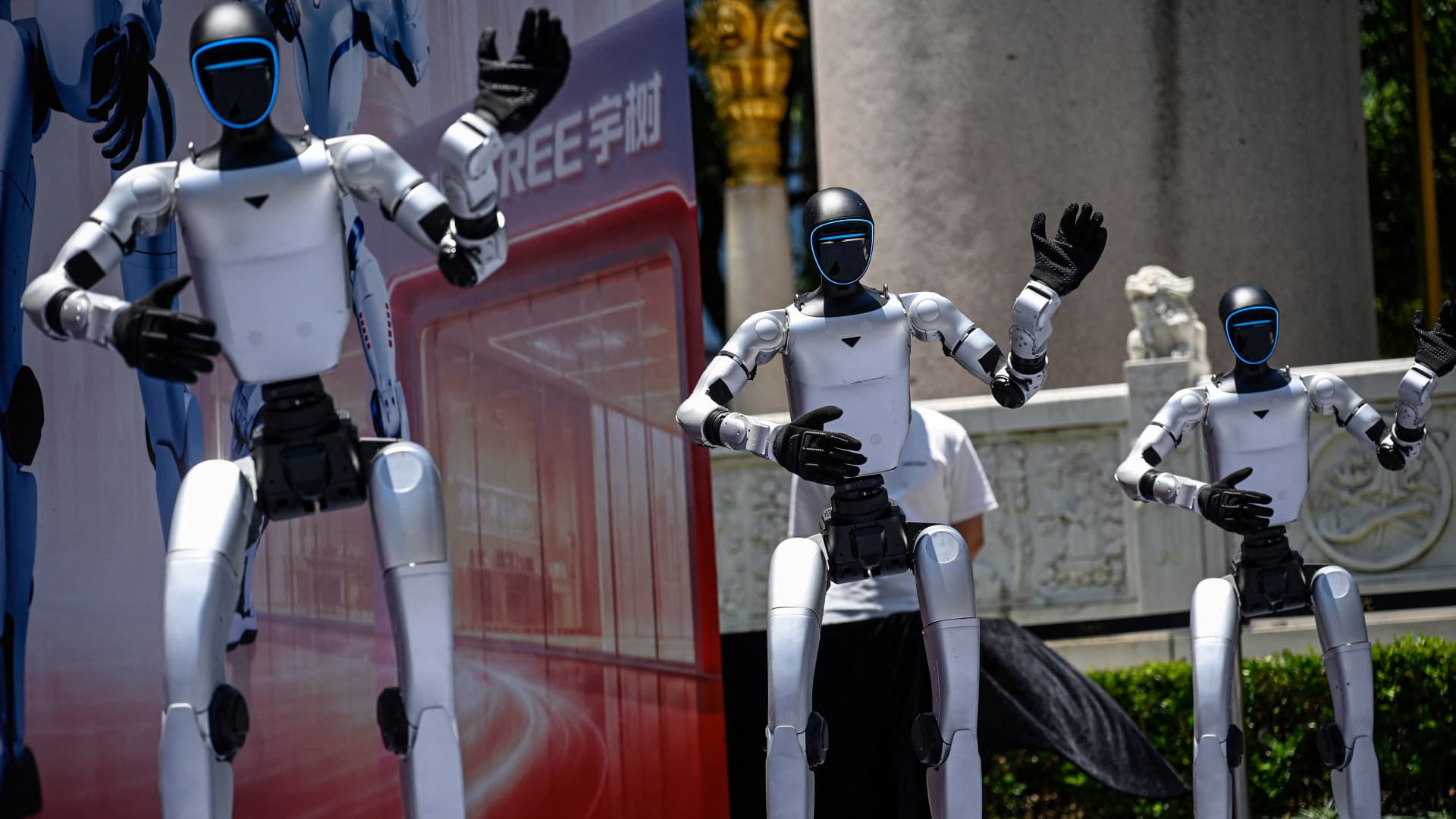
Unitree Robotics humanoids dance to the opening of Asia’s first Embodied Intelligence Experience Store in Shanghai, May 31, 2026.
Jade Gao | AFP | Getty Images
SoftBank CEO Masayoshi Son told CNBC this week that the next trillion-dollar company will emerge from physical AI and robotics.
Humanoid robots designed to mimic human movements and functions have been making headlines in recent years, from their use as baggage handlers at Japanese airports to Tesla’s big bet on its Optimus humanoid.
Market watchers predict that machines will change the world over the next decade, with the industry expected to grow 100 times as AI’s physical capabilities evolve. One investor said consumer stocks are the way to get value out of it.
“This is the decade of robots,” Zornica Todorova, head of thematic FICC research at Barclays and co-author of the bank’s “AI Gets Physical” report, told CNBC’s “Squawk Box Europe” on Thursday.
“Humanoid robotics is really on an upward trajectory,” she said. “The current market size is very small, between $2 billion and $3 billion, but it is expected to reach $200 billion by 2035.”
According to Todorova’s report published earlier this month, humanoids are “Automation 3.0.” The report says these machines are designed to fill structural labor shortages, with aging populations, urbanization and changing work preferences making “dirty, boring and dangerous” roles suitable for robots.
“They’re[already]doing simple, well-defined tasks like lifting boxes or picking things up off an assembly line, filling roles where there aren’t that many people who can do those jobs,” Todorova told CNBC.

“That said, there is a lot of work to be done and the technology is maturing really quickly,” she added.
“I think we’re on the cusp of a transformation right now. We’ve just scratched the surface of what humanoid robots can do. As the technology matures and models become better and faster in real-time responsiveness, I think we’ll see a lot of applications in more service-oriented roles.”
The big opportunity in Western markets is when physical AI reaches a service-oriented role, where most of the Western economic growth will come from, she added.
The Barclays report predicts two waves of humanoid robot adoption. The first wave is currently occurring in sectors such as manufacturing, logistics, agriculture, and construction, and is expected to continue until 2030, while the second wave is expected to see the introduction of robots from 2030 onward in sectors such as healthcare, elderly care, education, and hospitality.
The report also notes that China is “the world’s robot powerhouse and innovation laboratory,” deploying nearly half of all industrial robots in the world (nearly 300,000 compared to 34,000 in the United States) and increasing robot density by 600% since 2016, to nearly 500 robots per 10,000 workers.

The report also said that China “dominates in the production and deployment of humanoid robots,” accounting for 85% of installations last year, and that China produces robots “at about half the cost of Western competitors, typically in the $50,000 range.”
Jason Pidcock, who manages the £2.75 billion ($3.69 billion) Asian Income fund at asset management firm Jupiter, said in 10 years “the world will be completely different” thanks to developments in robotics.
“In 10 years, there will be humanoid robots everywhere,” he told a meeting at Jupiter’s offices in London on May 13. “You may have a humanoid robot in your home. No doubt your friends and family will have a humanoid robot. Factories will be filled with humanoid robots. Military and government agencies will be filled with humanoid robots.”
Mr Pidcock said the introduction of machinery would dramatically increase productivity, noting that manufacturing robots requires the production of both hardware and software.
“Asia will be at the forefront of delivering these things. This is a big part of where we are investing,” he said.
How two investors are trading robotics
In the year to the end of April, Pidcock’s fund rose 49.2%. Major holdings include: media tech, TSMC, samsung, foxconnST Engineering and Singtel.
“We’re looking for sectors that have companies that have the ability to evolve,” Pidcock said at an event in London.
“The reason we as a sector underestimate consumer discretion is because we prefer to use the high-tech sector to leverage consumers. So we think that in the coming years, consumers will spend more discretionary spending on high-tech products, such as upgrading their mobile phones and computers or purchasing their first humanoid.”
People ride bicycles past one of 15 humanoid robot police officers deployed in Hangzhou, eastern China’s Zhejiang province, on May 3, 2026.
Agatha Cantril | AFP | Getty Images
Dan Ives, managing director and senior equity analyst at Wedbush Securities, told CNBC in an email that the company believes humanoid robots “could represent one of the biggest market opportunities in the AI revolution.”
“This is a golden goose for physical AI and speaks to Tesla’s grand vision for Optimus,” Ives said.
Mr. Ives runs Wedbush’s AI Revolution ETF, which is up 4.19% since the beginning of the year. The top holdings of the fund are: micron, AMD, broadcom and Nvidia. But he told CNBC that the major companies at the heart of the humanoid robot space remain privately held.
“We see China as the clear leader in this space at the moment. The United States is playing catch-up mode,” he said.
Ives added that the market will be worth trillions of dollars over the next decade and “over time will change the way consumers and businesses operate.”
He said this would lead to a “massive increase in production”, but “there are clearly risks when it comes to robots and industry and government need to strike a careful balance”.
