

When a barrage of Ukrainian drones descended on Moscow early Thursday morning, Russia’s response looked more like a scramble than a carefully planned strategic defense. Video from the streets of the capital gave a glimpse of the chaos that followed.
Footage reviewed by CNN and analyzed by experts shows soldiers firing shoulder-mounted portable air defense systems as cars cautiously pass by on a busy highway. People flee for safety as a drone, presumably shot down by Russian air defenses, swoops down on a vast market building.
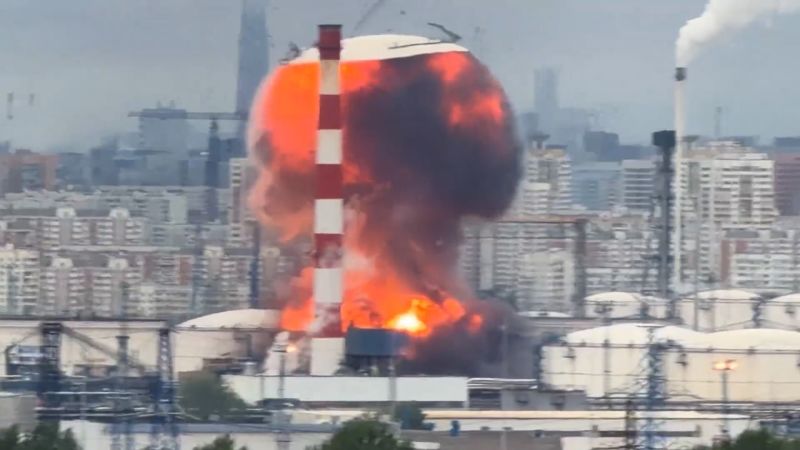
Another video shows what appears to be a Russian defense missile missing its target, likely hitting an oil storage tank on the outskirts of Moscow instead. A weapons expert at the Stockholm International Peace Research Institute told CNN it was a “Russian own goal” and ended with a plume of mushroom smoke blowing the tank’s huge top into the air.
Thursday’s attack on Moscow, the largest since the start of the all-out war, was another example of how successful Ukraine’s strategy of using drones to overwhelm Russia’s air defenses has been.
“Russia has a track record of not being able to trust its old systems 100%,” Markus Schiller, a senior researcher at the Stockholm International Peace Research Institute, said of the chaotic response in Moscow. Meanwhile, Ukraine has been continuously improving its offensive capabilities “for years.”
Starting in 2024, Ukraine has stepped up long-range attacks on Russian oil refineries and military facilities. Most recently it broke through the Russian defenses of St. Petersburg and repeatedly attacked Moscow, bringing war to Russia’s two largest cities.
Stu Ray, senior analyst at Mackenzie Intelligence Services, said: “Video of manned man-portable air defense system (MANPADS) firing on a busy highway shows a hasty and ad hoc response to the attack. , and a frankly unprofessional response. The complete lack of traffic control and the use of military equipment in incredible proximity to civilian vehicles and individuals supports this assessment.”
A Ukrainian military official previously told CNN that early in the conflict, Russia concentrated its air defense systems on the border and front lines with Ukraine. But Kiev’s strategy is to target many different locations within eastern Ukraine and Russia’s occupied territories, forcing Russia to spread its air defense systems into a more worn-out tapestry.
Kiev has also targeted air defense launchers themselves for years, as well as radar detection systems, with the aim of reducing Russia’s defense capabilities. The Ukrainian Armed Forces claims to have destroyed 166 Russian “anti-aircraft elements” since the beginning of this year and more than 1,432 since the start of the full-scale invasion in 2022.
Moreover, Russian air defense systems are not designed to counter drone attacks. They were designed to shoot down conventional military aircraft, ballistic missiles and cruise missiles, said Thomas Withington, a military scientist at the London-based Royal United Services Institute.
“It’s clear that Russia’s air defenses are simply not fit for purpose,” Withington told CNN. “They are not equipped to detect, track, and engage these types of attacks, and that will remain the case unless there is a major redesign of Russia’s air defense systems.”
Withington noted that international sanctions are hampering Russia’s ability to access the technology needed to develop new systems that could counter such attacks on Ukraine. “Even if we could increase production, we would just increase production of missile systems that don’t even have a role to play,” he said.
The growing threat from unmanned aircraft forced the Kremlin to scale back May’s Victory Day parade on Red Square without displaying military equipment, unlike previous events, due to what the Russian Ministry of Defense called “the current operational situation.” Moscow also called for a temporary ceasefire during the festive period.
Still, experts say Russian air defenses likely shot down most of Ukraine’s drones. On Friday morning, the Russian military announced that it had shot down 216 Ukrainian drones across Ukraine.
Robert Brobdy, commander of Ukraine’s Unmanned Systems Force, said in an assessment of Moscow’s air defense posture that as of mid-May, the Russian capital still had more than 100 air defense launchers and more than 50 “Pantsir” mobile air defense systems.
But Ukraine has launched more than 100 drones in a single attack, so even if it is well-equipped, it is likely that at least some of them will be able to penetrate its defenses.
Modern drones are harder to track than larger missiles or aircraft, so they have the potential to break through.
“They may show up on radar, but there’s a world of difference between detecting something on radar and getting a so-called ‘high-quality track,'” Withington said.
He also said hundreds of drones flying in from multiple directions require significant coordination by Russia’s integrated air defense system, which “is not being done properly.”
Ukraine’s repeated large-scale long-range attacks have led to speculation that Russia may also be running low on defensive ammunition. Experts have warned that it is difficult to know what the country’s defense missile stockpile is because the information is closely guarded. However, if Ukraine’s salvoes continue to be large and frequent, the stock will certainly decline.
“All of the options for Russia are bad in terms of the frequency and intensity of Ukraine’s attacks on Russia,” Withington added. “I think this is probably due to the military thinking about what is the least bad option to counter what they are facing from Ukraine.”
CNN’s Victoria Butenko and Brad Rendon contributed to this report.
