

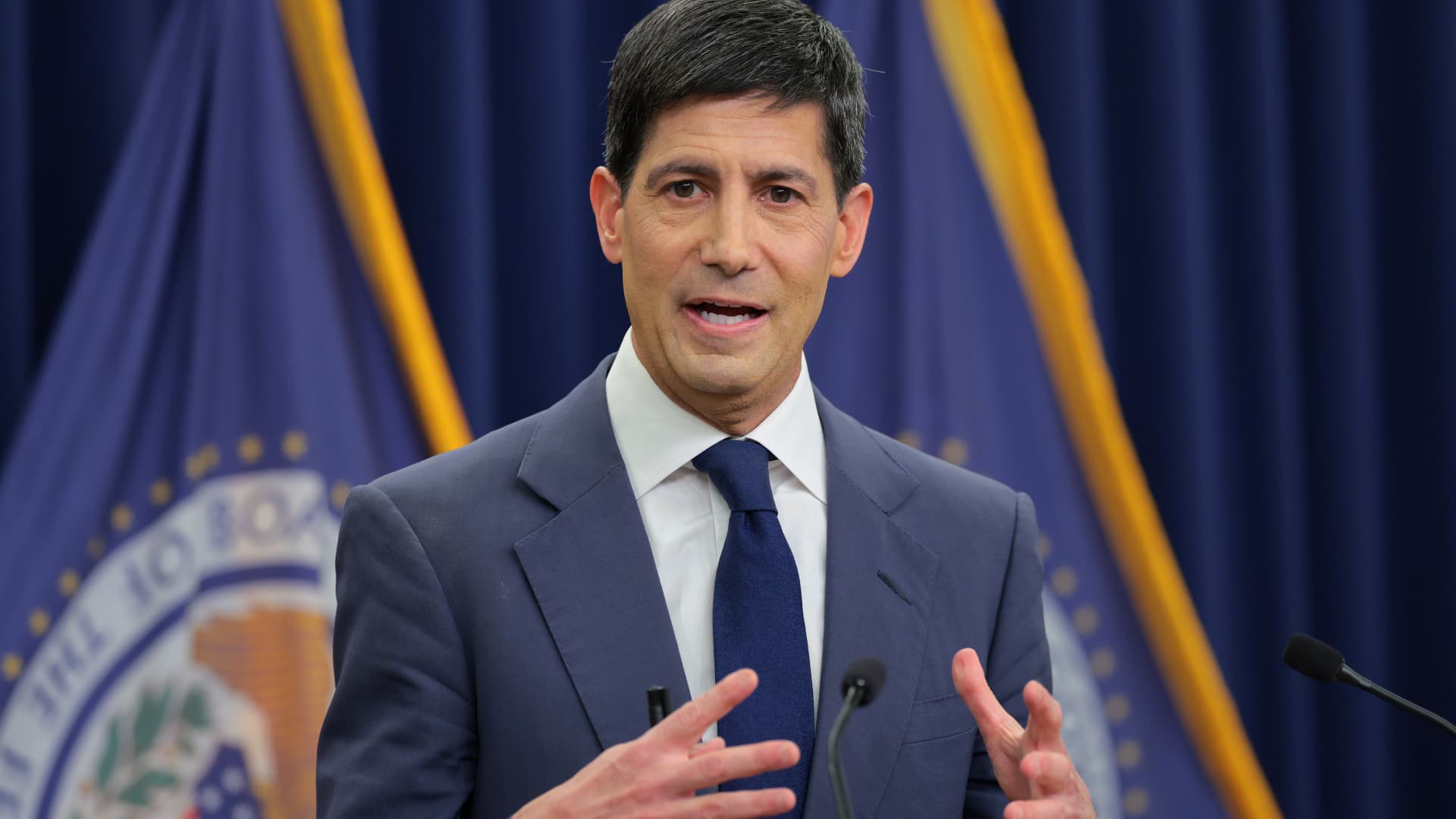
Federal Reserve Chairman Kevin Warsh spoke to reporters in Washington, DC, on June 17, 2026, during his first press conference since taking the helm of the central bank.
Chip Somodevilla | Getty Images
The first big change announced by Fed Chairman Kevin Warsh points to a quiet revolution, with a task force set up to rethink virtually everything done to set policy and the approach to getting there.
After Wednesday’s first meeting, Warsh outlined his plans. The plan is a vast and ambitious effort involving five task forces that draw on resources and expertise within and outside the Fed.
This review will comprehensively consider all areas that define modern monetary policy. No other chair in recent history has launched a project that can match the ambition of this chair.
Their job will be to examine communications, the data the Fed uses to measure the economy, its views on inflation and its causes, the impact of technologies such as artificial intelligence, the size and composition of the Fed’s $6.7 trillion balance sheet, and potential paths to reducing its holdings.
Warsh said the task force will “start with first principles, ask tough questions, examine current practices, consider alternatives, and ultimately recommend next steps for consideration by policymakers.”
He added, “Each task force will contribute to the goals shared by everyone in the system and by everyone around the table I’ve sat with over the past few days: a Federal Reserve that is clearly aware of its mission, fit for purpose, and focused on the future.”

In announcing the task force, Mr. Warsh was emphatically cautious.
But the harsh rhetoric he has used over the past year to criticize central banks is gone.
In an interview with CNBC last July during his campaign for office, Warsh called for “systemic change” at the Fed and cited a “lack of credibility” caused by the Fed’s “incumbent.” Instead, it featured comments about how he was “incredibly impressed” with what he saw in his first few weeks on the job and how the meeting “represented the best of the Fed’s tradition.”
What once appeared to be a potentially malevolent atmosphere within the organization quickly became collegial as Mr. Warsh sought to fundamentally rethink the way business was done.
“What we’re seeing is a regime change, but I think it’s coming with a velvet glove,” said Scott Clemons, chief investment strategist at Brown Brothers Harriman. The task force “will essentially review and possibly revise every aspect of the Fed’s practices, from communications to data sources to the way it approaches its balance sheet and its inflation framework. There’s a lot of potential for regime change there.”
Mr. Warsh’s decision to take a positive view came as little surprise to Fed veterans, some of whom spoke out in support of the direction the new chairman is charting.
“Everyone who was at the Fed knows that how change works is exactly what he did, which is through the creation of consensus-building task forces,” former central bank vice chairman Roger Ferguson told CNBC. “There are some things that I think can be removed that I think will be helpful, and others that I should probably be careful of.”
Start
Former Cleveland Fed President Loretta Mester served on the Communications Subcommittee during her tenure from 2014 to 2024, part of a nearly 40-year career at the central bank. She is familiar with the Fed’s previous efforts to enact changes, which were perhaps less structured than the approach Mr. Warsh is taking.
“Everything he’s considering is something the Fed has been considering, but I think he’s getting his work together and working on some of the projects that the Fed has been working on to earlier deadlines than normal,” Mester said. “So I think it’s good to study. Of course we need to see what the recommendations are at the time and what changes he wants to make.”
One of the most visible areas that Warsh has changed is communication.
The post-meeting statement eschewed much of the boilerplate language of its predecessors, instead providing a bare-bones view of what the committee had decided and how it viewed the current economic situation. The format of the statement began with actual interest rate trends, which were unchanged as expected, and then looked back at how the Fed had prepared statements prior to March 2009. Since the days of the financial crisis, the Fed has begun its statements with an assessment of economic conditions.
Mester said he has no problem with the Federal Open Market Committee returning to its previous format. But this week’s statement also removed so-called forward guidance language, and officials may want to respond by providing more information about the Fed’s “responsive function” — an outline of how and why the Fed adjusts its position to economic factors, he said.
“I like the fact that they’ve gotten rid of a lot of what we call boilerplate that doesn’t really serve any purpose anymore,” she said. Mester added that the Fed has had a “Hotel California problem” for a long time.
“Once a phrase or sentence got in there, it was very difficult to get it out, so this was like a necessary erasure,” she said.
Other areas that may be considered include eliminating the “dot plot” rate forecasts by individual FOMC members and possible adjustments to the press conferences that the chairman has held for the past 15 years.
Other reform areas
The special committee will take aim at a wide range of Fed operations.
On balance sheets, Warsh has long opposed the Fed’s large positions in bond markets, which expanded during and after the 2008 financial crisis and even during the 2020 coronavirus pandemic.
There will also be a study of how the Fed measures inflation, which has been above target for five years after erroneous “temporary” calls in 2021 and 2022. There will also be a focus on artificial intelligence and its impact, as well as a comprehensive look at the metrics the Fed uses to measure the economy, and is expected to make greater use of data and analytics to guide.
Rick Rieder, BlackRock’s head of fixed income and a finalist for Mr. Warsh’s nomination, called the chairman’s approach “a new era in American monetary policy.”
“Creating confidence in the achievement of monetary policy goals will only be enhanced by a thorough examination of the complex subject matter that has the potential to significantly impact the economy and the Fed’s goals going forward,” Rieder said in a note after the meeting. “So this time is different. We’re hearing about a different philosophy, different tools, and potentially a very different policy ethos.”
Mester, a former Cleveland Fed president, added that one key way to make everything work is to draw clear lines on what will drive future monetary policy.
“It doesn’t have to be numbers, it doesn’t have to be too prescriptive, but you do need to get a sense of what they’re seeing and what types of things are going to persuade them one way or another,” she said. “I think that’s something you want central bankers to clearly communicate. Otherwise it’s like, ‘Trust me,’ and ‘Trust me’ is not good communication.”
