

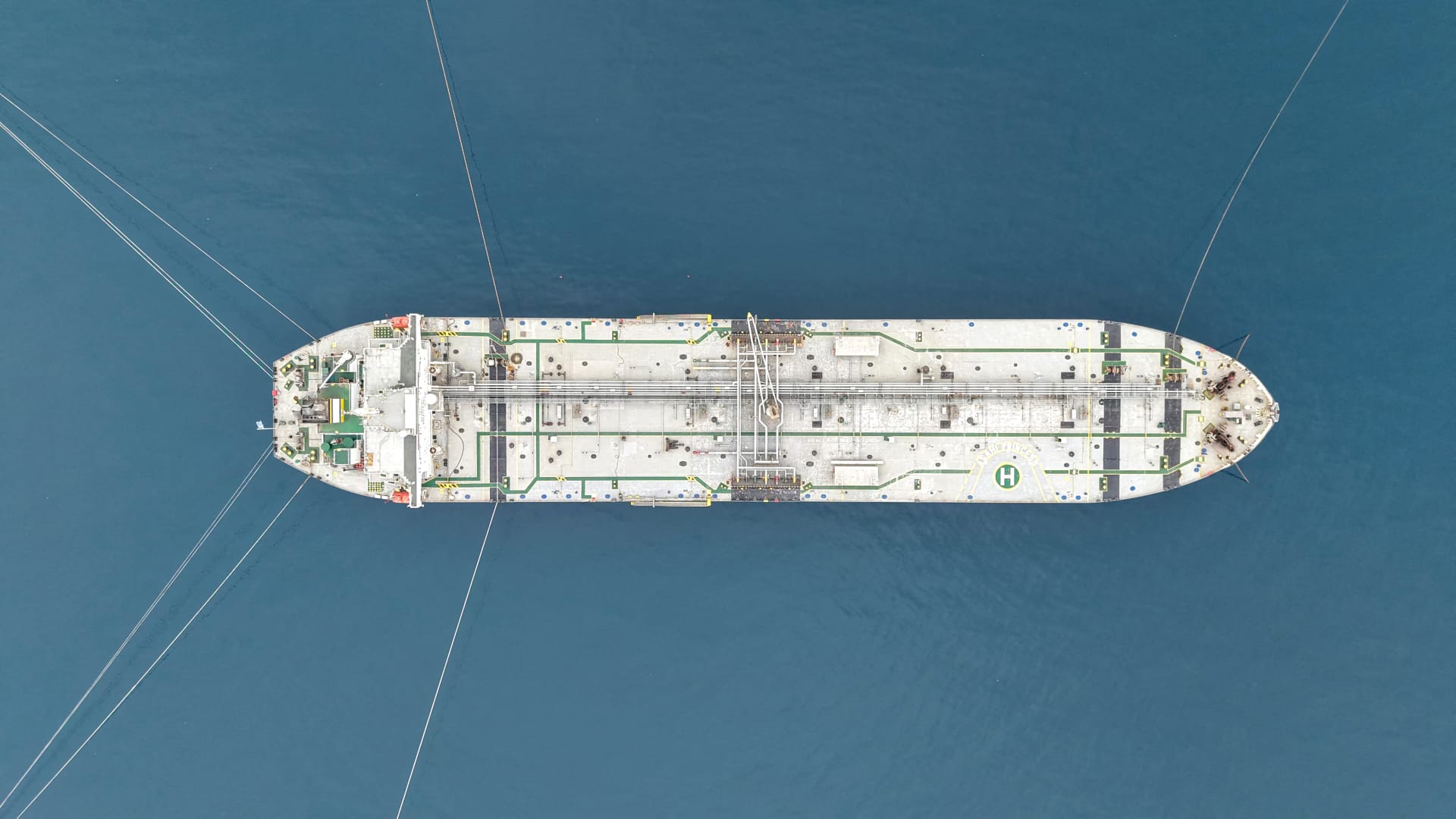
Aerial photo of the Greek-flagged crude oil tanker Asahi Princess floating off the coast of Syria’s Baniyas port refinery on the Mediterranean Sea on April 15, 2026.
Bakr Alkasem | AFP | Getty Images
Ahead of a meeting of Group of Seven (G7) finance ministers in Paris on Monday, a senior European official said the situation in the Middle East highlights how interconnected global economies are exposed to external shocks.
“Opening the Strait of Hormuz and bringing the conflict to a lasting end is paramount to reducing the economic impact,” Eurogroup President Kyriakos Pierakakis said in a statement.
The Eurogroup is an organization that brings together ministers from the euro area, and Pierakakis, who is also Greece’s finance minister, is the G7’s representative. The core members of the G7 are the United States, United Kingdom, Canada, France, Germany, Italy, and Japan.
“The European economy has proven resilient in the face of this energy crisis. But even if the conflict is quickly resolved, the global economy will feel the pressure,” Pierakakis said.
Long-term borrowing costs for several G7 countries have risen in recent weeks as investors worry about rising inflation due to tight energy supplies as the Iran war disrupts oil and gas supplies through the crucial Strait of Hormuz.
U.S. Treasury yields jumped on Friday as traders focused on pricing in interest rate policy under new Federal Reserve Chairman Kevin Warsh following a week of mixed inflation data.
The 30-year Treasury yield rose nearly 11 basis points to 5.121%, its highest level since May 22, 2025, and near its highest level since October 2023.

US 30-year government bond yield
In Britain, a combination of political instability and fears of rising inflation has sent yields on 30-year government bonds, known as gilts, trading at their highest since the late 1990s.
Japan is particularly sensitive to inflationary pressures related to the Iran war, given its status as a major energy importer, and bond yields have risen significantly in recent days.
Bond yields and prices move in opposite directions, and traders often demand higher yields on bond investments when confidence in the government that issues them is shaken.
On the other hand, crude oil prices remain high.
International benchmark Brent crude oil futures for July contract rose more than 3% to close at $109.26 a barrel on Friday. U.S. West Texas Intermediate futures for June rose more than 4% to settle at $105.42 per barrel.
Brent crude oil prices have risen 74% since the start of the year, but are still below the high of $118 a barrel hit in late April.
Global oil stocks are falling at a record pace to compensate for massive supply disruptions in the Middle East and will approach crisis levels unless the Strait of Hormuz reopens.
As a result, oil and fuel prices are likely to exceed peak demand this summer, the International Energy Agency warned in its monthly update last week.
“As the turmoil continues, buffers are shrinking rapidly, which could foreshadow future price increases,” the IEA said.
