

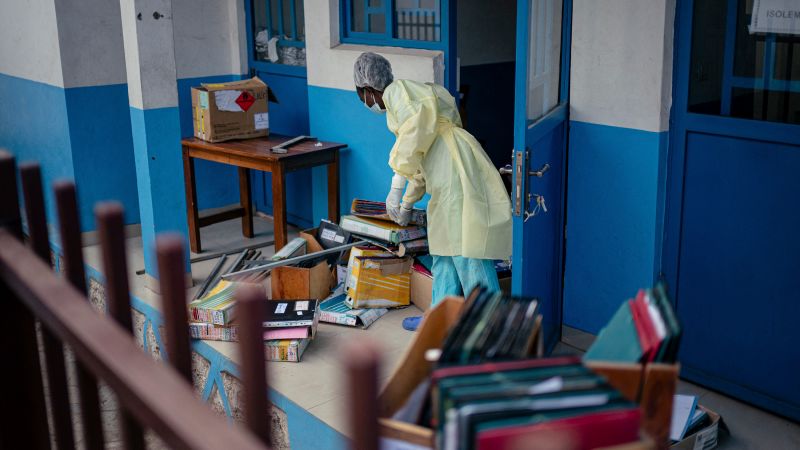
The World Health Organization on Sunday declared the Ebola outbreak in the Democratic Republic of Congo and Uganda a “public health emergency of international concern.”
The group said the outbreak caused by the Bundibugyo virus did not yet meet the criteria for a “pandemic emergency”.
But with the number of infections rising, at least 80 people suspected of having died, and no vaccine approved, concerns are growing over how effectively the virus will be able to contain the spread. Here’s what you need to know:
According to the Africa Centers for Disease Control and Prevention (Africa CDC), Ebola is a serious and often fatal disease that is spread through direct contact with the body fluids of an infected person.
It can also be spread by contact with contaminated materials or people who have died from the disease.
Symptoms often include fever, fatigue, muscle pain, headache, and sore throat, followed by vomiting, diarrhea, and abdominal pain. As the disease progresses, internal and external bleeding may occur.
There are six known virus species associated with Ebola, but only three can cause large-scale outbreaks: Ebola virus, Sudan virus, and Bundibugyo virus, and the latter is behind the current outbreak, according to the WHO.

The current outbreak in the Democratic Republic of the Congo has seen at least 80 suspected deaths, eight laboratory-confirmed cases and 246 suspected cases reported as of Saturday in the country’s northeastern Ituri province on the border with Uganda, the United Nations health agency said.
On Saturday, another laboratory-confirmed case was reported in the Democratic Republic of Congo’s capital Kinshasa, which the WHO said was linked to the Ituri outbreak.
Meanwhile, in Uganda, WHO reported that two laboratory-confirmed cases (including one death) have so far been reported in the capital, Kampala. There was no obvious link between the two cases, but the individuals had traveled from the Democratic Republic of the Congo. The two were admitted to an intensive care unit in the city.
According to the WHO, the fatality rate for Ebola in past outbreaks has ranged from 25% to 90%. The average mortality rate is approximately 50%.

The mortality rate for the Bundibugyo strain is estimated to be between 25% and 40%, according to the medical group Médecins Sans Frontières (MSF), which is preparing to expand its response in Ituri province.
Trish Newport, MSF’s emergency program manager, said on Saturday: “The number of infections and deaths occurring in such a short period of time, coupled with the spread of infection across multiple health zones and even across borders, is extremely worrying.”
“Many people in Ituri are already struggling to access health care and living in continued fear, and swift action is critical to prevent further spread of the infection,” she said in a statement.
Last year, an Ebola outbreak in the remote Kasai province killed 45 people in the Democratic Republic of Congo, according to the U.S. Centers for Disease Control and Prevention.
According to health experts, there are currently no approved treatments or vaccines specific to the Bundibugyo virus.
yes. According to MSF, this is the third outbreak linked to the Bundibugyo strain, following outbreaks in Uganda in 2007-2008 and in the Democratic Republic of Congo in 2012.
The group said this is the 17th Ebola outbreak in the Democratic Republic of the Congo since the first case was discovered in 1976.

In its assessment, WHO provided several reasons to explain why the outbreak was classified as a public health emergency of international concern.
Notably, the number of suspected, laboratory-confirmed, and suspected cases is increasing. The true scale of the outbreak is unknown, but all signs point to “the potential for an outbreak much larger than what is currently being detected and reported.”
Another key concern is how the disease spreads to other countries, with countries bordering the Democratic Republic of the Congo considered “at high risk of further spread.”
Humanitarian organizations like MSF are preparing to launch a large-scale response as soon as possible.

Meanwhile, international coordination aimed at preventing the spread of the disease has been stepped up, with WHO Director-General Tedros Adhanom Ghebreyesus praising the “candor” of the DRC and Uganda in determining the risks posed to other countries.
The WHO said Ghebreyesus would convene an emergency committee “as soon as possible” to address the situation and discuss how countries should respond.
