

Taipei —
A group of indigenous Taiwanese sailors have completed a daring adventure, navigating the choppy seas and using the stars to navigate their way to the Philippines in a traditional wooden canoe. The trip was part of a journey that highlights humanity’s incredible feats across the Pacific Ocean.
Although Taiwan’s indigenous peoples now make up a small portion of the island’s population, they are thought to be the ancestors of many groups that came to inhabit lands from Hawaii and Easter Island in the eastern Pacific to Madagascar off the coast of East Africa.
They share genetic and linguistic ties, and the navigational skills of their ancestors, who managed to travel extraordinary distances and find their way to small landmasses in primitive ships, in what is considered one of the great migrations in human history.
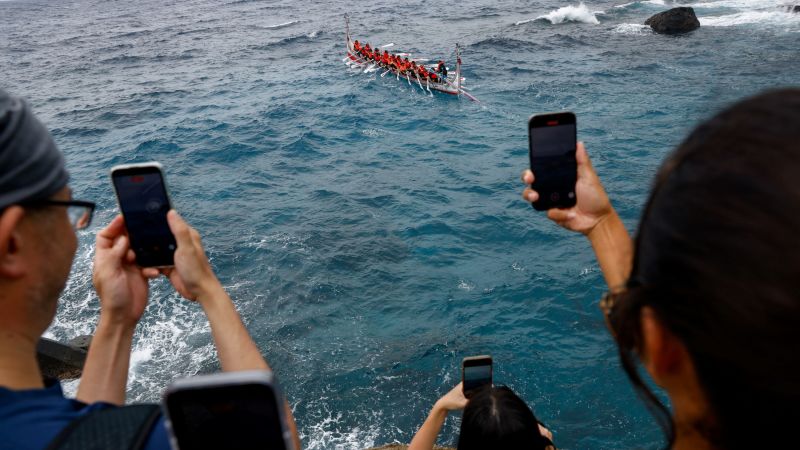
On Monday, 60 members of the Tao tribe from Taiwan’s Lan Island embarked on a 111-mile voyage, taking turns rowing against strong currents to reach the Ibatan tribe on Batan Island in the far north of the Philippines. This is a reenactment of a journey originally thought to have taken place over 4,000 years ago.
They arrived the next day and were welcomed with drum and dance performances.
“Today is not only a momentous day for the Pacific, but also a day of remembrance for Austronesians,” said Malaos, chairman of the Taiwan Indigenous Cultural Foundation (IPCF). The Malaos, like many Tao people, go by a single name.
The journey aims to revive a sea route that has not been used for 300 years and was considered almost impossible in the past, given the lack of maps and the crude ships once used by the early navigators of the Bashi Strait.


More than 200 people from six tribal communities participated in building the canoe, named “Obayan” or “Golden Friendship,” using traditional methods of tying together specially cut wood without nails.
“If the surface is uneven and there are slight irregularities here and there, the resistance from the sea will be much greater,” shipbuilder Shen Xun said in a promotional video. This effort was supported by the Taiwanese government.
The Tao people are one of Taiwan’s smaller indigenous groups, with a population of just 5,120 people, according to government counts. And indigenous peoples only make up 3% of Taiwan’s current population of 23 million. This population is currently dominated by descendants of Han Chinese from the mainland. But the role they played was crucial to the story of the Great Pacific Migration.
Peter Bellwood, professor emeritus of archeology at the Australian National University, told CNN it was “absolutely certain” that the journey began in Taiwan “probably 5,000 years ago”. “Then it spread to the Philippines and beyond.”
From there, the group spread further to other locations, including Indonesia and the Pacific islands, he said, adding that there were archaeological records and DNA traces to support that.
He said a group of Austronesians from Taiwan carried food such as yams, taro and livestock onto ships during their expeditions.
“Without these animals and plants, you can’t survive on a small island,” Bellwood said, adding that the ships usually also had women on board.
“They had a basic knowledge of astronomy, so they were able to know where they were going, and perhaps even record where they came from and where their direction was to get back home again,” he also said.
Victoria Chen, a senior lecturer at New Zealand’s Victoria University of Wellington, said Taiwan was also the first point where many Austronesian language transit points could be traced.
She says many of those languages still share similar words, such as Indonesian “lima”, New Zealand Maori “lima”, and Hawaiian “elima” – five.
However, many more variations of Austronesian, with more complex grammatical structures and expansive vocabularies, have been identified in Taiwan, providing insights for linguists.
“The high degree of diversity suggests that Taiwan was the first dispersion of the family,” Chen said.
Despite being widely accepted by scientists, the so-called “outside Taiwan” theory has been challenged in recent years by mainland Chinese scholars who have sought to argue that Austronesians originated in southern China.
The Taipei government says this is an attempt to strengthen Beijing’s territorial claims to Taiwan, which China claims as its own territory even though it has never ruled it.
