

Hebron, West Bank —
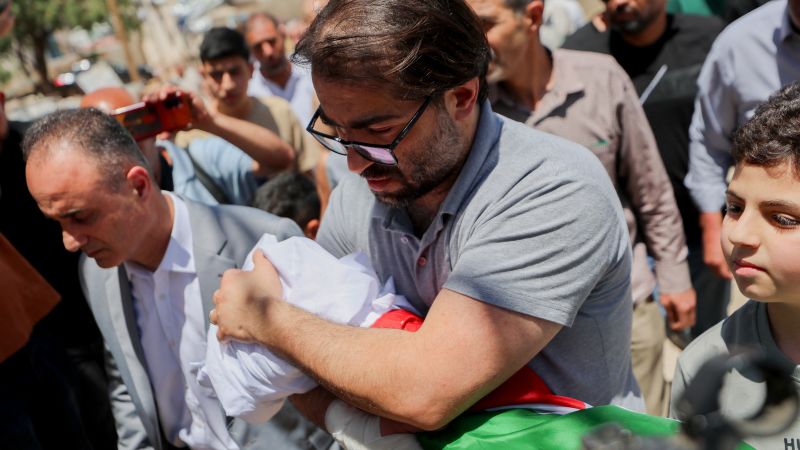
Fahd Abu Haykal was driving through the Palestinian city with his family last week when he suddenly spotted a group of Israeli soldiers on the road.
He began to slow down, but when he stopped, one of the soldiers raised his rifle and fired.
One bullet penetrated the hood of the car. But the other one crashed through the car’s windshield, grazing the steering wheel and one of Fahad’s fingers and hitting his son Sam in the head.
He was only 7 months old.

Sam Abu Haykal is the 13th child killed by Israeli forces in the occupied West Bank so far this year, according to Israeli human rights organization B’Tselem, marking the killing of 236 children by Israeli forces in the region since October 7, 2023, when Hamas attacked Israel.
The video that follows paints a singular portrait of tragedy and despair. Fahad cradles the bloody baby and presses his hand against Sam’s head to try to stop the bleeding. As the wails of Sam’s mother and grandmother rose into the air, he looked around silently and frantically, then whisked Sam away to a passing car.
“I just wanted to get out and get him to the hospital,” Fahad said in an interview with CNN a few days later. “And…when you see this hit, there’s no hope. There’s no hope.”

“They tried to save Sam, they gave him blood products, but they couldn’t do anything to save him,” said Sam’s mother Dania. “I couldn’t do anything.”
Hours later, the Israeli military issued a statement confirming the June 5 shooting in Hebron, claiming that soldiers “perceived a vehicle accelerating towards them” and that IDF soldiers “fired a single shot at the vehicle.”
But a new video obtained by B’Tselem and shared with CNN paints a different picture. Instead of accelerating, Fahd’s vehicle slowed to a stop as it approached the soldiers.
The video has no audio, but the videographer told B’Tselem that the soldiers had opened fire just as the car was coming to a stop. Fahad and his mother, who was in the passenger seat, pinpointed the same moment of the shooting while reviewing CNN video.

All three also identified the same soldier who was standing in the middle of the road within 30 feet of the vehicle as the person who fired the shots.
“They’ll say, ‘Get out, go home, you have to go back,’ (or) they’ll shoot in the air to make you change direction,” Fahad’s mother Ferial said. “But they didn’t do anything, they just shot him.”
After firing the fatal shot, the soldier left the vehicle and retreated on foot, video shows. Witnesses said none of the soldiers present cooperated in providing medical care.
Asked about the incident, the Israeli military said it had opened an investigation into the shooting.
CNN searched the street where the shooting occurred and located multiple surveillance cameras, but no additional footage of the incident was available. Local residents and business owners said Israeli forces later returned to the area and confiscated all surveillance camera recordings. The Israeli military declined to comment on the matter to CNN, saying only that an investigation was underway.

Israeli military investigations rarely result in disciplinary action, let alone criminal charges, but Fahd is cooperating with the investigation, saying he will do everything he can to get justice for his son.
“If you see something in front of you and you aim at him and shoot, it’s not a mistake,” Fahd said of the soldier who fired. “He shot directly to kill.”
Friends and family filed in and out of the family’s funeral home in Bethlehem to comfort the inconsolable.
Sam’s mother, Dania, was lying on the bed in the corner of the room. In the midst of immeasurable grief, she is also recovering from her own painful wounds. Part of the bullet that killed her son passed through her face, entering her right cheek and exiting behind her ear.
Pieces of the shrapnel are still lodged in her chest. Because they were so close to her heart, doctors didn’t want to do surgery to remove them.
But she also endures other hardships. It is a pain known only to the tragic few mothers who have lost their babies.
“I was breastfeeding him,” she said. “My heart hurts right now.”
The pain means she has to express breast milk. It’s a daily reminder of everything she’s lost.
“Every time I use this pump, I start crying,” she said.

Sam was Dania’s only child. And most of her phone’s camera roll is filled with photos and videos of smiling boys.
“I thought he was going to be a genius,” she said, noting how precocious it was that he still looked so young.
Sam’s maternal grandparents are especially saddened. He was often with Dania and Fahad (both academics) while they were working.
Nidal Salameh described himself as a grandfather of “seven, now six” grandchildren. Sam was “unique,” he says.
He remembered Sam reaching out his arms toward him, begging to be in his grandfather’s arms.
“If I hold him, he will calm down,” Salameh said, her voice choked up with tears in her eyes. “This innocent baby, seven months old, what did he do to them (the soldiers)?”
Days after her son was killed, Dania is filled not only with grief but also with anger.
Anger that his son was killed. Anger that Israeli soldiers are rarely held accountable. Anger that the world doesn’t seem to be listening to the pain of so many Palestinians.
She said she wanted the soldier who killed her son to feel her pain and feel the same sense of loss, “so they could feel what I did.”
She hopes the military investigation will lead to charges – the soldier won’t escape responsibility as so many have before him.
“He should be punished,” she said. “He shouldn’t run away.”
