

Washington DC —
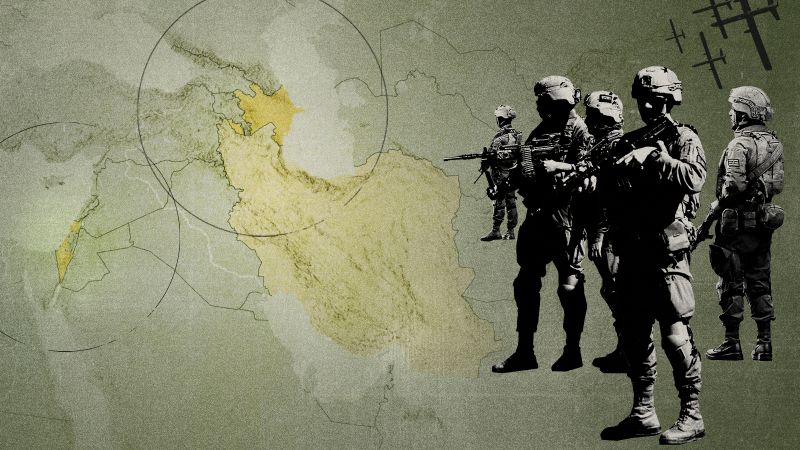
During its war with Iran, Israel secretly sent elite military and intelligence forces to Azerbaijan as part of a network of covert locations across the Middle East to facilitate operations against Iran, four sources familiar with the matter said.
The forces operate in several locations in southern Azerbaijan, bordering Iran’s northern border and the closest point being only about 90 miles from the Iranian city of Tabriz, which Israel attacked during the war, two sources said.
Two other sources said special commandos were also sent to the location to carry out intelligence-gathering missions and drone operations, giving Israel a valuable perch from which to view northern Iran during the war.
The secret deployment to Azerbaijan, first reported by CNN, gave the military unprecedented reach in one of several military positions maintained by Israel across the Middle East and highlighted the role Iran’s neighbors played – some with permission, some perhaps without permission – in facilitating operations against Tehran and drawing it into the conflict.
The Azerbaijani location was among a number of secret military facilities and bases in multiple countries, including Iraq, the United Arab Emirates and Somaliland, officials told CNN. The unit was originally planned as a potential rescue team in case of an emergency, but expanded in scope to become a military and intelligence gathering base.
Taken together, the developments described by these sources show that during the war, Israeli forces were positioned along Iran’s southern, western, and northern fringes, extending the military’s range hundreds of miles deep into Iranian territory. Front-line positions helped Israel withstand repeated attacks on targets across the country.
The Azerbaijani operation consisted of dozens of troops, including Israeli special operations forces, an elite combat rescue unit in helicopters and Mossad personnel, one of the sources said.
In a statement to CNN, a spokesperson for the Azerbaijani embassy in the United States said, “We categorically reject the baseless claims regarding the alleged use of Azerbaijani territory in operations against third countries.”
CNN has contacted the Israeli Prime Minister’s Office and the Israel Defense Forces for comment.
Meanwhile, the breakaway republic of Somaliland in the Horn of Africa offers Israel an additional military base and could be a stop for Israeli aircraft on long-haul flights to Iran, one of the officials said. In December, Israel became the first country to formally recognize Somaliland, and the UAE maintains a vast commercial and military presence in the port city of Berbera.
CNN, which first reported on Israel’s use of secret military facilities in Somaliland, has contacted the Foreign Ministry for comment.

The Israeli military also maintained two secret facilities in Iraq during the war with Iran, providing Israel with logistical support and, if necessary, a forward base for search and rescue operations. The two locations in Iraq were first reported by the Wall Street Journal and the New York Times. The Iraqi military said in a statement that as of early March there were no “unauthorized bases or troops” in the country.
Axios first reported that Israel secretly deployed the Iron Dome air defense squadron and the troops that operate it to the UAE, among other defense systems, during its war with Iran. CNN previously reported that Prime Minister Benjamin Netanyahu, head of Mossad and commander of the Israeli military, had visited the UAE during the war. The revelations led to strong refusals to visit from the UAE.
Azerbaijan’s military presence has given Israel a new base for air rescue operations in case a pilot crashes, as well as a base to spy on Iran.
Israel has long considered Azerbaijan a strategic partner in its fight against Iran, and preparations began weeks before the war began. In mid-January, Israel prepared a secret mission along the Azerbaijan-Iran border as Iran crushed large protests with mass killings of demonstrators, two people familiar with the planning told CNN. Officials explained that this was a preliminary operation that would lay the foundation for further measures by installing eavesdropping and intelligence equipment in the area.
Israel had planned to carry out the operation under the cover of a pre-emptive strike in mid-January. However, US President Donald Trump called off the airstrikes at the last minute, saying Iran had agreed to stop killing protesters.
Israel went on its own.
Because Israel’s political leadership believed that negotiations between the United States and Iran were doomed to failure, the Israeli Air Force brought in stealth jets and special forces as part of the device installation operation. The aggregation site provided another means for Israel to gather information about Iranian military operations and facilities, and could provide early warning of missile launches.
Less than two weeks later, Israeli Foreign Minister Gideon Saar visited Baku and met with Azerbaijan’s president and other government officials. Also in May 2025, Azerbaijan secretly hosted rare direct talks between Israel and Syria.

One of the key operations launched from Azerbaijan was the March 4 killing of Rahman Moghaddam, who headed the Islamic Revolutionary Guards Corps (IRGC) intelligence wing and whom Israel claimed was responsible for the 2024 assassination attempt on President Trump, one of the people said. The next day, a drone attacked the airport in the Azerbaijani enclave of Nakhchivan, damaging the terminal building and injuring several people. President Ilham Aliyev condemned Iran, calling it an “ugly, cowardly and shameless” act of terrorism. Iran denied launching the drone.
On March 6, Azerbaijan’s State Security Service announced that it had thwarted a plot by the Revolutionary Guards to attack critical infrastructure, as well as Israeli and Jewish targets. Weeks later, Israel publicly acknowledged that this was a joint operation involving the Mossad, Israeli military, and Shin Bet security forces.
Israel and Azerbaijan maintain close ties centered on commercial and military interests. Baku supplies most of Israel’s oil. In return, Israel sold Azerbaijan advanced weapons, some of which were used in the Nagorno-Karabakh conflict against Armenia in 2016 and 2020. Azerbaijan was also the first foreign country to purchase Israel’s Iron Dome air defense system in 2016.
Gershon Kogan, an Iran expert at the Begin Sadat Center for Strategic Studies, wrote before the Iran war began that “Israel’s strategy in Azerbaijan relies on long-term technological interdependence in the areas of arms transfers, intelligence cooperation, and security, and remains deliberately low profile.”
The relationship also gives Azerbaijan access to important diplomatic resources and gives Baku access to Israel’s lobby in Washington, D.C., said Joshua Kucera, a senior analyst at Crisis Group.
“Azerbaijan is increasingly trying to position itself as a regional power, which sometimes includes becoming a kind of bridge between Israel and Arab countries and other states,” Kucera said.
“If it is a means for Israel to support Azerbaijan in fighting the Revolutionary Guards’ destabilization efforts, it is top secret,” Kucera said.
