

Paris —
Few were surprised this week when plans to build a European fighter jet to surpass the U.S. F-35 were officially halted.
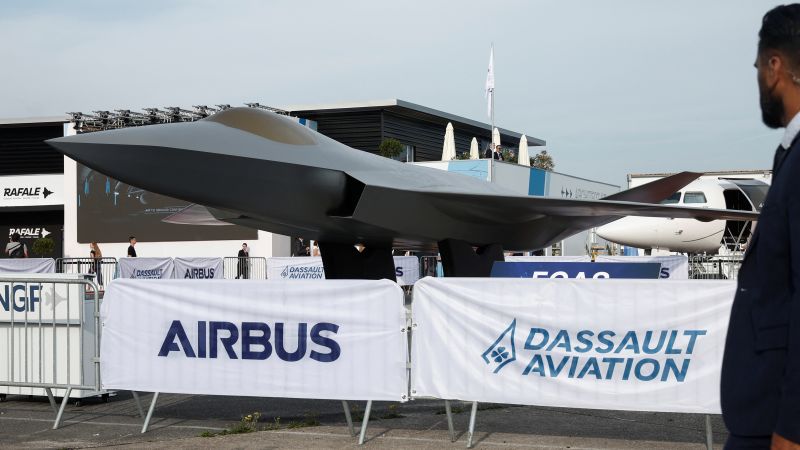
Industrial compatibility issues ultimately sank the central project of the Future Combat Air System (FCAS) program, the political pillar of Franco-German military cooperation. The deal, with an estimated 100 billion euros ($116 billion) price tag, seemed doomed from the start. France and Germany wanted two different aircraft.
The plan also promised a “combat cloud” to share information and high-tech drones to fly alongside fighter jets as unmanned “wing planes.” Some of those parts may still survive.
But the collapse of the fighter jet element calls into question a multilateral approach to developing next-generation military technology, as Europe rethinks how to arm its militaries in the face of a transatlantic partnership pared down by US President Donald Trump.
The project to build Europe’s first sixth-generation fighter jet has been questioned since it was announced in 2017.
“The first lesson is that the Germans and the French did not want the same aircraft,” retired French General Michel Yakovlev, former deputy commander of NATO forces in Europe, told CNN. Experts across the industry are surprised it took this long for the project to collapse.
The aircraft was to be the love child of French manufacturer Dassault Aviation and Germany’s leading European aerospace group, Airbus.
In the end, the two companies could not agree on how to design and build the aircraft. The French president’s office shifted at least some of the blame to Berlin, which “felt it impossible to apply further pressure” on Airbus and Dassault, the French statement said. “President (Emmanuel) Macron was the only one who still believed in the survival of (FCAS),” said Sen. Cedric Perrin, chairman of the French Senate Foreign Affairs and Armed Services Committee.

Although the German government has acknowledged that the two companies cannot cooperate on the jet, speaking at this week’s Berlin Air Show, Chancellor Friedrich Merz struck an optimistic tone, looking ahead to what the countries can still accomplish with the remaining FCAS projects. France and Germany are likely to look to their own development or other multinational projects to fill the fighter jet gap.
France has a long history of producing its own fighter jets, dating back to the early days of air combat. During the Cold War, France, nuclear-armed and skeptical of NATO, developed its own philosophy of air combat. At its heart were high-performance jet aircraft, some equipped for operations from French aircraft carriers, all of which were “versatile” in design. Dassault’s Mirage fighter jets, and more recently the Rafale, are capable of penetrating enemy airspace, engaging in dogfights, dropping bombs, and launching cruise missiles. Germany had no aircraft carriers or nuclear weapons of its own, and sought traditional air combat aircraft, questioning whether it even needed pilots.
Yakovlev said that in contrast to the overly strict technical requirements that bogged down FCAS, “the French Air Force is very good at creating fairly general requirements and letting Dassault sort out the technical compromises.” Even in the 1970s, the American think tank Rand Corporation was investigating how Dassault was able to field advanced fighter jets on time and at a price far below that of American manufacturers.
Since World War II, Germany has not produced its own jet aircraft, instead favoring European multinational projects. In the 1970s, then-West Germany collaborated with Britain and Italy to build the Tornado bomber. Then, in the 1990s, Germany collaborated with Britain, Italy, and Spain to produce the Eurofighter fighting dog.
This latest effort was a political project, suggesting European unity amid rising tensions at the continent’s borders. It was also a political failure. “It’s a question of national leadership,” Emile Archambault, a fellow at the German Council on Foreign Relations, told CNN. Berlin and Paris “failed to clearly define what their requirements were and how they wanted to proceed with them.”
Per Erik Soli, a senior defense analyst at the Norwegian Institute of International Studies, told CNN that the loss of joint aircraft is not a serious setback for European capabilities.
And substantial value could still be salvaged if the remaining two pillars of the FCAS project are maintained: a “combat cloud” to share information and so-called unmanned wingmen to accompany fighter jets.

What’s important for modern jets is “not how fast they can fly or how agile they can turn,” Soli said. With the advent of unmanned aircraft, they have become “command ships rather than independent fighters.”
When FCAS was first promised in 2017, the world had changed significantly. With NATO anticipating conflict with Russia by 2030, FCAS’s promised 2040 delivery date no longer seems prudent.
At the time, the defense industry was “more focused on technological advancement and keeping pace with peers and adversaries, rather than capabilities and combat readiness,” Ed Arnold, a senior associate research fellow at the Royal Defense Institute (RUSI), a British defense think tank, told CNN. Nowadays, large-scale production is important.
Building fighter jets is difficult and expensive.
A new poll from the European Council on Foreign Relations shows that Europeans support increasing defense spending and buying European weapons (but not Italy) as trust in America’s partners reaches a generational low.
Europe is now the world’s largest arms importer, with arms purchases tripled in 2021-25 compared to the previous five years, according to data from the Stockholm International Peace Research Institute (SIPRI). The United States has been a major beneficiary, with sales to the continent more than doubling over the same period.
In March 2025, President Macron, an ardent defender of European defense autonomy, announced that he would persuade allies to buy European weapons instead of American ones. “That’s how we increase production rates,” the French leader said.
In recent months, there has been a flurry of announcements from Europe and Western countries that do just that. Germany, a longtime benefactor of U.S. manufacturers, expressed the clearest setback. Berlin’s 80 billion euro ($93 billion) military procurement plan for 2025-2026 was to source about 90% of weapons from Europe.
Denmark, hurt by President Trump’s plans for the self-governing territory of Greenland, did not allow a US company to bid on a multibillion-dollar missile contract last year. And it’s not just the hardware that’s at stake. Some European NATO allies are moving to rally around European-made battlefield AI rather than the Maven AI system used by the United States.

The collapse of the FCAS fighter project has cast a long shadow on another French-German joint venture, the construction of next-generation tanks.
Unlike Germany, France currently does not have the industrial base to produce its own heavy armor. And the balance of power on the continent is now shifting, as Berlin’s sharp increase in defense spending (its planned 2029 military budget of 150 billion euros dwarfs even France’s, apart from Paris’ undisclosed nuclear spending) awakens Germany’s industrial giants.
“German politicians are more confident about their role in Europe,” defense analyst Soli told CNN.
“Why have such expensive and sophisticated tanks when you can just keep developing what you already have?” Arnold said, pointing to the German-designed Leopard tank, which outperforms Russian armored products.
However, the disappearance of FCAS fighters may nevertheless offer a glimmer of hope for European defense if the billions of euros earmarked for it are used to rapidly build up capabilities and stockpiles. “If something doesn’t work, you can get better value for money by eliminating it and redirecting resources from there,” Arnold said.
Additional reporting by Elina Baudier Kim
