

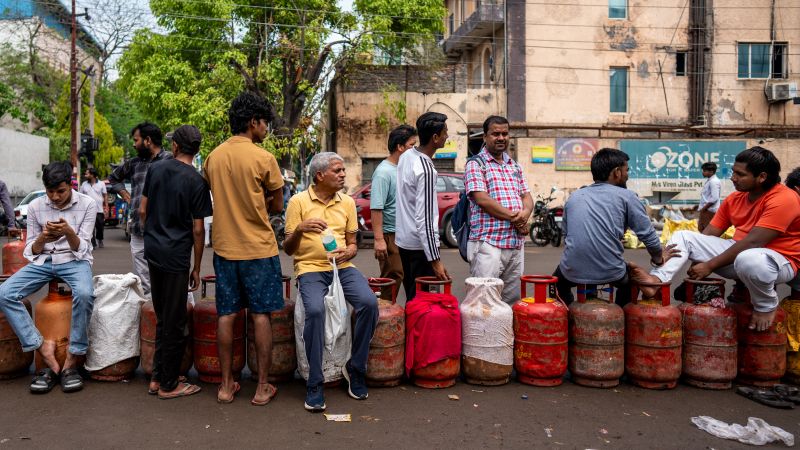
The fallout from the US-Israel war against Iran could cost Asia-Pacific economies hundreds of billions of dollars and push millions into poverty, a United Nations report said Tuesday.
The United Nations Development Program estimates that military escalation in the Middle East could cause production losses of between $97 billion and $299 billion in the Asia-Pacific region due to increased costs of transportation, electricity and food.
This represents about 0.3% to 0.8% of regional GDP, the report said. UNDP also estimated that war puts 32 million people at risk of falling into poverty around the world, 8.8 million of whom are in the Asia-Pacific region.
After U.S.-Iranian peace talks failed to restore free trade in the Strait of Hormuz, President Donald Trump said he had initiated his own blockade of the vital waterway, threatening maritime traffic in and out of Iranian ports.
The worst oil crisis in history has already sent oil and natural gas prices soaring, weighing on economic growth prospects. As countries that import large amounts of energy from the Middle East, Asia is particularly susceptible to energy shortages. With the prospect of a prolonged conflict, countries are seeking alternative energy sources to conserve fuel and electricity, but these options are expensive and limited.
“What you’re seeing is this kind of instantaneous, massive shock where everything shuts down and these reserves come into play,” said Kanni Wignaraja, UNDP’s regional director for Asia and the Pacific. “If countries adapt very quickly, the loss in regional GDP would be around $97 billion to $100 billion. That loss would triple if many of these countries used up these reserves and had little to really fall back on.”
Asia is the most populous continent and accounts for more than half of the world’s manufacturing, so any economic blow to the region could have significant global implications.
Many of the United States’ key allies, including South Korea, Japan and the Philippines, are also scrambling to save their economies as the energy they depend on in the Middle East slows to a trickle.
“It is not possible to make a clean return.”
While governments have responded to oil shortages by securing oil supplies, reducing demand and providing financial support to offset rising costs, the burden of trying to contain price increases, protect households and businesses, and maintain public spending will only increase, UNDP said.
Another report from the UN’s Food and Agriculture Organization warned that food shortages could reach catastrophic levels due to disruptions in supplies of agricultural products from the Middle East, including oil, natural gas, urea and fertilizer. FAO said if the Strait of Hormuz remains effectively closed, countries may need financial aid to secure fertilizer for the planting season and avoid a global food crisis.
“To avoid problems with food inflation, it is essential that the ceasefire continues and ships can begin sailing,” FAO chief economist Máximo Torello said.
Many organizations are issuing dire warnings of dire economic consequences that will worsen the longer the oil crisis lasts. The International Monetary Fund is expected to cut its economic growth forecast in its latest World Economic Outlook on Tuesday, saying soaring fertilizer prices could make 45 million people food insecure.
“Without this shock, the world economy would have grown even more,” IMF Managing Director Kristalina Georgieva said in a speech in Washington last week. “But now even our most hopeful scenarios include a decline in growth rates. Why? Because of the effects of significant infrastructure damage, supply disruptions, loss of confidence and other scars.”
The Asian Development Bank also recently predicted that Asia-Pacific growth would slow to 5.1% from 5.4% in both 2026 and 2027, with regional inflation rising 3.6% from 3% last year in 2026 due to disruptions in primary goods from the Middle East.
“Prolonged conflict in the Middle East is the single biggest risk to the region’s outlook, as it could lead to persistently high energy and food prices and strained fiscal conditions,” ADB Chief Economist Albert Park said in a release accompanying the report.
The United States and Iran have said talks to end the war will continue, and CNN reported that U.S. officials are discussing the possibility of a second face-to-face meeting. But analysts say that even if the Strait of Hormuz reopens immediately, it will take months to restore normal, standard market conditions.
“Even in the best case scenario, there will be no clean return to the previous status quo,” said Georgieva of the IMF.
