

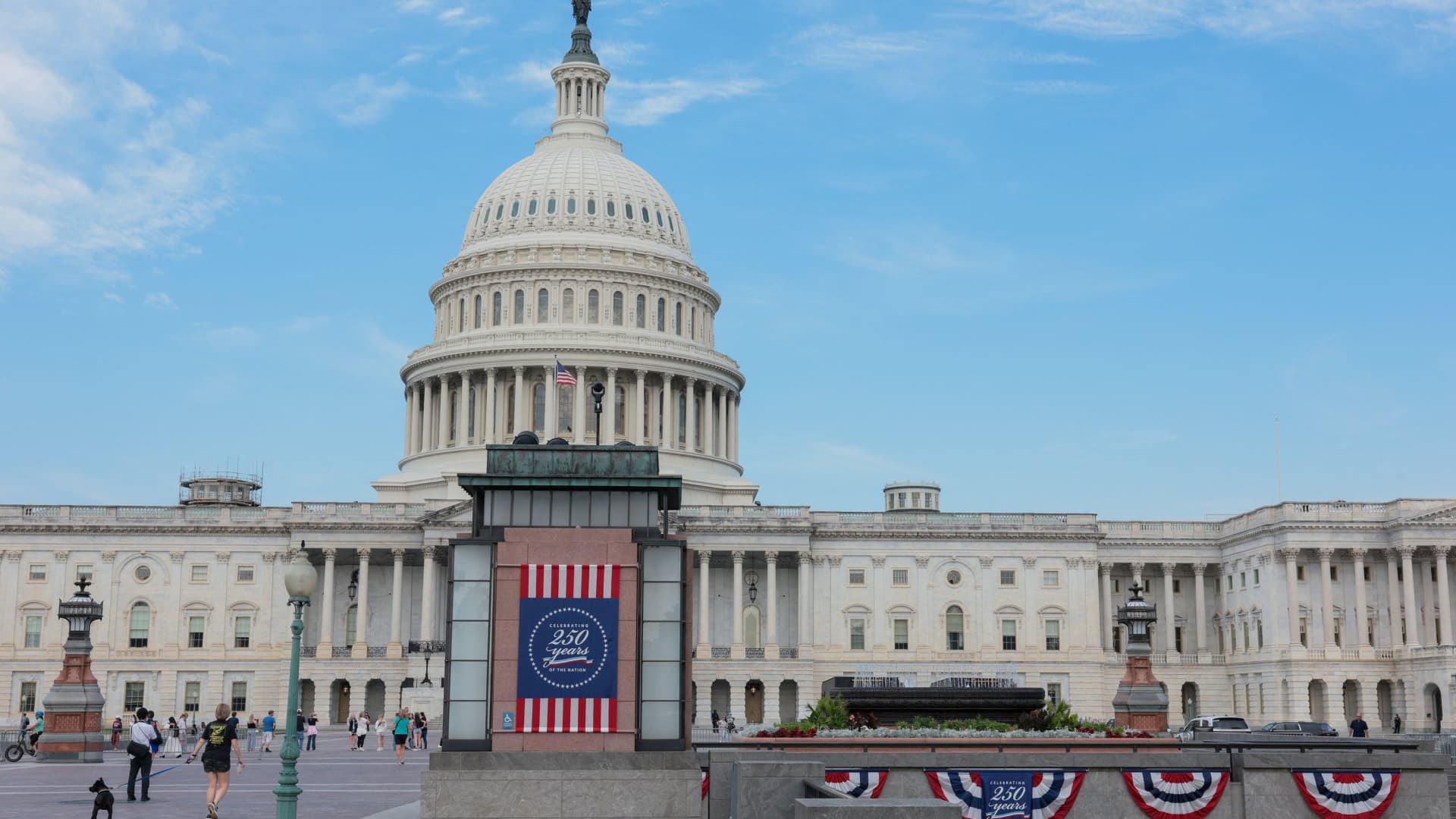
A banner celebrating the 250th anniversary of American independence is hung outside the U.S. Capitol Building in Washington, DC, on June 22, 2026.
Kylie Cooper | Reuters
Delays in social security reform could have a negative impact on bond markets and the economy, a new study finds.
The findings, released June 26 by George Mason University’s Mercatus Center, follow the Social Security Administration’s annual report. The agency predicts that the Old Age and Survivors Insurance (OASI) trust fund could be depleted in the fourth quarter of 2032, three months earlier than predicted the previous year. Projections suggest that only 78% of these benefits could be paid out at that time.
Pushing reforms closer to that deadline increases fiscal risks and increases the likelihood that lawmakers will seek additional borrowing, putting a strain on debt markets and the broader economy, wrote co-authors Veronique de Rugy, a senior fellow at the Mercatus Center, and Jason Fichtner, executive director of the LIMRA Retirement Income Institute, a research initiative within the insurance industry group LIMRA.
“We see the impending depletion of the Social Security OASI Trust Fund in the early 2030s as an inflection point that could lead to a fiscal crisis unless proactive legislative action is taken,” De Rugie and Fichtner wrote.
The Committee for a Responsible Federal Budget, a bipartisan organization dedicated to educating the public on fiscal policy issues, similarly points to the impending depletion of Social Security’s trust fund as a potential tipping point for the U.S. economy.
Social Security is funded primarily by payroll tax revenues, which can supplement benefit payments through a trust fund that holds past surpluses and interest. According to the CRFB, if Social Security were allowed to spend beyond that amount, possibly using general funds, it would result in significant new borrowing.
“Social Security has been a 90-year-old promise to be a self-funded contributory system, and in some ways this is one of the last fiscal rules,” said Mark Goldwein, senior vice president at CRFB.
“If we say we don’t have to pay Social Security, we’re opening the floodgates to much more debt than the country can afford,” Goldwein said. “Once the floodgates open and borrowing occurs, that’s when a financial crisis can occur.”
How trust fund shortages cause a “fiscal burden”
A U.S. Social Security Administration sign is seen outside its headquarters in Woodlawn, Maryland, on Thursday, March 20, 2025.
Tom Williams | Cq-roll Call Inc. | Getty Images
According to the Social Security Administration, Social Security trust funds are invested in government bonds that are backed by the full faith and credit of the U.S. government. Trust fund securities are special issues of the U.S. Treasury and are “as safe as U.S. savings bonds and other federal financial instruments,” the agency’s website states.
SSA says the government has always used borrowed cash to repay the program with interest. But without legislation to address the trust fund shortage, long-term securities would have to be redeemed before maturity, officials said.
By combining the trust funds, lawmakers could extend the depletion deadline from the fourth quarter of 2032 to the third quarter of 2034. At that point, 83% of the scheduled benefits will be paid.
“But at that point, the bond market will say, ‘Okay, we’ve got 12 months to get our act together. We’re going to be looking for more than $600 billion a year,'” Fichtner said in an interview with CNBC.
Social Security’s annual shortfall could rise from $600 billion in 2033 to about $700 billion by 2036, according to a study by De Rugy and Fichtner. Add to this an estimated $2.7 trillion budget deficit and $46.5 trillion national debt in 2033.
“Fiscal stress can occur faster than trust fund depletion,” Fichtner said.

The CRFB cited an even larger amount, Goldwein said, with the 75-year solvency facility borrowing in nominal terms at $800 trillion, or $180 trillion adjusted for inflation.
De Rugie and Fichtner said recent market events that disrupted Treasury bill auctions could be “a harbinger of things to come.”
Fichtner said overseas holdings of U.S. Treasuries are decreasing due to global uncertainty and new U.S. tariff policies. Other potential early warning signs include spiking inflation that has not yet subsided to the Federal Reserve’s 2% target, and longer maturities on U.S. Treasury inflation-protected securities, suggesting expectations that higher inflation may continue.
Affordability crisis ‘intensified’
Fichtner and De Rugie said the study does not predict an “immediate crisis” but that there are already early warning signs.
Markets may be hoping Congress will come up with a fiscally responsible solution that avoids large-scale borrowing. However, if this forecast changes to expecting borrowing without fiscal backing, “the market correction will be less gradual and the subsequent adjustment in price levels will be less gradual,” Fichtner and De Rugy wrote.
Their research found that without social security reform, two risks could arise.
First, higher deficits could increase borrowing costs across the economy by increasing the supply of government bonds and raising bond yields, they write. Continued deficit spending could reduce private sector investment, while interest rates could outpace economic growth, making it difficult for the debt-to-gross domestic product ratio to stabilize.
Second, investors may lose confidence that future government revenues will be sufficient to cover outstanding debt. As a result, higher domestic price levels could reduce the real value of government debt, the study said. That would spur inflation, and bonds might react, but prices wouldn’t necessarily fall as in the first scenario.
Fichtner said rising interest rates will crowd out consumer spending, so consumers looking to borrow to buy a home or car or use a credit card will end up paying higher interest rates.
Fichtner said interest rates would rise across the board for both governments and consumers, leading to higher prices.
“This is similar to the affordability crisis we see today, but intensified,” Fichtner said.
Fichtner said that with 12 months left until Social Security runs out, the bond market could start moving money around by changing holdings and duration risk if Congress does nothing to address the program’s solvency issues.
According to CRFB’s 2025 study, the neutral rate of 4% on 10-year Treasuries could rise to 6.6% if General Fund funds were used for Social Security. Similarly, the CRFB estimates that 30-year fixed-rate mortgages could rise from 6.3% to nearly 9%.
Reforms can bring economic opportunities
Purposeful decisions about the future of the program could have a beneficial impact on the economy, Goldwein said.
“If we make smart choices, we can target Social Security benefits to the people who need them and actually promote faster economic growth in the process,” Goldwein said.
Goldwein said adjustments to Social Security, the biggest source of retirement income for most people, could change incentives to save, invest and work. That, in turn, could encourage higher wage growth and faster economic growth, he said.
The CRFB developed a plan to revise social security in 2019, which announced that the projected size of the economy would increase by 3.5% to 13% by 2050, increasing the annual growth rate by about 0.25 percentage points. According to the proposal, average per capita income would increase by about $8,000 in 2050, and that growth rate would reduce projected debt levels by about 20% of GDP.
CRFB’s plan calls for a combination of reforms, including raising the Social Security retirement age while protecting vulnerable workers at age 62, automatically enrolling workers in supplemental retirement accounts, and counting all years of work toward benefits.
