

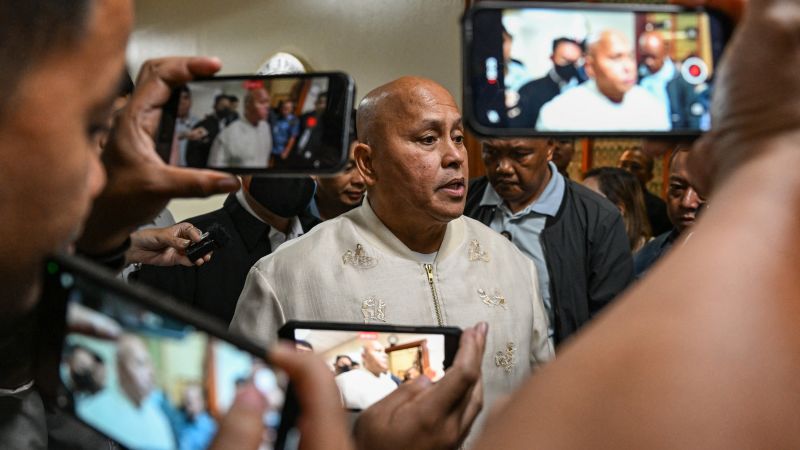
The large bald man ran through the back halls and staircases of the Philippine Senate, his aides chasing him and falling at least once as he tried to evade local agents.
At the center of this comic cat-and-mouse game was Sen. Ronald dela Rosa, a longtime ally of former Philippine President Rodrigo Duterte, who became a wanted man on the run from a powerful enforcer in a bloody drug crackdown.
The incident was caught on surveillance camera and quickly became a national topic of conversation.
Prosecutors at the International Criminal Court (ICC) have accused Mr. de la Rosa of conspiring with Mr. Duterte to commit alleged crimes against humanity during a brutal anti-drug campaign that left thousands of people dead.
On Monday, the ICC confirmed it had issued an arrest warrant for him for the killings of 32 people between 2016 and 2018. When local investigative force agents failed to arrest the 64-year-old in a pursuit inside the Capitol, riot police surrounded the Senate grounds.
In response, enthusiastic supporters of Mr. de la Rosa and Mr. Duterte gathered to protest the ICC’s warrant.
More than 100 supporters camped outside the Senate building overnight, waving flags and blocking nearby roads before being dispersed by police.
An ICC spokesperson told CNN that the judicial body “relies on the cooperation of states to execute arrest warrants,” adding that “national authorities are needed to arrest suspects and bring them to court.”
The situation remained stalemate as of Wednesday. Dela Rosa holed up in the Senate chamber for two nights and, in a news conference streamed live on Facebook, appealed not to be sent to The Hague, Netherlands, to face prosecution.

When asked about the possibility of his arrest, the lawmaker appeared tearful and said, “This was the lowest point in my life.”
“As long as they follow the proper process, I’m going to face it. If there’s a legitimate arrest warrant, it should be filed in district court. Let’s argue, and we’re going to face it,” he said Tuesday.
He reiterated his position that the ICC had no authority to arrest him without the approval of the local Supreme Court.
This avoidance of due process is what Mr. Duterte and Mr. de la Rosa are accused of.
The police officer rose to fame thanks to his close ties to the strongman leader, who ruled the Philippines with an iron fist from 2016 to 2022. This period was the height of the war on drugs.
Dela Rosa, nicknamed “Bato,” meaning “rock,” is from the Davao region in the southern Philippines and has been a loyal sidekick of Duterte for many years.
He served as police chief when Duterte was mayor of Davao City, where police are accused of using a tactic known as “opran tokhang,” in which low-level contractors were forced to surrender and then executed.
For more than 20 years, anti-drug operations have been carried out across Davao. According to Human Rights Watch, when Mr. Duterte became president and Mr. de la Rosa rose to the upper echelons of the national police, extrajudicial killings spread across the country.
The ICC’s arrest warrant alleges that de la Rosa used his position as national police chief to carry out Tokhang-style killings nationwide during Duterte’s presidency, a charge he has repeatedly denied.
In a 2016 interview with CNN, Dela Rosa said police officers would kill suspected drug traffickers “if it endangered our lives.”
When asked how he felt when he saw the bodies of suspected drug traffickers murdered and abandoned on the sidewalk, he said, “I have mixed emotions. I feel bad for that person who lost his life. At the same time, I think it’s one less person to push out, one less person to push out. Minus one.”

The Philippines’ “war on drugs” former police chief told CNN in 2016.

According to police data, more than 6,000 people have been killed in anti-drug operations since President Duterte took office. Many of the extrajudicial killings of drug suspects occur in the country’s poorest regions, and independent observers believe the number of those killed may be even higher.
Duterte himself was dramatically arrested at Manila’s international airport in March 2025, put on a plane to The Hague, and remains in ICC custody. A start date for his trial has not yet been set.
President Duterte has long denied accusations of human rights abuses, insisting the drug problem should be solved by domestic law enforcement. He has repeatedly said he has no intention of bowing down to the ICC’s foreign jurisdiction.

The Philippines was a member of the ICC, but President Duterte revoked its membership after the court launched an investigation into Duterte’s war on drugs. However, under the ICC’s withdrawal mechanism, the court retains jurisdiction over crimes committed during the accession period, in this case between 2016 and 2019, when the Philippines’ withdrawal became official.
Despite months of speculation that he was close to obtaining an ICC warrant, Mr. de la Rosa has not appeared in public.
But he made his first public appearance in the Senate on Monday, appearing to weigh in on the latest episode in the long-running feud between President Ferdinand Marcos Jr. and Vice President Sara Duterte, Rodrigo Duterte’s daughter.
Two things happened on Monday. The House of Representatives voted overwhelmingly to impeach the vice president on a variety of charges, including misappropriation of public funds, accumulation of unused wealth, and plotting to assassinate the president. She is currently awaiting trial in the Senate. If they kick her out, she won’t be running for president in 2028.
To help the Duterte family’s political survival, Dela Rosa and other senators voted to expel the Congress president and install Duterte ally Alan Peter Cayetano as Senate president.

Shortly after the vote, Dela Rosa was placed in “protective custody,” effectively shielding him from the threat of arrest, according to the government-run Philippine News Agency.
As of Wednesday, it remained unclear whether authorities would continue pursuing De La Rosa.
Amnesty International Philippines executive director Ritz Lee Santos III said the government should “immediately arrest” Mr. de la Rosa after issuing an arrest warrant and that he should be prosecuted along with Mr. Duterte.
“Dela Rosa played a key role in implementing the so-called ‘war on drugs’ under former President Duterte’s administration, and was responsible for providing command and command to the police,” Santos said in a statement.
“Mr. de la Rosa’s current position as a senator should not protect him from charges before the ICC. It is imperative that the process of justice prevails, regardless of politics.”
