

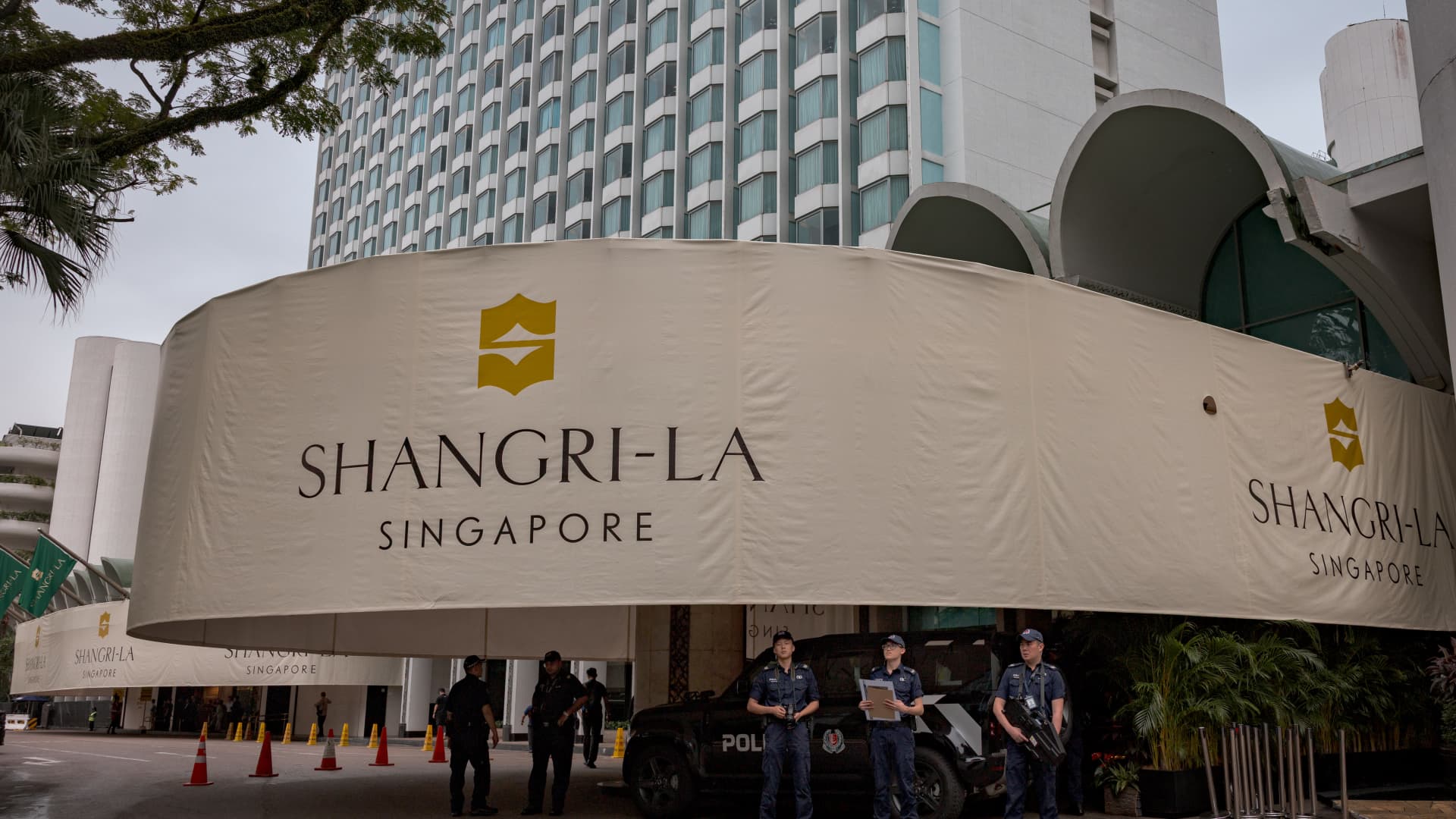
SINGAPORE, SINGAPORE – MAY 29: Police officers stand on patrol during the 23rd IISS Shangri-La Dialogue held at the Shangri-La Hotel on May 29, 2026 in Singapore. Senior defense and military leaders from across the Asia-Pacific region and beyond will gather at the Shangri-La Hotel in Singapore for the International Institute for Strategic Studies (IISS) Shangri-La Dialogue, one of Asia’s premier intergovernmental security forums. (Photo by Ezra Akayan/Getty Images)
Ezra Akayan | Getty Images News | Getty Images
Defense spending, China’s position in the Asia-Pacific region, and lessons from Ukraine are just some of the topics that dominated this year’s IISS Shangri-La Dialogue.
The summit will bring together the world’s top leaders, defense officials and key executives in Singapore from May 29th to 31st.
Here are some important points:
defense spending
Countries appear to have largely accepted the premise that they need to spend more on their defense. Countries such as Japan, the Philippines and the Netherlands are planning to increase allocations there.
U.S. Army Secretary Pete Hegseth said in remarks Saturday that countries should spend at least 3.5 percent of their gross domestic product (GDP) on defense. Even countries like New Zealand that are below the 3.5% threshold are increasing spending in this area.
US President Donald Trump has been touting the idea for years, but it initially drew surprise from many countries. Many of them now accept it, at least publicly.
Dutch Deputy Prime Minister Dilan Ecilgos-Zegelius said Russia’s invasion of Ukraine had shifted the Dutch people’s calculations in that direction, and even said the US was “right” to ask countries for more spending.
“One country can’t do everything alone,” said Gen. Jenny Carignan, Canada’s chief of defense staff. “Having the ability to come together to complement each other’s abilities is very important. But in order to do that, we have to have our own defenses,” she said.
China sends another low-level delegation
Even before the summit actually began, there was much talk about China not sending its defense minister to the forum for the second year in a row.
The Beijing delegation will be led by Major General Meng Xiangqing of the People’s Liberation Army National Defense University.
Dong Jun’s absence was noticeably felt, with Hegseth saying, “I wish my counterpart was here for this meeting, but I look forward to other options when we can communicate across the street.”
Japan’s Defense Minister Shinjiro Koizumi said he was “regretted” that Dong did not attend the meeting and urged further dialogue with the Chinese government.
German Defense Secretary Carsten Breuer and others said China was missing out on dialogue by not having a ministerial-level delegation.
The Philippines took an overtly negative stance, with Defense Minister Gilberto Teodoro telling CNBC that “as a value proposition, the[China’s]presence here will be minimal…It’s more about furthering the party line than engaging constructively, so as far as I’m concerned, it’s not a big loss for me.”
barb trading
However, the junior delegation did not stop the Chinese delegation from vigorously defending its position.
During the dialogue, Meng took aim at Japan’s increased defense spending and arms sales, and asked whether Asian countries would trust Tokyo to rearm after World War II.
Even former officials in the delegation, such as former Vice Foreign Minister Cui Tiankai, took a tough stance, maintaining Beijing’s position that cross-Strait tensions are a matter of China’s territorial integrity and national unity.
“No one cares more about the stability of the Taiwan Strait than we, China, because both sides of the Strait are Chinese territory.”
But it wasn’t a one-way street. Japanese Prime Minister Koizumi criticized the “lack of transparency” in China’s military buildup, and U.S. President Hegseth warned Beijing that there was “reasonable alarm” in the Asia-Pacific region about China’s military buildup.
Manila’s Teodoro struck the most belligerent note, saying that China’s expansionism continues unabated. “They are unrepentant and relentless in their expansionism, and it would be completely disingenuous to deny that,” he said.
Lessons from Ukraine
Ukraine continues to resonate strongly within the international community, with nations taking note of the methods of war being used as the country repulses an invasion from a larger and better-resourced Russia. This concept of “asymmetric warfare” has reshaped defense strategy on a global scale.
Pavlo Klimkin, a former Ukrainian foreign minister, said in an interview with CNBC: “There is a very strong interest in the lessons in and around Ukraine. First of all, it’s like an understanding that asymmetric deterrence and asymmetric warfare are important.”
“What’s at stake in this war is the whole sense of security. Is there a security structure in and around Europe that Ukraine belongs to? And how to fix it in the future security structure,” Klimkin said.
Countries such as the Philippines are keeping an eye on Ukraine’s tactics to increase defense spending. Dutch Defense Secretary Onno Eichelsheim said he was actually working with Ukrainian advisers to assess what would and would not be beneficial to allocate resources to.
