

Zelenograd and Khimki, Russia —
Elena Vladimirovna woke up around 4 a.m. to the sound of loud buzzing over her apartment in the Moscow region. She looked out the window and saw multiple drones overhead.
The noise quickly subsided and she thought the danger was over. But at that moment, there was a loud noise nearby.
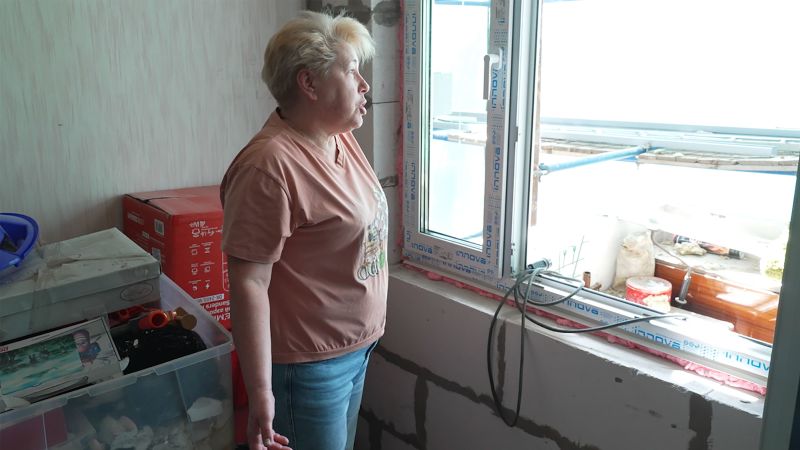
“There is a canopy like a shelf below us on the balcony. The drone fell into this canopy and then it burst into flames and black smoke started coming out,” she recalled. The fire started in her fifth-floor apartment.
The 56-year-old mother of two, who did not give her full name, told CNN she rushed towards the fire with one of her sons, a bucket and a tub of water. However, when they heard an explosion, they realized they had to grab the dog and run away. Her building in Zelenograd was just one of many damaged in a major attack by Ukrainian drones on May 17th.
Residents of Russia’s largest city are largely shielded from the day-to-day realities of Russia’s war with Ukraine, now in its fifth year. But the situation is changing as Ukraine increases its long-range attacks into the country.

Beyond the direct threat from drones, the Russians also face worsening fuel shortages as Ukrainian attacks on refineries limit supplies. Drivers in Russian-controlled Crimea battled over gasoline rations this week after the Ukrainian attack restricted deliveries.
At the same time, a shrinking economy, new restrictions on internet access, blocking of popular messaging apps, and concerns about state surveillance are adding to broader feelings of anxiety that are already beginning to be reflected in polling data.
On Wednesday, hours before the start of the Kremlin’s flagship Business and Economic Forum (SPIEF), Ukrainian drones rained down on St. Petersburg, Russia’s second-largest city and President Vladimir Putin’s hometown. Black smoke clouded the sky as thousands of participants arrived in the city.
Residents of St. Petersburg were told to stay at home on Saturday, the last day of SPIEF, following a second Ukrainian drone attack in and around the city of St. Petersburg, underscoring Ukraine’s ability to strike deep into Russia and disrupt the daily lives of Russians.
A resident of Kronstadt, a port city near St. Petersburg, told CNN that the walls of his home had been shaking and vibrating since 3 a.m. local time on Saturday. She heard drones flying around. She said she knew the Ukrainians were likely targeting military installations in the area, but “I couldn’t sleep. The noise was so loud I was scared that our apartment would be attacked somehow.”
She said she could hear Russian anti-missile systems trying to shoot down the drone, but it appeared to miss its target. Kronstadt is located on Kotlin Island, about 30 miles west of St. Petersburg, and was founded in the early 18th century as a naval defense base for the former Russian capital.

On May 17, Ukraine targeted Russia with more than 500 drones, killing at least three people in the Moscow region, Russian authorities said. The accident that struck Elena’s building caused damage to multiple floors, but there were no serious casualties.
Ukrainian President Volodymyr Zelenskiy said the strikes were “fully justified.”
“Now that Ukraine’s long-range attacks have reached the Moscow region, we are sending a clear message to the Russian government: It must end this war,” he said.
Elena said she was grateful to be alive. But days later, there were still large holes where windows should have been, and the rebuilt walls were bare and unfinished, a reminder to some Russians that the conflict seemed to be drawing closer by the day.
“I hope they don’t come anymore. We’re still alive and that’s the most important thing,” Elena said.
Then she quietly said that she hoped the war would end soon.

Like many Russians living near the capital, years of war and sanctions have shaped Elena’s daily life without completely disrupting it, making violence seem unimaginably remote to Ukrainians who have been directly exposed to Russian military operations.
Alexandra Arkhipova, a social anthropologist at the Paris-based École Normale Supérieure who studies the moods and tendencies of Russia’s population, told CNN that in the wake of the country’s full-scale invasion of Ukraine in 2022, an informal social contract was created between the Kremlin and residents of Russia’s major cities.
The authorities seemed to be sending a message: “Dear Muscovites, there is no war for you,” she said.
“The mayor of Moscow went to great lengths to make it seem like there was no war going on. It was a promise to Muscovites: ‘Live your life, there will be no war for you,'” she said.
Arkhipova, who lives in self-imposed exile and was labeled a foreign agent in 2023, believes official messaging is showing signs of strain following the state’s crackdown on internet access and the blocking of popular messaging apps such as WhatsApp and Telegram. “On top of that, we also have additional taxes,” she said.
Arkhipova said Russians are looking for ways to avoid new measures, including the gradual introduction of state-backed messenger app Max as an essential tool in public sector roles.
He said some people are downloading apps that make it appear like Max is installed on their screens, while others are buying “burner” phones, commonly called MAXophones, to segregate private communications out of fear of government surveillance.
Elena’s neighbor Maxim (who declined to give his last name) is one of those who has a second cell phone.
“Look, I have two cell phones now, one for MAX and one for me. You see,” Maxim said.

He was at his country cottage, a dacha, for the weekend when the drone crashed into the building on May 17. When they returned to Zelenograd, they discovered that authorities had broken down the door to assess the damage.
“Who told them they could do that?” he said, pointing to the front door. Maxime expressed frustration that repairs were not done quickly enough and expressed anger at the invasion of privacy as workers come and go.
But his anger seemed to extend beyond the disruption caused by the repairs.
“I’m half Lithuanian,” he said. “My whole family in Lithuania is just shocked by the fact that Ukrainians and Russians are dying. That’s the most important thing: Slavs are killing Slavs,” he said.
“I’m all for this ending. Hurry up, damn it!” he added.
It is difficult to gauge public opinion through public opinion polls in Russia, as there is a law that makes it a crime to “discredit” the armed forces, but the independent polling company Levada Center found in an April poll that 62% of respondents supported a transition to peace negotiations, while only 27% said military operations should continue.
The poll was taken before the latest strikes and appears to reflect a growing sense of fatigue and malaise in the capital, where war is slowly returning.

In a mass attack last month, another drone struck another residential building just 100 feet from Victory Square in the city of Khimki, about 11 miles northwest of central Moscow.
A black hole has now destroyed the top two floors of a skyscraper overlooking the square, where monuments depicting World War II veterans and participants in what Russia calls “special military operations” stand side by side.
President Putin has repeatedly drawn a direct link between Russia’s full-scale invasion of Ukraine and the Soviet Union’s defeat of Nazi Germany in World War II. The monument’s inscription says so: “By preserving the past, we protect the future!”
When CNN visited Khimki four days after the strike, Nadezhda stood outside the building looking up at the exposed damage. She said she was there on May 17 when a drone was flying overhead.

“My mother lives nearby. When I arrived and was waiting for her, she flew over me. Then, a second later, I heard a crash and my mother came out,” she said, adding that they tried to get closer to see if they could be helped, but were stopped by rescuers.
None of her acquaintances were hurt, but she was shaken by the close call.
“I flinch at everything now. Even if it’s just teenagers setting off firecrackers, I get really nervous,” she said.
Elena, who was walking with her 10-year-old son in front of the damaged building, told CNN that her family woke up the night of the attack to the sound of drones flying in the sky.
“It went on and on and on,” she said. “I want peace. I hope everything ends soon.”
