

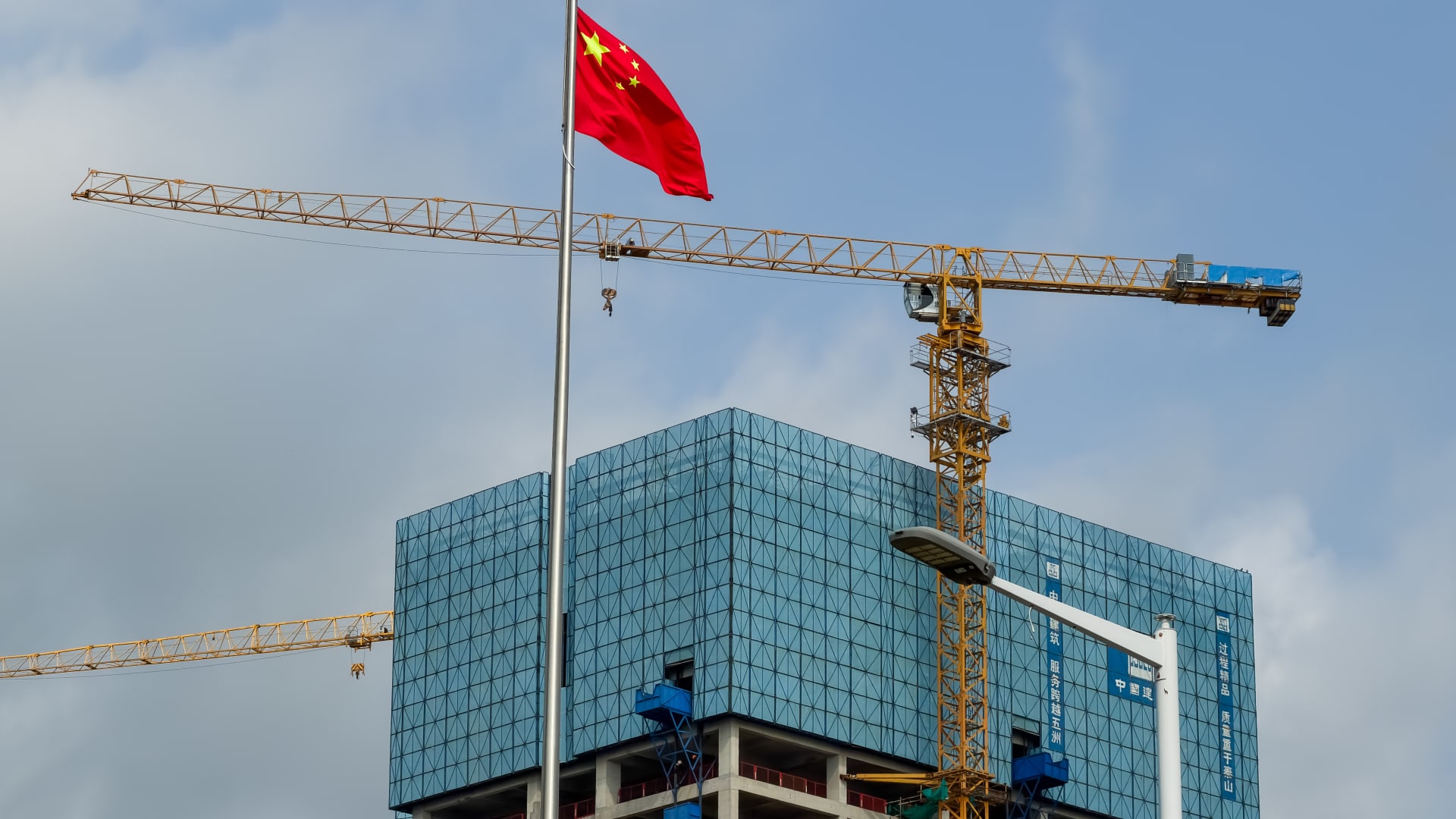
SHENZHEN, CHINA – MAY 3: The Chinese flag flies on a flagpole near a construction site with a tower crane and a high-rise building under development in Shenzhen city, Guangdong province, China on May 3, 2026.
Chen Xin | Getty Images News | Getty Images
China’s retail sales fell in May for the first time in more than three years, while urban investment contracted more than expected, increasing pressure on Beijing to roll out meaningful stimulus to stimulate consumption, even as detente in the Middle East provides short-term relief.
Retail sales, a measure of consumption, fell in May for the first time since December 2022, falling 0.6% year-on-year, the Office for National Statistics said on Tuesday. The Labor Day holiday in early May failed to offset weak consumer spending, and the Chinese government scaled back trade-in subsidies earlier this year.
The contraction in sales was a surprise as economists polled by Reuters had expected flat growth. Fu Linghui, a spokesperson for the bureau, highlighted that retail sales, which include goods and services, increased by 2.8% in five months.
China’s urban fixed asset investment, which includes real estate and infrastructure, fell 4.1% year-on-year at the end of May this year, compared to an estimated 2% decline, worse than the 1.6% decline in the first four months of the year.
Real estate was a drag on investment, with capital inflows falling 16.2% in the January-May period. Manufacturing fixed asset investment contracted for the first time since December 2020, wind data showed, despite manufacturing resilience backed by high-tech and policy support. Infrastructure investment increased by 0.6% from the previous year.
The only bright spot was industrial production, which rose 4.5% in May, hitting the highest estimate of 4.3% growth and rebounding from April’s 4.1% growth, the lowest in nearly three years.
“The imbalance between strong domestic supply and weak demand is serious,” the statistics agency said. “Some companies are facing significant operational pressures,” the agency said, calling for the development of new technologies and increased employment support to achieve “an appropriate increase in economic output.”
The economy is showing signs of slowing down after a strong first quarter. Growth slowed across the board in April, with industrial production and retail sales recording their weakest growth in years. In May, the official index of manufacturing activity fell to 50, the dividing line between expansion and contraction.
During the long holiday period in early May, travel and dining activities picked up, but as consumers became more price-conscious, the amount spent per person was lower than the same period in 2025.
“Weak retail sales statistics are putting pressure on the government to consider policy measures to stabilize consumption,” said Zhiwei Zhang, president and chief economist at Pinpoint Asset Management, adding that he expected policy “fine adjustments” to be made in July after the release of second-quarter GDP statistics.
The national unemployment rate fell to 5.1% in May from 5.2% in April.

sputtering growth
China’s economy is developing in what economists call a “K-shaped” growth model, with strong manufacturing and export sectors countering persistent weakness in real estate and consumer spending.
“China’s economy will slow and the recovery will be limited,” said Shane Yue, senior economist at Oxford Economics, predicting economic growth in the second quarter of 4.2%, significantly slower than the 5% growth in the first quarter.
President Donald Trump and Iran’s chief negotiator signed a deal on Monday to extend a delicate ceasefire for another 60 days and reopen the Strait of Hormuz, allaying concerns about a prolonged energy shock that has spooked global markets and clouded global economic growth prospects.
But the path to a durable solution remains unclear, and economists warn that normalizing shipping through the Strait of Hormuz will take time.
The country’s exports continued to be the standout sector, posting double-digit growth in April and May, as a surge in renewable energy and AI-related demand largely offset the drag from the Middle East conflict.
The disruption of energy flows caused by the Iran war caused commodity prices to rise, helping to ease the deflationary pressures that had plagued China for years, but the rise was hardly reflected in consumer prices as demand slumped.
Producer inflation rose at the fastest pace in nearly four years in May, but consumer inflation remained modest at 1.2% as upstream suppliers absorbed costs rather than passing them on.
“Companies are absorbing higher costs in the face of weak pricing power, suggesting that new growth engines have not yet offset the drag from old models,” Yue said, adding that corporate profit margins continue to be squeezed rather than what reflation policymakers would like.
