

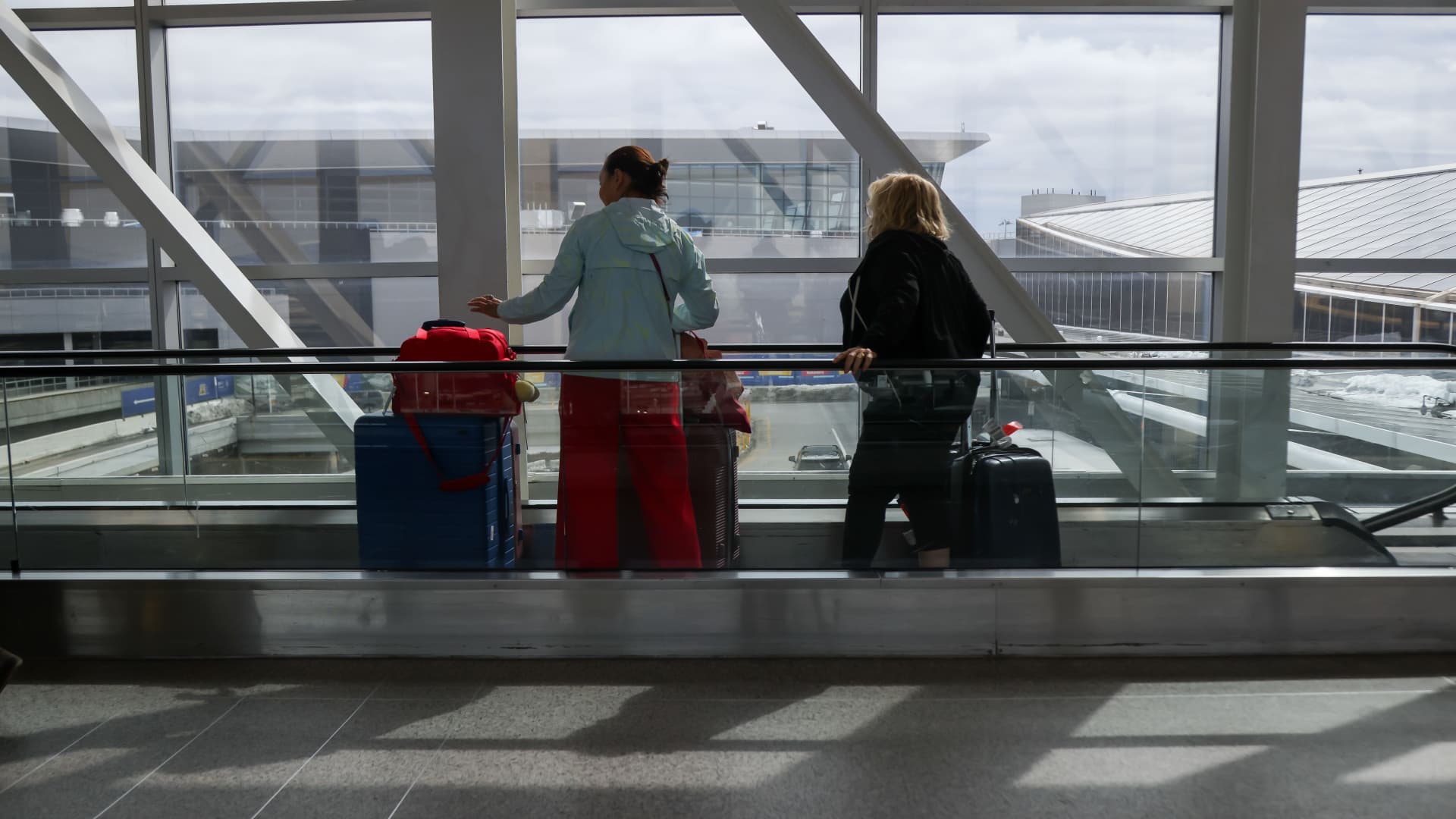
Travelers in Terminal 1 at John F. Kennedy International Airport in New York on March 1, 2026.
Michael Nagle | Bloomberg | Getty Images
As airfares continue to rise due to the Iran war, potential travelers may be wondering, “Should I buy a ticket now or wait until the situation improves?”
Travel experts say it’s generally best to buy early.
“Whether you’re looking to travel in the next two weeks, two months, or in the fall, waiting to buy a plane ticket in the hope that the conflict will end soon is honestly riskier than the fashion choices we made as teenagers. We won’t be happy with it in the future,” said Katie Nastro, a travel expert at the travel trading site Going.
In other words, “If it’s within your current budget, don’t put it off,” Nastro says.
Airfares are rising, especially on international flights.
A technician prepares a Delta Air Lines aircraft to refuel at Austin-Bergstrom International Airport on April 10, 2026, in Austin, Texas.
Brandon Bell | Getty Images News | Getty Images
Airline ticket prices generally increase gradually as the high-demand summer travel season approaches.
But this year, prices rose significantly more than usual amid an oil supply shock triggered by the ongoing Middle East conflict that began on February 28, when the United States and Israel launched attacks on Iran.
As of April 20, the average round-trip ticket cost for a domestic flight was $361, according to weekly data from travel search engine Kayak. The price is up about 8% from $335 on February 23, before the Iran war began. It is also up 19% from $304 a year ago in late April 2025.
International flight fares have further increased in recent months, with the average round-trip ticket reaching $1,097 on April 20, up 42% from $774 on February 23 and up 14% year-over-year, according to Kayak.
Jet fuel and the impact of the Iran war
A jet fuel truck sits on the tarmac at Fort Lauderdale-Hollywood International Airport (FLL) on Wednesday, April 22, 2026 in Fort Lauderdale, Florida, USA.
Eva Marie Uzcategui | Bloomberg | Getty Images
Haley Berg, chief economist at travel booking app Hopper, said the cost of jet fuel is the main reason airlines are raising prices for the summer.
Jet fuel is one of the largest operating costs for airlines, typically accounting for 20% to 30% of total costs, making it a “significant driver” of airfares, Berg wrote in an email.
Iran and the United States are racing to block the Strait of Hormuz, a shipping route through which about 20% of the world’s oil supplies pass, inflicting economic pain on the other and pushing up global oil prices.
The price of U.S.-made jet fuel refined from crude oil has risen about 82% since the start of the Iran war, from $2.50 on Feb. 27 to $4.56 a gallon as of Wednesday, according to Argus Media’s Jet Fuel Price Index.
Airlines will need to absorb these additional costs or pass them through through pricing to recover the “significantly higher” per-flight costs, Berg wrote.
In addition to raising ticket prices, airlines are managing the impact by increasing baggage fees, adding fuel surcharges and reducing flight schedules.
The extent of the impact on consumers varies by route, Berg wrote.
For example, on short-haul flights, the impact on prices may be more limited because fuel is a smaller portion of total operating costs, she wrote. But bunker price changes have a more direct and noticeable impact on travelers, she wrote, because fuel is a “major cost factor” on long-haul flights.

Berg said he estimates summer airfares are already about 10% higher than Hopper expected due to higher fuel costs. Fares to Europe, a top summer destination for Americans, rose about 9%, she wrote.
“With the outcome of the current conflict unknown, we do not know what fuel price trends will be this summer,” Berg wrote. “Travelers looking to book domestic or international flights for the summer should start checking prices now. If you find a great deal, we encourage you to go ahead and buy.”
Even if the war ends in the near future, experts say it will likely still take several months for the situation to normalize.
For example, it will take time to rebuild the Middle East’s oil infrastructure and iron out delays in oil production, Nastro said.
“Don’t wait[to buy]because you don’t want to take the risk at this point,” she said. “If you think fares are going to go down significantly, there’s a risk that they won’t go down at all.”
This logic applies not only to summer travel, but also to flights in September and October, she said.
“Goldilocks” window for purchasing airline tickets
LeChat Noir | E+ | Getty Images
War aside, airfares could become volatile, experts say. Also, airline tickets tend to become more expensive weeks to months before departure.
Travelers usually get the best deals by buying months in advance, rather than waiting until the last minute.
Nastro calls this the “Goldilocks” window.
Nastro said domestic travelers typically get the best deals if they buy about three to seven months before their trip, while international travelers typically buy four to 10 months in advance.

Berg offered similar schedules depending on the destination. She recommended:
Domestic flights: Monitor prices 3-4 months before your trip and book 1-2 months in advance. Traveling to Europe: Watch prices 7-8 months before departure and book 3-6 months in advance. Travel to Asia, Australia, and Africa: Monitor prices 7 to 8 months in advance and book long-haul international flights 5 to 7 months in advance.
Travelers who haven’t yet booked a trip could consider flying in the fall instead of summer to save money, or even postpone until there’s perhaps more clarity about the Iran war, Berg said.
“Compared to the peak summer months, flying in September or October can offer significant savings, especially when traveling to international destinations like Europe,” she said.
