

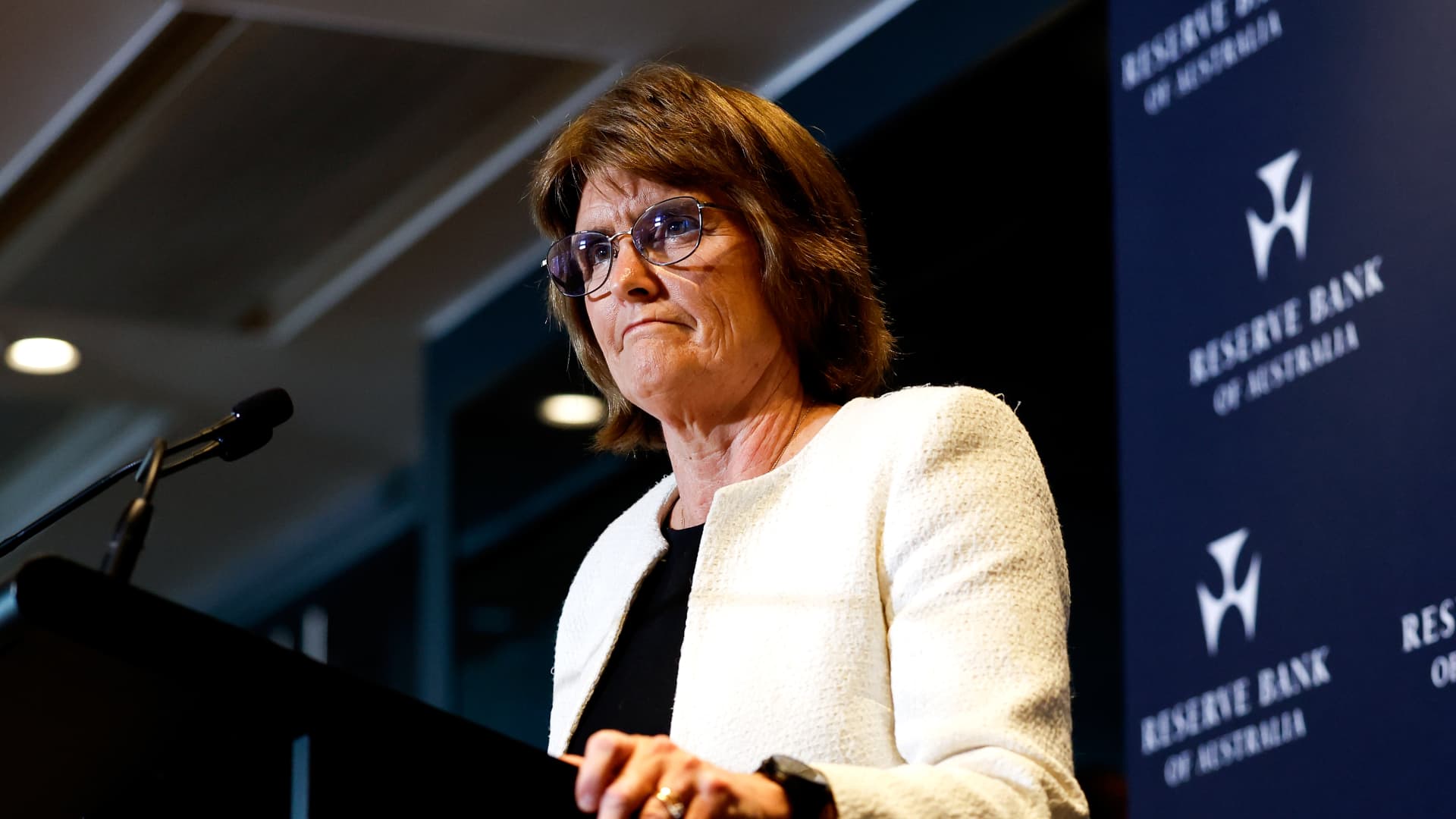
Reserve Bank of Australia (RBA) Governor Michelle Bullock attends a press conference at the bank’s headquarters in Sydney, Australia, on Tuesday, December 9, 2025. Australia’s central bank left its key interest rate unchanged for the third consecutive meeting in a widely expected decision, but reiterated that any future moves would depend on future economic data. Photographer: Brendon Thorne/Bloomberg via Getty Images
Bloomberg | Bloomberg | Getty Images
The Reserve Bank of Australia kept its policy rate unchanged at 4.35% on Tuesday, but said it was prepared to raise rates to meet its price stability and full employment mandate.
The unanimous decision was in line with the opinion of economists polled by Reuters and comes as Canberra struggles to curb domestic inflation.
The RBA said in a statement that inflation “remains too high” and that it was justified in keeping the cash rate unchanged after assessing “the response to past interest rate increases and the impact of oil supply disruptions”.
australian S&P ASX/200 The price fell slightly after this decision, but australian dollar Against the dollar, it traded 0.3% lower at 0.705.
Although the US and Iran have reached a deal to end the Iran war, the RBA said a resolution was still in its early stages, and that it would take some time to resolve the global oil supply issue, with energy prices and inflation likely to remain high.
Earlier this month, Australia reported that its gross domestic product (GDP) expanded by 2.5% year-on-year in the first three months of this year, weaker than expected and the same rate of growth as the previous quarter.
Australia’s GDP rose 0.3% quarter-on-quarter (Reuters poll expected a 0.5% increase), slowing from the previous quarter’s 0.9% increase.
“An extended period of uncertainty could also reduce growth in Australia’s major trading partners and within Australia,” the RBA said.
Growth is lower than expected, but inflation is above the RBA’s target. The year-on-year rate slowed to 4.2% in April, but was still above the central bank’s target of 2-3%.
“Inflation is likely to remain high for some time as higher fuel prices are directly pushing up inflation, and there are signs that this is spilling over into the prices of other goods and services,” the RBA said.
