

Beijing —
China, the world’s largest energy importer, has so far weathered the global energy shock brought on by the Gulf War better than some of its Asian neighbors.
But the uneasy US-Iran ceasefire and a new US military blockade that threatens Iranian exports mean global fuel markets remain volatile, raising the risk of conflict for Beijing.
One reason? China, a major importer of Iranian oil, is the country most affected by U.S. moves to affect its oil flows, both last month when the White House lifted certain U.S. sanctions on Iranian barrels and now that the U.S. military has begun blockading Iranian ports.
Such moves may not immediately lead to supply shortages in China, which is well prepared for energy shocks.
But the pressure on the world’s second-largest economy is mounting at the same time that soaring global fuel prices are beginning to ripple through the economy, with diplomats preparing for next month’s crucial and already postponed meeting between U.S. President Donald Trump and Xi Jinping in Beijing.
Xi met with Abu Dhabi’s Crown Prince Sheikh Khaled bin Mohammed in Beijing on Tuesday, making his most substantive comments on Middle East security since the outbreak of the conflict and offering “four proposals” for peace in the region.
The proposal is largely broad-based and linked to Xi’s vision to reform international security, but it is the latest sign of Beijing’s growing emphasis on calls for peace after peace talks between the United States and Iran collapsed over the weekend.
The statement follows weeks of diplomacy by Chinese officials promoting a ceasefire and touting China as a responsible spokesperson for peace. President Trump even suggested in recent weeks that China helped bring Iran to the negotiating table.
How the Chinese government adjusts its diplomacy now at this critical ceasefire stage will have a bearing on how much pressure the Chinese economy is under.
“With China’s interests increasingly at stake, the United States may be able to further engage China in nudging Iran toward a negotiated settlement,” said Yun Sun, director of the China program at the Stimson Center think tank in Washington. “China will resort to diplomatic pressure, including bilateral and multilateral, to seek a prompt lifting of the blockade.”
So how much of an economic risk is it for Beijing?

Most of the vast amount of energy needed to power China’s economy and manufacturing industry is produced domestically, and gasoline-free electric vehicles are rapidly growing on the country’s highways.
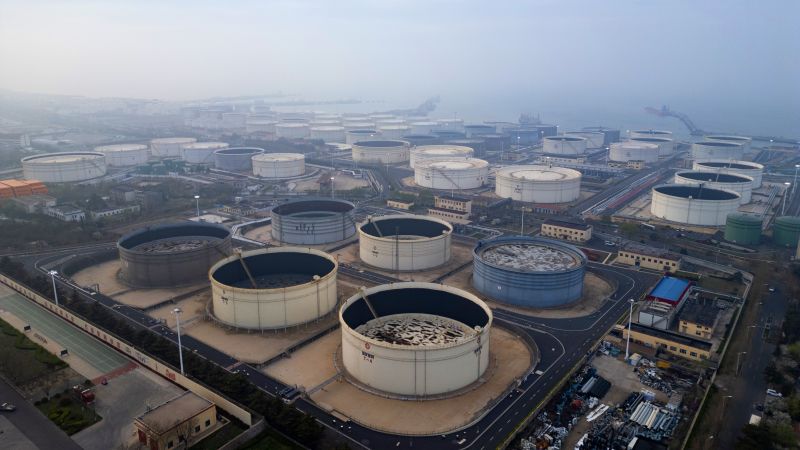
China remains heavily dependent on imports for oil, which accounts for about 18% of its energy mix, but the Chinese government has long worked to diversify supplies. Importantly, analysts estimate that China has also planned ahead and amassed enough oil reserves to last at least three months between the Commercial Strategic Stockpile and the National Strategic Stockpile, giving the Chinese economy significant breathing room.
China’s government has given a state oil company the green light to exploit commercial oil reserves as the Iran war drags on, Bloomberg News reported Thursday, citing people familiar with the matter.
Still, China is not immune to price shocks from volatile global energy markets.
China’s central economic planners have intervened multiple times to cushion the impact of rising global prices for diesel and gasoline, but the price increases are still starting to ripple through the economy.
Airlines are being forced to raise ticket prices due to rising jet fuel costs. Official economic figures released last week showed transport fuel costs rose 10% in March compared to the previous month. Ex-factory prices in China also turned positive last month for the first time in more than three years.
These changes are ending long deflationary cycles that have been a headache for economic planners. But analysts warn that this kind of “cost-push inflation”, rather than natural price increases due to increased demand, is not a desirable solution.
“Profit margins will compress rather than expand, putting pressure on household disposable income without improving consumer confidence or propensity to spend,” Joe Pycelle, senior macroeconomic analyst at consulting firm Trivium China, said in a recent note.
On the other hand, there are other risks as well. Chinese planners are well aware that the longer a war negatively impacts the global economy, the greater the impact will be on their export-dependent economy now that domestic demand is lagging.
About 38% of oil and 23% of liquefied natural gas that normally passes through the Strait of Hormuz is headed for Chinese ports, according to financial firm Nomura. Overall, this accounts for about half of China’s offshore oil supply and one-sixth of its natural gas supply.
While Iran’s control of the strait cut off much of its supply from other countries, Iranian crude oil, which normally accounts for 13% of China’s seaborne imports, continued to flow in at near-normal levels.
The U.S. blockade is expected to hamper fuel shipments from Iran, but analysts say the impact on China could still be muted for several reasons.
One is that large reserves are already in offshore storage or tankers and accessible, even though shipments from Iran are expected to slow.
“Iranian oil remains abundant and the days covered for Chinese refiners is hovering around 120 days,” said Johannes Rauboll, senior oil analyst at Kpler, adding that this is assuming China maintains imports at normal levels. This means that “a potential decline in Iranian exports will not affect supply in the short term.”
Meanwhile, the U.S. decision last month to lift sanctions on certain barrels of Iranian crude oil sent prices soaring. As a result, small so-called teapot refiners on China’s coast, which typically process the product on narrow profit margins, have already cut back on purchases, said Rystad Energy analyst Tianyue Hu.
Still, the blockade is unlikely to have an immediate impact on China’s energy supplies, but that could change if the situation drags on.
If prices continue to rise and inventories fall, these refineries could cut back on gasoline and diesel production.
“Given the Chinese government’s priority to maintain stable domestic supplies, authorities are likely to respond with policy support such as securing alternative crude oil supplies and encouraging refinery operations to mitigate the impact,” Hu said.
How significant these effects will be will also depend on whether other countries’ cargo remains restricted in the Straits.

Beyond energy, China has significant economic influence in the broader region, highlighting the other interests Beijing has in resolving the conflict.
A recent analysis by AidData, a research institute at the College of William and Mary in Virginia, found that Chinese-owned infrastructure considered to be targeted or at risk of being targeted in the region totals about $6.5 billion.
These facilities include ports, power and desalination plants, refineries and petrochemical operations, and airport infrastructure across Qatar, Oman, the UAE, Saudi Arabia, Iran, and Israel, demonstrating the extent of China’s financial exposure. Analysts noted that some of the numbers reflected the lender’s share of syndicated loans, as estimated by AidData, rather than its exact loan exposure.
Customs statistics showed China’s trade with the Middle East fell in March after increasing year-on-year in the first two months of the year, officials said Tuesday.
Beijing balances these interests in its diplomatic rhetoric. That means supporting Iran and opposing attacks on Iran by the United States and Israel, while asking it to respect the security of Gulf states targeted by Iran.
Chinese diplomats have repeatedly appealed for peace in the region over the past six weeks. The White House did not confirm or deny that the two countries were involved in brokering the two-week ceasefire agreed last week, but the White House said high-level talks had taken place between the two countries as negotiations on the deal progressed.
The White House has been closely monitoring Beijing’s support for Tehran and has threatened to impose 50% tariffs on countries that supply weapons to Iran. CNN reported last week, citing sources, that US intelligence suggests China is preparing to provide new air defense systems to Iran. China flatly denied this.
Beijing may be interested in the United States bonding in another region and not focusing on competing with China. However, Chinese officials have said they do not want the war to affect the current stability of U.S.-China relations, especially ahead of President Trump’s planned visit to China next month.
And when it comes to playing a mediating role, “China clearly wants to promote its friendship with the United States and give the appearance of support,” said the Stimson Center’s Sun.
Following the failure of last weekend’s peace talks between the United States and Iran, China’s top diplomat, Wang Yi, spoke Monday with diplomats from Islamabad, Pakistan, where the peace talks were held, and stressed that Beijing is ready to continue working with Islamabad towards peace.
That call may feel even more urgent now as the impact on China’s economy continues to grow.
