

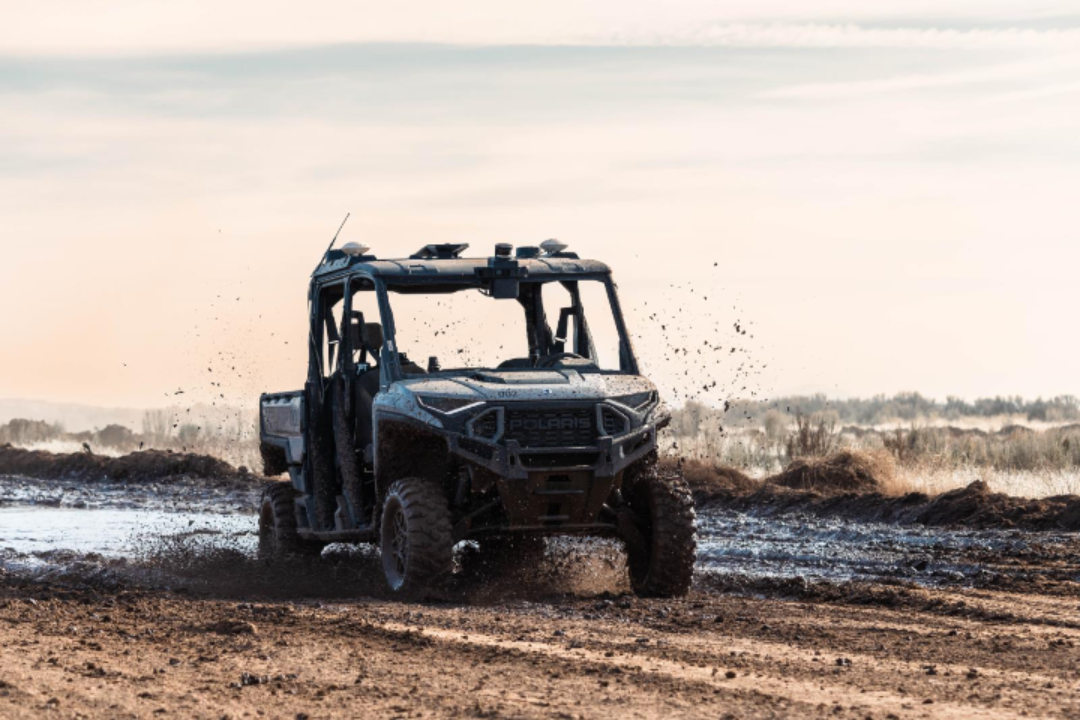
American self-driving vehicle manufacturer Forterra today revealed that more than 100 of its self-driving ATVs have been deployed to conflict zones in Ukraine over the past nine months. The company believes this is the largest deployment of self-driving ground vehicles in combat by a U.S. defense technology company.
“I think this is true of every defense technology ever developed. You don’t know until you see real combat,” Scott Sanders, chief growth officer at Forterra and a former U.S. Marine Corps officer, told TechCrunch.
The mission, funded by the U.S. defense budget, is part of a growing effort to transform the U.S. military by supporting Ukraine’s resistance to Russian invaders. Drones have received a lot of attention in combat, but the dynamics they create – large no-go zones where surveillance from the air can be deadly – have led Ukrainian strategists to also seek autonomy on the ground.
“There’s nowhere to hide,” explained Sergeant Major Corey Wilkens, who heads the Army’s program to develop self-driving vehicles and tactics. “[First-person drones]can be attacked by other types of drones that drop ammunition, artillery, mortars, etc., making them very vulnerable.”
Ukraine is already building its own unmanned ground vehicles (UGVs) to help transport supplies and ammunition or evacuate wounded soldiers, according to a member of the Ukrainian military who has worked on the vehicles, but TechCrunch is not identifying them for security reasons.
Forterra’s Lancer vehicle is based on the Polaris ATV, has a custom-built sensor and computing stack, is gasoline-powered, and can carry 750 kg of cargo, making it more versatile and convenient. “The bottom line is that this UGV for logistics and defense maintenance is the most important UGV in Ukraine,” the soldier said. “This is really great and we hope to get more.”
They didn’t feel that way at first. The Ukrainian military has had mixed experience with Western contractors bringing new technology into combat, and at first it felt like Forterra’s products were a little too suited to the U.S. military’s high-end requirements. Modifications to the vehicle according to the situation, in particular the addition of a Starlink satellite internet antenna, added significant value to the vehicle.
Since arriving in Ukraine last October, the vehicles have traveled more than 2,500 miles on more than 1,100 missions, carried a total weight of 777,440 pounds, and completed 52 casualty evacuations. Some have lost their lives in combat, especially when stuck in deep mud or terrain that is easily targeted by Russian forces.

Fortera learned several valuable lessons, including electronic warfare, updating software remotely, how to maneuver in difficult conditions, and ensuring the vehicle does not break down. The company, which has raised more than $500 million in venture funding from funds such as XYZ Venture Cpaital and Moore Strategic Partners, is now well positioned in the race to win lucrative national security contracts.
They are also aware of the limits of autonomy. For now, Ukrainian soldiers primarily operate vehicles remotely in combat zones, in part because the vehicles are too valuable to lose, and in part because self-driving vehicles are not well suited to the realities of war.
For example, vehicles can move autonomously across different terrains, but they are not yet at a stage where they can identify unexpected enemy forces and react appropriately. “We actually need to be able to live and respond to enemy threats while in the presence of the enemy, and the autonomous government does not yet know how to do that,” explained a Ukrainian soldier.
Forterra, which began researching self-driving cars 20 years ago, is working on ways to combine the kinds of algorithms that have made self-driving cars possible with new generative AI software that allows machines to react to their surroundings in a common way. As with any autonomous system, one of the key obstacles is collecting appropriate data.
“There’s a lot of things that need to be done that aren’t available in an open source model, whether it’s finding a way through a minefield or[operating]a weapons system, because that’s not something humans do,” Sanders told TechCrunch. “You need to be able to turn a dial, operate something that is more like a classic robotics approach, and leverage AI when needed.”
Competitors in this space are also trying to solve similar challenges. For example, Scout AI raised $100 million earlier this year to train basic models and develop autonomous platforms for the military, including UGVs. Other startups, such as Field AI and Overland AI, are also piloting UGVs with the U.S. military.
Despite the limitations of UGVs, American military experts believe the time is right to invest in these tools. “Ground autonomy is now achievable and we are seeing it,” Wilkens said.
Scott Phillips, Forterra’s chief technology and innovation officer, earned the respect of his troops by visiting the Ukrainian unit’s operations center, seeing the vehicles in action firsthand, and visiting areas within Russian attack range.
“What struck me most was seeing exactly where the seams were: which steps are still done manually, where data needs to be manually re-entered or re-validated, and where teams have already found ways to automate or speed up the work,” Phillips told TechCrunch. “This is the kind of truth you can’t get from a slide deck, because better tools can show you exactly where you can take the pressure off the people doing this work in real time.”
One challenge the Ukrainians have put forth is to make it cheaper. Forterra’s Lancer is not expensive for its category, as the vehicle itself relies on Polaris’ commercial supply chain, but it is still too valuable to be freely deployed like a UAV.
“Consumables are just a fact of this battlefield, and at the moment we’ve lost some men and it hurts. We need more, and therefore we need something cheaper,” a Ukrainian soldier told TechCrunch.
If you buy through links in our articles, we may earn a small commission. This does not affect editorial independence.
