

As the Trump administration wages full-fledged wars with enemies and trade wars with friends, Americans’ attitudes toward their biggest rival, China, are changing for the better, according to a new survey.
It’s a stark contrast from just a few years ago, when Sinophobia and anti-Asian hate crimes spiked in the United States during the coronavirus pandemic. Tensions between the two countries have deepened following a trade war during President Donald Trump’s first term, with just 14% of Americans having a favorable view of China by 2023, according to data released Tuesday by the Pew Research Center.
Now, that number has nearly doubled to 27%, reflecting a broader shift in sentiment among Americans overall, especially Democrats and young people. This reflects a growing curiosity about Chinese culture and entertainment on Western social media, evident in recent trends such as “Chinamaxxing.”
The report, which surveyed more than 8,500 adults nationwide in January and March, found that while fewer respondents called China an enemy than last year, most Americans still view China as the United States’ main competitor.
The results also showed a softening of attitudes toward China’s authoritarian leader Xi Jinping and growing doubts about President Trump’s leadership.
More than twice as many Americans (17%) now say they have confidence that President Xi will do the right thing regarding world affairs compared to 2023. Meanwhile, the public is losing confidence that President Trump will make good policy decisions regarding China, with his favorability rating dropping to 39%, down 6 points from last year.
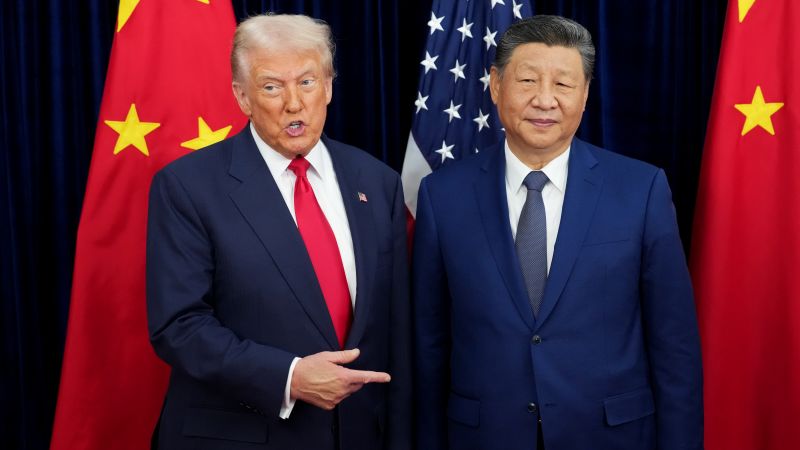
This comes as Trump and Xi prepare to meet in Beijing in May, and as China seeks to present itself as a stable and responsible world power, alongside Trump’s often unpredictable foreign policy, from high global tariffs to war with Iran.
“Today’s world faces a confrontation between justice and power and is full of turmoil,” Xi declared in comments to Spanish Prime Minister Pedro Sanchez on Tuesday, according to a statement from China’s Foreign Ministry.
“How a nation deals with international law and international order reflects its worldview, concept of order, values, and sense of responsibility,” Xi said.
Some Americans hold similar views. According to Pew, survey respondents rated President Trump’s ability to develop good policy regarding China as well as his ability to develop foreign policy toward other countries, such as North Korea, Cuba, and Venezuela.
Sentiments in other countries are also swaying China’s approach. A poll from last fall found that nearly three times as many Canadians now have a positive view of China than in 2021. And in Southeast Asia, a recent survey found that if the region had to ally with one of two countries, a majority of respondents would choose China over the United States.
PewPew’s findings found some differences along specific party lines and demographics. According to the report, respondents from both parties have grown more favorable toward China, but the change is particularly pronounced among Democrats and Democratic-leaning independents.
Similarly, far more Republicans than Democrats felt that Mr. Trump could make good decisions regarding China, but this confidence has declined among Republicans as well.
There are also significant generational disparities. According to the report, Americans over 50 are much more likely to say China is an enemy of the United States, while younger Americans have a much more positive view. Young people also had less trust in President Trump than older people.

Why Gen Z Americans are “becoming more Chinese”

This change in opinion can also be seen online. There was a trend earlier this year called “China Max Thing,” in which content creators experimented with common Chinese customs, such as drinking hot water, making fruit tea, and doing traditional gymnastics, in hopes of “becoming Chinese.”
There was the Adidas tan jacket that sparked a global shopping frenzy after its debut at Shanghai Fashion Week. There’s a huge craze surrounding Lovebus, a Chinese-made figurine with a fluffy exterior and grinning sharp teeth that took the world by storm last year and helped fuel a billion-dollar business.
And Xiaohongshu (RedNote) is a hugely popular Chinese social media app that hundreds of thousands of US users flocked to last year, fearing a possible ban on TikTok in the US.
It was perhaps the first time that social media users from China and the United States, who are usually separated by China’s Great Firewall, had come together in such large numbers on one sharing platform, providing a rare opportunity for people from both countries to share jokes and foster online friendships.
On the surface, these may be short-lived internet trends. But this wholehearted embrace of Chinese products and cultural exchange would have been difficult to imagine just a few years ago, when anti-Asian racism skyrocketed during the coronavirus era.
Underlying the memes and viral items are shifts in public opinion at the helm that could work in Xi’s favor as he cements his place on the world stage.
