

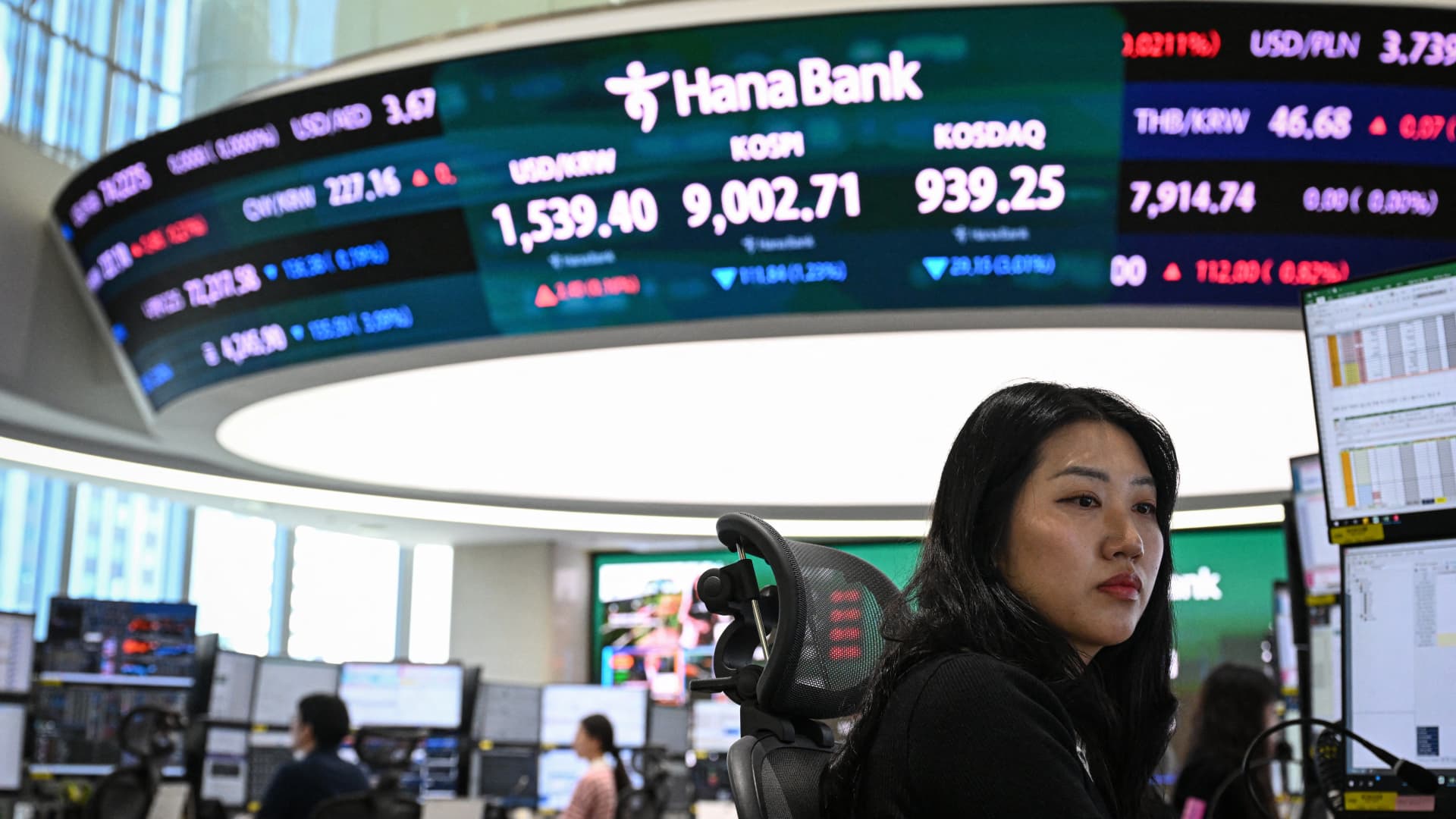
Currency dealers monitor exchange rates as the Korean Standard Stock Price Index (KOSPI) is displayed on an electronic screen (above) in the foreign exchange dealing room at Hana Bank’s main branch in Seoul on June 23, 2026.
Jade Gao | AFP | Getty Images
Korean stock benchmark, KospiThe world’s most-watched stock market has plunged into bearish territory within weeks, underscoring how averse investors are to artificial intelligence initiatives and highlighting concentration risks.
The Kospi fell more than 5% on Wednesday, leaving it 20% below its all-time high on June 19, according to LSEG data. The stock closed slightly higher on Thursday amid choppy trading.
“South Korea’s recent drawdown is driven by global investors’ growing skepticism about AI, coupled with the market’s extreme concentration,” said Manishi Raichaudhuri, CEO of Emer Capital.
The speed of the reversal highlights a central feature of this year’s bull market: South Korea’s extraordinary dependence on AI trade. As of June, semiconductor manufacturers Samsung Electronics and SK Hynix accounted for more than half of Kospi’s weighting, according to data provided by Emer Capital. This extreme dependence has caused the index to rise and fall.

Kospi’s performance since the beginning of the year
“The correction was caused by positioning rather than deteriorating fundamentals,” said John Ying Yun, founder of Fibonacci Asset Management Global. He added that Korean stocks “went through a very strong rally and became one of the most crowded AI trades in the world, so it didn’t take long to trigger profit taking.”
He described the Kospi’s decline as “a healthy reset rather than a fundamental change in the outlook”, although heightened global uncertainty and concerns about the potential for earnings improvements to ease are also making investors more cautious.
Peter Kim, global investment strategist at KB Financial Group, argued that the move also reflects broader changes in modern market dynamics.
“The gamification of finance is creating these fluctuations that are driven by news flows and trends rather than fundamentals,” he said, adding that 5% to 10% fluctuations are becoming increasingly common due to retail capital flows, exchange-traded fund leverage, and AI-driven concentration. The Cospi Volatility Index has soared more than 200% since the beginning of the year.
Appraisal value adjustment
The Kospi has taken a hit recently, despite strong earnings for the companies at the center of the selloff. Samsung reported massive profits on Tuesday as memory prices continued to rise. However, the semiconductor giant’s shares plunged on concerns about AI spending.
“The market has more doubts about the pace of profit growth than the sustainability of demand for AI itself,” Fibonacci’s Jung said. “This difference is important because it suggests a valuation correction is occurring, rather than the end of the AI cycle.”
Underscoring the strong demand, memory prices rose between 50% and 80% in the second quarter, and are expected to rise further in the second half of the year, said Rolf Balck, head of semiconductors and infrastructure at Futuram Group.

Bulk added that the memory maker’s fundamentals remain unchanged, citing multi-year supply shortages and long-term contracts with hyperscale customers. KB Financial Group’s Kim agreed: “This correction presents an opportunity for companies that can withstand short-term volatility based on their fundamentals and earnings outlook.”
The Kospi rose more than 75% last year and is up more than 70% this year.
“While there may be continued volatility in the short term, we believe the medium-term outlook remains constructive,” Fibonacci’s Jung said. “Once global risk sentiment stabilizes, foreign investors are likely to revisit South Korea given its central role in the global AI supply chain.”
However, experts said the timing of a sustained recovery in the Korean stock market remains difficult to predict and depends in part on broader global market conditions.
SK Hynix’s U.S. listing on Friday could provide a short-term boost for memory stocks, Baruch said. He added that any constructive management comments on the sustainability of the memory cycle through the second half of 2026 could help lift both the semiconductor maker and the broader Kospi.
“SK Hynix and Samsung Electronics’ 2026 Q2 financial results to be announced later this month could provide further positive momentum. Constructive comments from both companies regarding the sustainability of the business cycle in the second half of 2026 could support their stock prices and the overall Korean market.”
