

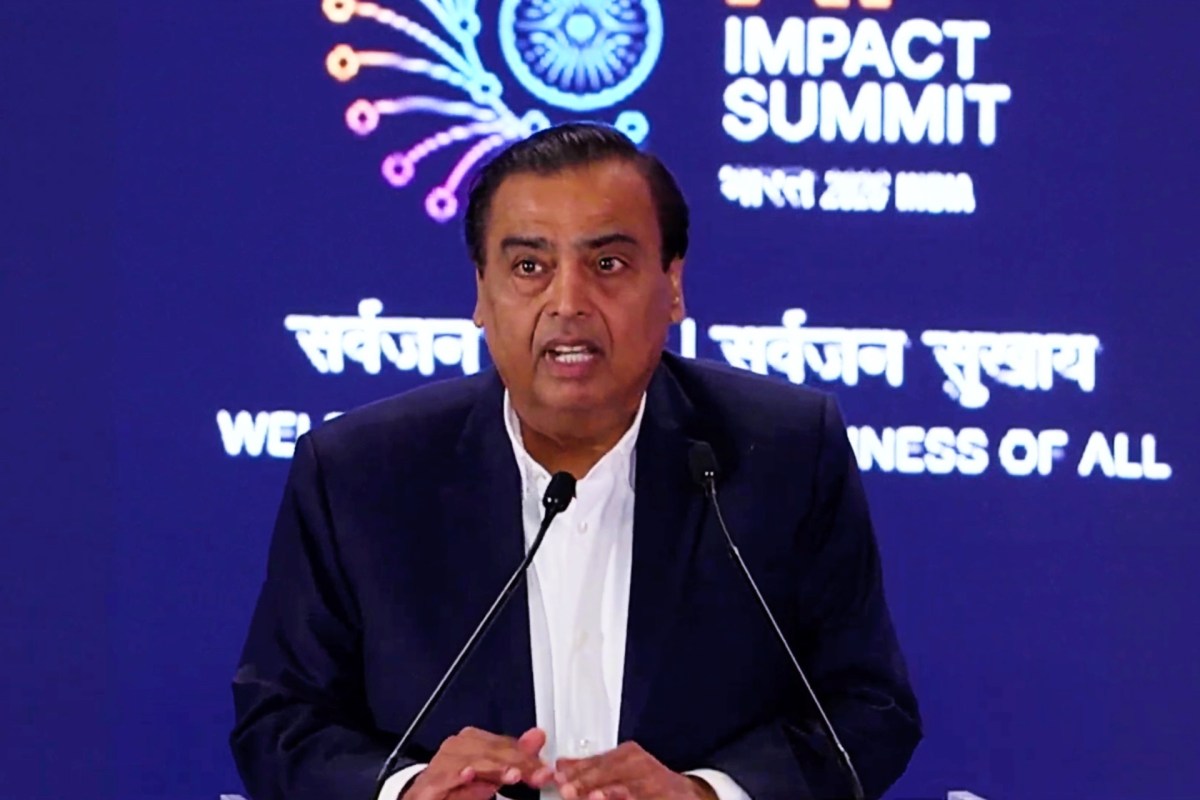
As India looks for a homegrown competitor in the global artificial intelligence race, billionaire Mukesh Ambani has positioned Reliance Industries as the domestic champion, rolling out AI services for calls, mobile apps and connected homes.
At its annual general meeting on Friday, the Mumbai-based conglomerate unveiled Jio Call Agent, an AI assistant that can join calls, transcribe conversations, create summaries, and perform tasks like booking taxis, ordering food, and making reservations. The service, which can be activated by saying ‘Hey Jio’, will be launched later this year for over 500 million Jio users.
Jio is betting that by embedding the service directly into telecom networks rather than offering it as a standalone app, AI assistance could become a native feature of calls. This approach could reduce consumers’ dependence on third-party calling assistant apps and give Reliance a strong distribution advantage in the increasingly crowded AI market.
Reliance also announced an AI-powered version of its MyJio app that can perform tasks on behalf of users, from eSIM activation to selecting roaming plans, through natural language requests. The company also introduced TeleFrame, a home display that uses AI agents to proactively display information and recommendations such as weather forecasts, schedules, and household reminders. The product appears to reflect a broader industry move toward ambient AI assistants for the home, an area that companies like Amazon and Google are exploring.

The announcement marks the next step in Reliance’s AI ambitions as India looks to build domestic capabilities in a field largely dominated by US and Chinese technology companies. The initiative follows the launch last year of Reliance Intelligence, through which the conglomerate aims to develop AI infrastructure and services for consumers, businesses and governments, including applications supporting 22 Indian languages.
“India cannot be just a consumer of AI created in other countries. India must become a creator, an adopter and a global leader in AI,” Ambani, 69, said.
Reliance has stepped up its AI ambitions through partnerships with Google, Meta, and Nvidia. Earlier this year, the company announced plans to invest $110 billion in AI infrastructure, aiming to establish itself as a key player in India’s emerging AI ecosystem.
At the general meeting, Reliance also announced a range of AI services for healthcare, education, agriculture, and small and medium-sized businesses. The products, branded JioHealthIQ, JioLearnIQ, JioKrishiIQ and AI Vyapar, work in multiple Indian languages and are designed to meet local needs, the company said.
The general meeting also marked a major development for investors who were waiting for Jio’s stock market debut. According to a stock exchange filing, Ambani said Jio Platforms’ board has approved the draft prospectus for the initial public offering, which includes a fresh issue of up to 270 million shares.
The announcement also raises questions about how Reliance will handle user data as it expands AI services into calls, mobile apps and connected homes. The company said the service operates based on user consent, but did not answer questions about whether data generated through the product could be used to train AI models or shared with technology partners.
Reliance’s AI ambitions come as Indian companies continue to rely heavily on foreign AI models and cloud providers. Recent restrictions on access to some of Anthropic’s latest models highlight that dependency and show how decisions made overseas impact startups and companies building AI products in India. This is the kind of supply chain risk that is pushing Indian conglomerates towards building their own stacks rather than renting stacks from others.
Last week, Reliance announced that it will collaborate with Mehta to set up an AI data center in the western state of Gujarat. This builds on Mehta’s previous investment in Jio Platforms and the joint venture it launched last year to develop AI solutions for enterprise customers in India and international markets.
Reliance is not alone in pursuing AI opportunities. As India’s biggest companies race to secure a leading role in the country’s AI future, Tata Consultancy Services, Infosys and rival Adani Group are also expanding their AI efforts and partnerships with global companies such as Anthropic, Google and OpenAI.
Nevertheless, the stakes are especially high for Reliance. Jio is gearing up for its long-awaited stock market debut and needs new growth engines, but the conglomerate’s share price has fallen about 17% this year.
If you buy through links in our articles, we may earn a small commission. This does not affect editorial independence.
