

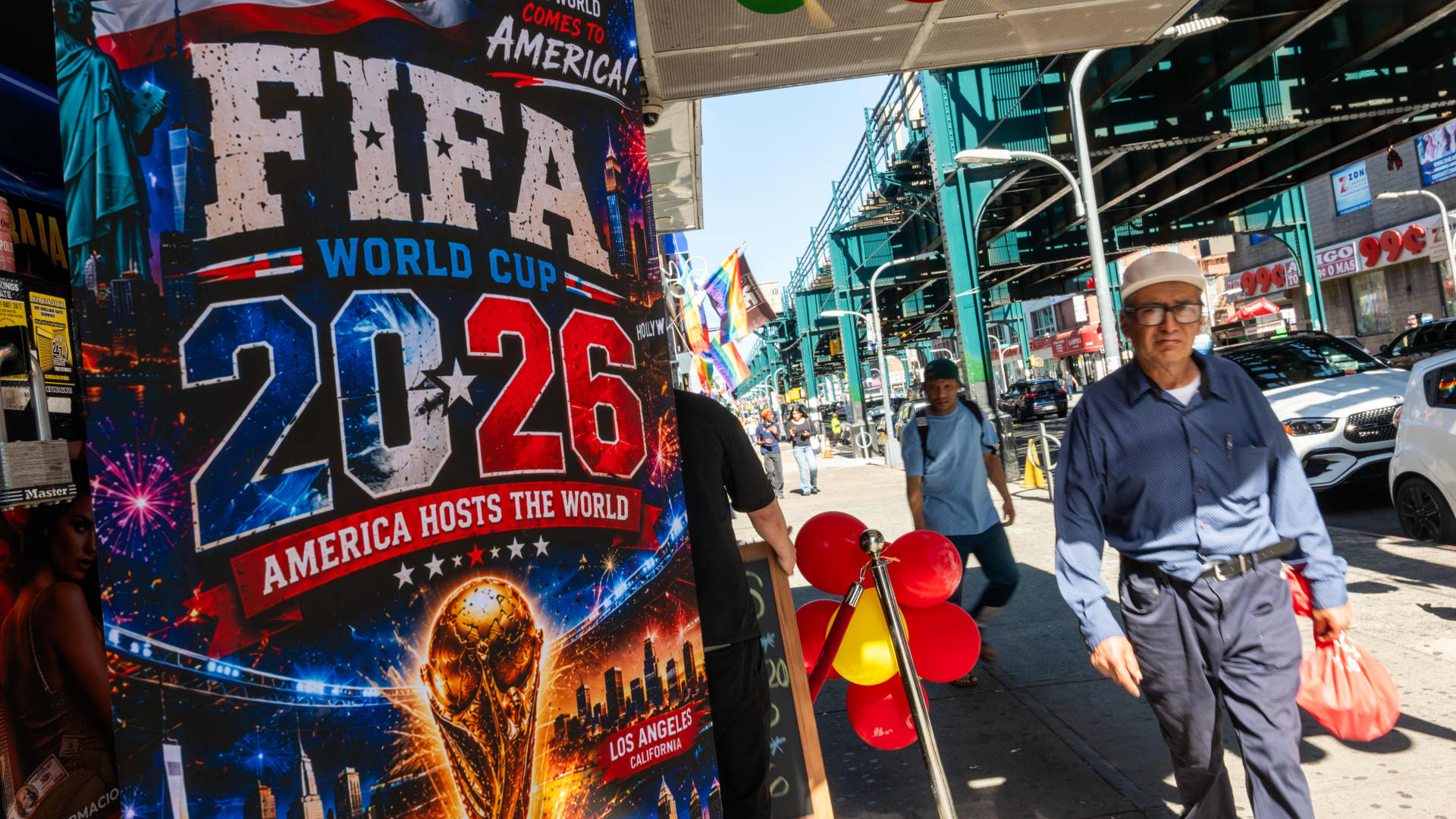

Soccer fans from around the world are expected to flock to North America for the 2026 World Cup. But the travel boom is becoming less of a uniform surge and more of a city-by-city, game-by-game test of pricing power.
“Demand is real and positive, but it’s not evenly distributed across host cities,” said Jay Wardle, president of travel data intelligence firm Sojourn.
New flight booking data released by Sojourn shows that most host cities in the U.S. and Canada have seen year-over-year increases in tournament slots, with Houston and Dallas leading the way. But all three host cities, Seattle and Mexico, are behind last year’s pace.
The tournament opens Thursday in Mexico City and runs through mid-July, ending with the final at New York’s New Jersey Stadium (also known as MetLife Stadium) in East Rutherford, New Jersey. The largest World Cup in history, 48 teams will participate and 104 games will be played in the United States, Canada and Mexico.
For hotels, restaurants, airlines, rideshare companies and host cities, the pitch is simple: more teams, more games, more fans, more spending.
FIFA estimates that the event could contribute up to $17.2 billion to U.S. GDP.
But Deutsche Bank said that even if it were to bring 1.2 million international fans to North America, the overall economic impact would likely be limited in a U.S. economy of this size, and that FIFA’s estimate would be equivalent to about a 0.05% boost to GDP in the short term.
Hotels and Airbnb
Businesses along Roosevelt Avenue prepare with flags, soccer jerseys and banners for the World Cup on June 9, 2026 in Queens, New York City.
Spencer Pratt | Getty Images
The economic benefits are likely to be unevenly distributed among cities, hotels, restaurants, and other tourism-dependent businesses.
airbnb He said he expects it to be the greatest competition in history, surpassing the 2024 Paris Olympics. The company expects to benefit from families and groups seeking more spacious accommodations and lower costs per person.
It may also benefit from the length of a traveler’s stay. More than three-quarters of World Cup travelers plan to spend six to 12 nights in their destination, according to Sojourn data.
“We look at our booking patterns going into the summer and are thinking pretty hard about the impact of FIFA.” marriott CEO Tony Capuano told CNBC. “We are seeing very strong demand patterns in both FIFA and non-FIFA cities in the United States.”
Capuano said Marriott expects the World Cup to increase U.S. revenue per available room by about 40 basis points.
Marriott, the world’s largest hotel chain, said it is particularly well-positioned because of its brand recognition and rewards ecosystem.
“We have extensive global reach, so we have extensive experience with FIFA, the Olympics, the Super Bowl, and more,” Capuano said. “The booking patterns we’re seeing are pretty much in line with our expectations.”
Capuano said the release of some of FIFA’s room blocks is expected and current bookings are “on track” with Marriott’s projections. The bigger variable, he said, is the second half of the season, with travel demand likely to change depending on which national team advances.
Jim Allen, chairman of Hard Rock International and CEO of Seminole Gaming, said he is already seeing World Cup-related momentum in South Florida. Allen said more than half of the game tickets in the Miami area are purchased by local residents, with the rest being purchased by tourists.

He said Miami’s deep ties to Latin America, along with the region’s existing tourism infrastructure and soccer culture, are helping to drive demand.
As for Hard Rock, Allen said the World Cup is already generating high-end international traffic. He said the company has guests from multiple continents, some of whom are staying at a Hard Rock property for the first time.
He also said casino play associated with the event was above normal levels and comparable to the type of activity Hard Rock sees around major events such as the Super Bowl or Formula 1.
“We are still finalizing the plan.”
Businesses along Roosevelt Avenue prepare with flags, soccer jerseys and banners for the World Cup on June 9, 2026 in Queens, New York City.
Spencer Pratt | Getty Images
Air booking data from Sojourn shows a nearly 8% increase in Miami and a similar increase in New York. Prices are up about 10% in Dallas-Fort Worth and about 13% in Houston.
But not all cities are rising equally. For example, Seattle flight bookings are down nearly 21% compared to this time last year.
Expanding the World Cup format will allow us to sell more inventory and more tickets for more games. High profile matches, matches between host countries, and finals are still expected to have premium demand. But lower-profile group-stage games played in large NFL stadiums are finding it harder to fill, especially as ticket prices remain as high as Super Bowl-level rarity.
This creates a pricing challenge. Host cities and hotel owners geared up for the once-in-a-generation event. But fans are making practical decisions about which games are worth traveling to, how far to travel, whether to stay in a hotel or short-term rental, and whether the price is still reasonable.
Rosanna Maietta, president and CEO of the American Hotel and Lodging Association, said hotel demand in host cities is “developing differently than many initially expected,” in part due to lower-than-expected international visitor numbers.
In a survey conducted by the industry group in April, 80% of respondents said their reservations did not meet their expectations. Some were furious that FIFA had canceled a large block of rooms they had previously booked.
But she said she now sees demand for AHLA members increasing, consistent with shorter booking windows for major events.
“Unlike typical leisure travel, many visitors are still finalizing their plans and securing tickets,” Maietta said. “The industry expects some acceleration in late bookings for individual games and believes stadium attendance will remain strong.”
Sojourn said that historically 35% of hotel bookings in World Cup host cities occur in the last seven days before travel.
FIFA president Gianni Infantino downplayed concerns over the disappointing results on the trip. “There should be an analysis after the World Cup is over. I’ve never seen so many requests for tickets,” he told CNBC’s Sarah Eisen on Tuesday.

Deutsche Bank said hotel real estate investment trusts with greater exposure to full-service hotels could benefit from World Cup demand as team delegations, sponsors and business groups use not only guest rooms but also meeting space and food and beverage outlets. The company typically incorporates 50 to 75 basis points of revenue per available room elevator into its tournament-related hotel REIT model. It also expects luxury hotels to benefit more than economy hotels.
Restaurants may be well-positioned to reap far-reaching benefits. Deutsche Bank said restaurant companies should benefit from both tourism and viewing parties, particularly from restaurants near stadiums and host cities, delivery-oriented concepts such as pizza and wings, and sports bars showing games during North American time zones.
Marcus Samuelsson Group CEO Derek Evans told CNBC that it’s too early to count chickens in the restaurant industry.
“I haven’t seen the fandom really take off yet,” he said. “If your country’s team starts winning, your travel budget will disappear.”
ride-sharing companies, etc. Uber and lift Pre- and post-game demand is also likely to increase.
A key question for host cities is whether there should be a price cap on the world’s biggest sporting event.
Disclosure: CNBC’s parent company, Versant, broadcasts Olympic coverage produced by NBC Sports on its networks, including USA Network and CNBC.
