

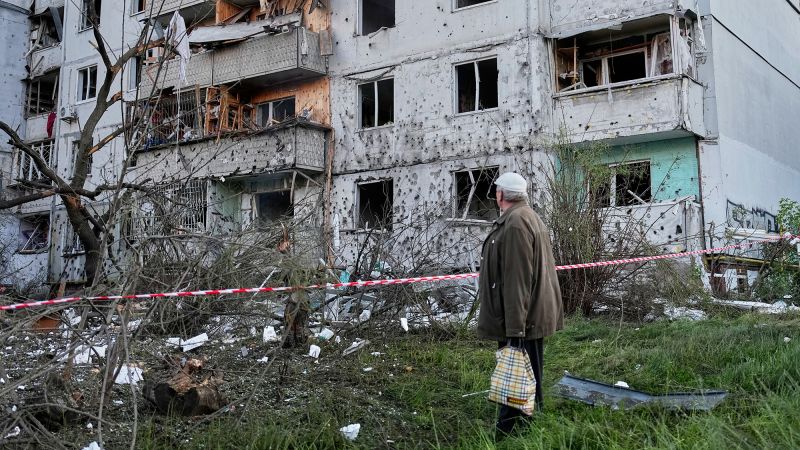
Russian airstrikes have increased enormously in recent months, hitting Ukraine with more drones and faster missiles than ever before, as the Russian military struggles to make meaningful progress on the ground.
This massive attack is designed to overwhelm Ukraine’s air defenses, with waves of cheap drones, then fast-moving ballistic missiles, then cruise missiles coming in quick succession in a series of carefully planned attacks to inflict maximum damage. Experts say the “overwhelm” approach allows more missiles to pass.
Ukrainian officials said Tuesday’s latest attack also included eight high-velocity Zircon missiles, nearly impossible to shoot down and powerful enough to destroy an aircraft carrier, the most ever used in a single attack. None of these eight hypersonic missiles were intercepted.
According to Ukrainian authorities, the barrage left 23 people dead and 151 injured across the country. Beyond their direct impact, experts say the attacks are part of Russia’s broader strategy to instill fear among ordinary people and increase public pressure on Ukrainian leaders to end the war.
A key factor in the increase in the frequency and scale of airstrikes is that “Russia is now really struggling to make any meaningful gains on the battlefield,” said Thomas Withington, an associate research fellow in military science at the Royal United Services Institute (RUSI), a UK-based think tank. In April, Ukraine actually regained more land than Russia had seized for the first time since 2024.
“What that means is that if you’re Russia… you have a weakened mechanism for putting military pressure on Ukraine,” Withington told CNN. “Given this situation on the ground, I think the use of air power may actually be the only path open to the Russian leadership right now in terms of hoping to have some strategic effect on Ukraine.”
Earlier this year, Russia was launching about 5,000 Shahed attack drones every month. That number rose to more than 8,000 last month, according to an analysis by the Center for Strategic and International Studies (CSIS), a Washington, D.C.-based think tank.
While some of these drones have passed through, causing casualties to civilians and damaging homes and infrastructure, RUSI and CSIS analysts say Ukraine’s air defenses have performed surprisingly well considering the enormity of the Russian attack. Ukraine has maintained its drone interception rate about the same as before the recent escalation, shooting down about 90% each month and using electronic warfare to keep some munitions away from populated areas.
But Ukraine has more trouble intercepting ballistic missiles and hypersonic Zircon missiles, both of which move at incredibly high speeds and require more advanced interceptor missiles to shoot down.
Tuesday’s attacks across Ukraine included 41 ballistic missiles, more than Russia launched in the entire last month. 30 of them were hits. This comes as Ukrainian President Volodymyr Zelenskiy told CBS News that given production constraints, Ukraine only acquires about 60 to 65 interceptor missiles each month.
“There are not enough missiles for the Patriot system. Too many missiles were used in the Middle East,” Ukrainian Air Force spokesman Yuriy Inat told CNN on Tuesday following heavy overnight bombing. “Another factor is how the enemy deploys its missiles, which means they use ballistic missiles, especially against areas that are not well protected from such attacks.”
Experts said that given limited defense resources, the capital Kiev, which is a key strategic target and seat of the government, is expected to be more heavily defended than other regions and less populated regions.

Still, Russian military shells that arrived on Tuesday damaged several high-rise residential and commercial buildings in Kiev, starting fires and setting cars on the streets ablaze. According to the Russian Defense Ministry, some military infrastructure was also damaged.
Perhaps alarmingly, the city’s air defense systems appeared to be less active during the final wave of Russian airstrikes on Tuesday morning, with CNN producers hearing continuous explosions but no gunshots from opposing systems.
Elsewhere in Ukraine, authorities said volleys caused numerous casualties in the city of Dnipro and also hit an energy facility in the Kharkiv region. At least one attack was a so-called “double tap” in which a Dnipropetrovsk firefighter was killed while responding to a previous wave of attacks.
Ukraine’s Supreme Commander-in-Chief Oleksandr Shirushkyi on Wednesday ordered the Ukrainian military to improve its air defense command and control system, also stressing that the country is operating in a “lack of modern air defense systems and missiles.”
President Zelenskiy has repeatedly warned that domestic stocks of the U.S.-made Patriot defense system and PAC-3 interceptor missiles are extremely limited, and reiterated his appeal to allies for additional supplies.
“To finally end this war, Europe needs its own anti-ballistic capabilities, and we absolutely need U.S. support in supplying missiles to the Patriot system,” Zelenskiy said in a statement.
RUSI’s Withington said it was natural for the Ukrainian government to continue to pressure its allies to build more interceptors, because given the level of attacks, “there will never be enough” to meet the Ukrainian government’s needs.
“There has to be a balance between what’s available, what we can actually source, and what we can manufacture,” Withington said.
Analysts have previously expressed concern that the U.S. inventory of interceptor missiles has been depleted by the Iran conflict and last year’s 12-day war between Israel and Iran, and said it would take time to build more.

Russia’s Defense Ministry said Tuesday’s “large-scale attack” targeted Ukrainian defense, military, fuel and transportation facilities in several key regions, and noted that the attack involved “high-precision long-range weapons,” including hypersonic missiles.
The Russian government also claimed the attack was in retaliation for an attack on a university dormitory in Starobilsk, in the Russian-occupied Luhansk region, in which the Russian Ministry of Defense said 21 people were killed. At the time, Ukraine announced that it had attacked Russian troops and claimed that the Russian military was solely targeting “military infrastructure.”
Despite Ukraine’s claims of retaliation for specific attacks, analysts say Russia’s large-scale airstrikes are not specifically timed in retaliation and occur regularly. They are also part of a broader, ongoing strategy to push Kiev toward surrender.
“They want to increase the pressure on the population,” said Yasir Attaran, a data fellow at CSIS. The argument is that growing fear among the Ukrainian population will increase pressure on Zelenskiy’s government to end the war on the Kremlin’s terms.
“This is what Russia is trying to do with its airstrikes,” Attaran said, referring to airstrikes that specifically target population centers and energy infrastructure. “Whenever negotiations take place, they want to settle for the more favorable option.”
CNN’s Victoria Butenko and Anna Chernova contributed reporting.
