

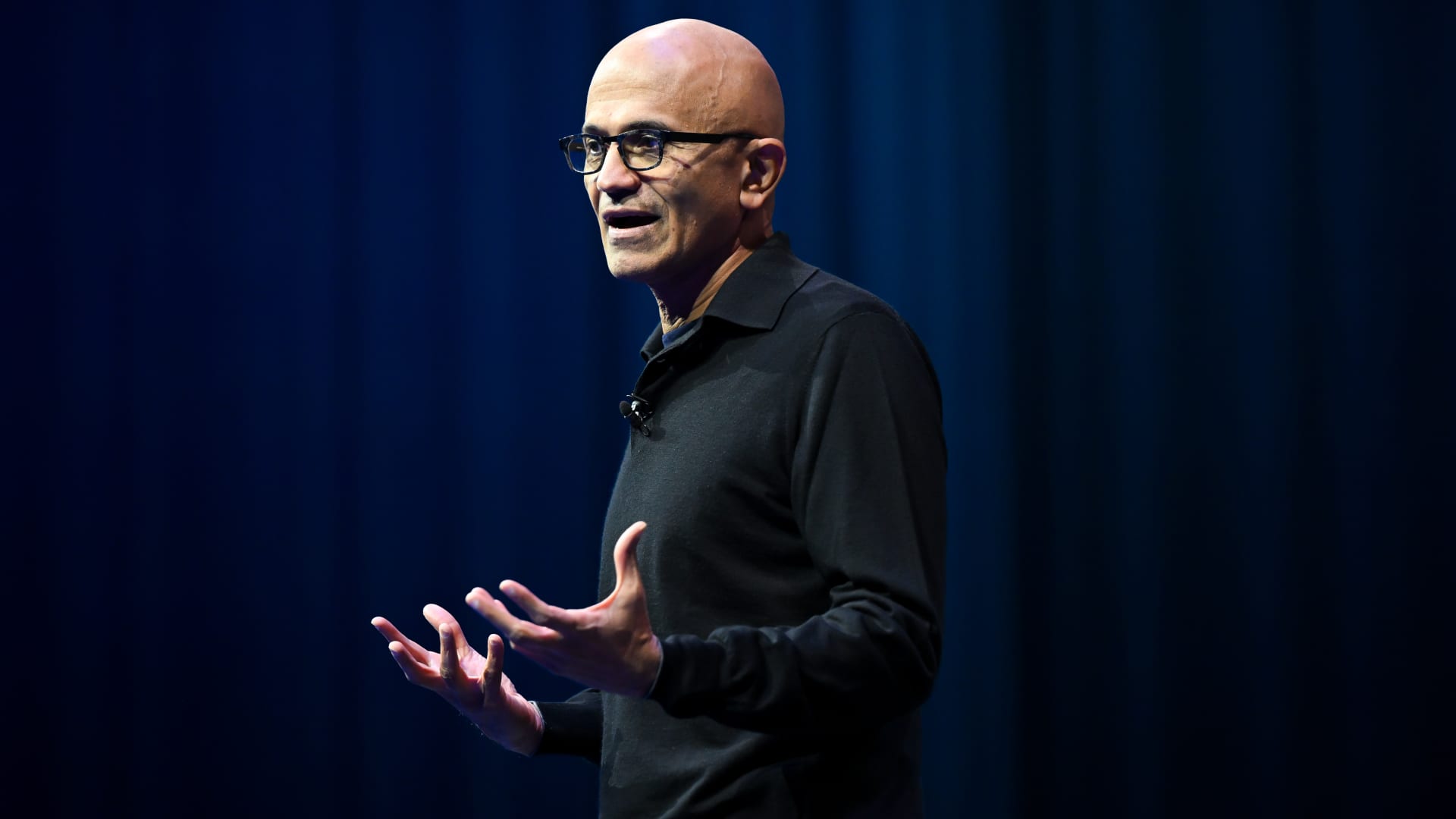
Microsoft CEO Satya Nadella speaks on stage during the Microsoft AI Tour on February 25, 2026 in Munich, Germany.
Sven Hoppe | Picture Alliance | Getty Images
In the fast-growing generative AI market, Anthropic has made strides in this space thanks in large part to its AI coding assistant, Claude Code. Seeing where the money was, OpenAI shifted much of its focus from the consumer market to the enterprise market, with its Codex offering now competing with Claude Code.
now, google and microsoft is making a concerted effort to get into the game, trying to lure developers with its huge balance sheet and expanding cloud business.
Google has put a lot of emphasis on agent AI at its developer conference last month, including announcing Antigravity 2.0, which the company said can “coordinate multiple agents to perform tasks in parallel, such as one agent coding a website while another generates brand assets.” And at the beginning of a blog post announcing Gemini 3.5 Flash, Google said the new model offers “cutting-edge performance for agents and coding.”
Microsoft will be on stage this week at the annual Build conference in San Francisco. The company plans to unveil the coding models available on Copilot there, and will emphasize its low cost compared to alternatives, said a person familiar with the plans, speaking on condition of anonymity to discuss internal matters.
The Information reported on the plan last week. Microsoft declined to comment.
As companies rapidly adopt coding assistants, market research firm Mordor Intelligence predicts that the AI coding tools market will grow 26% annually from $9.3 billion this year to about $30 billion by 2031. The numbers are big, but Google and Microsoft aren’t just looking for new revenue streams. They want developers to be able to use tools, run workloads on the cloud, and rely on models so that the models themselves can perform more training and become bigger and smarter in the process.
“It’s extremely important for these companies to compete in this market,” said Gil Luria, an analyst at DA Davidson who covers software and other tech stocks.
This is a sentiment echoed by Tomasz Tunguz, founder of Theory Ventures, who says AI coding is the most attractive market for generative AI models. He estimates that AI could eventually account for 30% to 60% of R&D spending.

In addition to Anthropic and OpenAI, companies like Cursor are also specifically targeting coding opportunities. In May, Cursor signed a deal with SpaceX that gave Elon Musk’s company the right to buy the startup for $60 billion.
The tool became so powerful that Wall Street began bailing out software stocks over concerns that products could be vibe-coded and entire companies could disappear. Anthropic announced on Thursday that it had completed a funding round at a valuation of $965 billion, more than OpenAI, and on Monday said it was privately filing for an IPO.
“AI was moving in a very consumer-centric direction, but Anthropic also started focusing on coding because we recognized that coding was going to be the frontier of AI,” Luria said. “At a time when everyone else was focused on images and videos, Anthropic realized that coding improves model performance and helps everyone else with their tasks, so now everyone is focused on coding.”
Also last week, Anthropic announced an upgrade to Claude Opus, its most advanced model for complex tasks like coding. In Opus 4.8, Anthropic announced a new 1 million token default context, increasing the amount of working memory it provides for complex coding tasks in a single conversation.
Meanwhile, Google reset Gemini’s token allocation for anti-gravity products after last week’s developer conference and raised the model’s rate limit following complaints from developers who quickly used up their initial allocation.
Also, in line with rising costs, Microsoft has started charging based on usage of its Copilot AI coding assistant.
“Every time you ask one of these tools, ‘make this,’ you’re spending a token,” said Ken Parmelee, an analyst at technology industry research firm Forrester. “This is the new gateway drug. It’s a way to get people into other products.” A token is about three-quarters of a word.
At a data analysis software company snowflakeits programmers primarily rely on the company’s proprietary CoCo development tools and Claude Code, CEO Sridhar Ramaswamy said. He said it’s not unusual for “incredibly productive engineers” to spend $50,000 a year.
In addition to Antigravity, Google has Gemini Code Assist, which can work within a variety of code editors. Last year, Google signed a $2.4 billion license deal for Windsurf’s technology and hired the AI coding startup’s CEO Varun Mohan and key researchers.
Alphabet CEO Sundar Pichai attends the Google I/O Developer Conference in Mountain View, California on May 19, 2026.
David Paul Morris | Bloomberg | Getty Images
Google CEO Sundar Pichai acknowledged his company’s coding challenges in a recent interview on the podcast Hardfork.
“I think we’re a little behind the curve right now when it comes to agent coding, which involves long-term tasks of using tools and following instructions,” Pichai said.
At Google I/O, the company promoted itself as a more affordable option for programmers, announcing a $100 monthly AI developer subscription tier.
“They can afford to distribute their tools cheaper because they know that if you’re in their ecosystem, you’ll be paying to use their memory and integrations,” Parmelee said. He added that intense competition is giving Google an opportunity to step in, calling it a “very turbulent market right now.”
“The more users we have on the platform and the more use cases we have, the better the quality of our models will be, which means the better our output will be,” Parmelee said.
Although DeepMind functions as Google’s AI lab, Luria was quick to point out that Google has a large business providing cloud infrastructure and services.
“Their job is to provide tools to businesses,” Luria said.
Customer’s choice
Even though Anthropic has a large lead and OpenAI races to catch up, users of coding tools regularly experiment with multiple options and there is little vendor lock-in. database software manufacturer Mongo DBFor example, CEO CJ Desai said the company has introduced three generative AI tools to its engineers, including Anthropic’s Claude Code.
“We use different things for different use cases,” he said. “So if we see that one thing can solve everything, of course we want to integrate it.”
MongoDB buys AI products one year at a time, rather than opting for long-term deals, Desai said.
“If Gemini comes up with something better, or Codex comes up with something better, I want to be able to use it and not make a long-term commitment, right?” he said.
Desai said AI coding tools currently represent a “small fraction of labor costs.” But he said the company would impose limits if costs rose significantly.
There is pressure on Microsoft to stay in the game. The software giant has direct access to millions of developers through its coding repository GitHub. Developers also have access to models from Anthropic, Google, and OpenAI through GitHub Copilot.
Microsoft CEO Satya Nadella (right) speaks as OpenAI CEO Sam Altman looks on at the OpenAI DevDay event in San Francisco on November 6, 2023.
Justin Sullivan | Getty Images
It is an open question whether Microsoft will simply provide all the top coding models or will also be a provider of important models.
During Microsoft’s January earnings call, finance chief Amy Hood talked about the need to balance AI infrastructure requirements across products like Azure, GitHub Copilot, and research that can drive product innovation.
Wells Fargo analyst Michael Tulin recommends buying the company’s stock, saying, “If Build can offer something that is highly proprietary to Microsoft, there is a chance that perceptions of Build will change.”
Developers will generally be attracted to the latest and most capable AI models, Tulin said.
“Microsoft will need to provide its users with some concrete use cases, not just the cost,” he said.
When GitHub Copilot launched in 2021 relying solely on OpenAI, it was a pioneer in the early AI coding space. However, with the rapid emergence of Cursor and Claude Code, that momentum has been lost.
Cursor, an AI-powered code editor, has 300 employees and is one of the fastest growing cloud software companies in history, growing annual revenue from $4 million to $2 billion in just 18 months. “I feel like people don’t know what to do with this, but it’s still a great tool,” Parmelee said of a possible deal with SpaceX.
Rob Sanfilippo, an analyst at advisory firm Directions on Microsoft, said Microsoft “may be able to truly differentiate itself by building its own model based on what it has learned about the capabilities of previous competing models. In some cases, it may end up losing much of its initial market share.”
Sanfilippo said this could be part of CEO Satya Nadella’s “plan to course correct Microsoft’s AI.”
WATCH: AI tokens or humans? A new debate to reshape corporate budgets

