

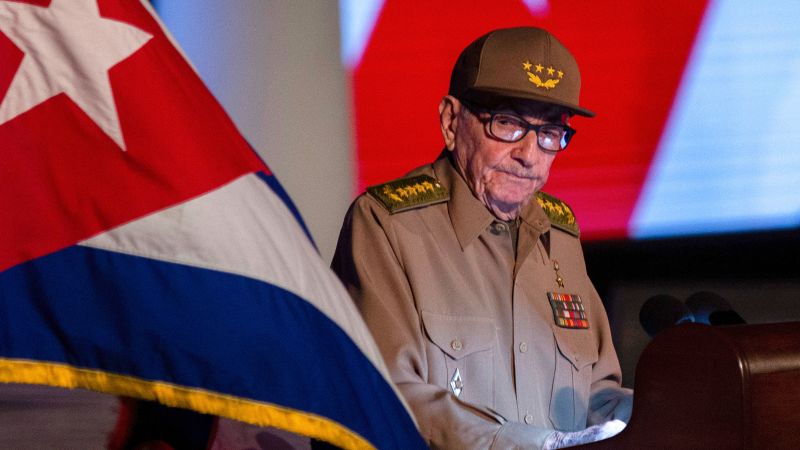
Former Cuban leader Raul Castro faces charges for his role in the downing of two commercial planes three decades ago that killed three Americans and soured relations between the United States and Cuba.
A plane belonging to the Miami-based volunteer group Brothers to the Rescue was shot down in 1996, triggering a long-standing embargo on Cuba that continues today.
Federal prosecutors are considering indicting Castro, who was the island’s defense minister at the time of the 1996 attack, sources told CNN last week. The Justice Department said it would make an announcement in Miami on Wednesday to coincide with a memorial service for those killed, but did not say what the announcement would include.
News of the possible indictments comes as the Trump administration ramps up its standoff with Cuba, increasing sanctions and imposing an oil blockade.
Here’s what you need to know about the case at the center of possible charges.
In the 1990s, Brothers to the Rescue operated regular flights to locate and assist Cubans attempting to sail to the United States.
On one such mission, on February 24, 1996, the Cuban military shot down two of its own aircraft near the Cuban coast and destroyed them with heat-seeking missiles, according to Congressional documents. Three American citizens and one U.S. resident were killed. A third brother plane escaped.
Immediately after the incident, the Cuban government accused Brothers to the Rescue of engaging in covert operations against the regime, an allegation that the United States quickly denied.
The U.S. government said the Brothers to the Rescue plane was unarmed and the volunteers on board posed no threat to the Cuban government, military or people.
On Tuesday, the Cuban embassy in the United States told X that the “violation of Cuban airspace” was not an isolated incident, but one of “more than 25 serious, intentional and systematic violations.”
“These were not miscalculations, but rather ongoing operations that endangered international aviation security,” the embassy said.
Brothers to the Rescue, now defunct, has described itself in the past as a pro-democracy humanitarian organization dedicated to using non-violent means to help the Cuban people free themselves from dictatorship.
The volunteer activist group was founded in May 1991 by dissident Cuban exile José Basulto and was made up of Cuban-American pilots who were on board the fleeing plane, which departed from a Miami-area airport. The group said the effort began after Gregoria Pérez Ricardo, a Cuban teenager who fled the communist-controlled island, died of severe dehydration while crossing the Florida Strait.

They also distributed leaflets in Cuba criticizing the communist government of former revolutionary leader Fidel Castro, who made Cuba the first communist country in the Western Hemisphere and played a central role in the Cold War.
Arbitrary arrests, brutal repression of dissidents, beatings, intimidation and surveillance were common during Fidel Castro’s dictatorship. Many of those trying to flee the island, some on makeshift rafts, are unlikely to survive the perilous journey across the Florida Straits.
The U.S. government immediately condemned the downing of the two planes, and days later, President Bill Clinton signed the Cuban Freedom and Democratic Solidarity (LIBERTAD) Act, also known as the Helms-Burton Act.
This law strengthens sanctions against Cuba and remains the basis of the U.S. embargo against Cuba. This law required an act of Congress to lift some of the embargoes on Cuba. Under the law, visas would be denied to anyone using or profiting from Cuban property, as well as Cuban government officials and Communist Party members.

The law also prohibited the U.S. president from lifting trade restrictions on Caribbean countries until he legalized political activity and committed to free and fair elections. It also prevented the United States from lifting sanctions on Fidel Castro or his brother and successor Raul Castro while they were members of Cuba’s government.
“The response chosen by Fidel Castro, the use of deadly force, is completely inappropriate to the situation presented to the Cuban government, and such an act is a blatant and barbarous violation of international law, tantamount to cold-blooded murder,” Congress said at the time, calling it a “premeditated act” that followed a major crackdown on the island’s coalition of pro-democracy rights groups.
The 1996 law also allows the President of the United States, under certain conditions, to support and assist NGOs and individuals in democracy-building efforts.
U.S. Ambassador to the United Nations Madeleine Albright criticized Cuban pilots who used the Spanish word for testicles on the radio to congratulate themselves after shooting down their plane. “Frankly, this is not Cohones,” she said. “This is cowardly.”
Fidel Castro accepted responsibility for the incident and said he had ordered the military to shoot down planes violating Cuba’s airspace. The United States claims the plane was shot down in international airspace.
Bruno Rodríguez Parrilla, Cuba’s representative on the UN Security Council at the time, said Cuba had proven that the two planes were in Cuban airspace, and that Cuban authorities had issued warnings, including shaking the wings, before they were shot down, but that they had been ignored.
Days after the shooting, then-Cuban Foreign Minister Roberto Lobaina Gonzalez told the United Nations General Assembly that Brothers to the Rescue had plans to harm Cuba, including sabotaging oil refineries and targeting Cuban leaders.
“Today, we are asking this Congress whether the sovereignty of nations to protect their borders and national security is the prerogative of great powers and not of small, poor nations,” he said.
The FBI later discovered that Cuban agents had infiltrated the exile group and provided information to the Cuban government, including information about Brothers to the Rescue’s ill-fated February 24 mission. Five Cuban spies were arrested in 1998 and later convicted of spying on prominent Cuban-American exile leaders and U.S. military bases.
U.S. President Barack Obama released them during his presidential term in a deal to restore relations with Cuba, and Havana released State Department contractor Alan Gross.
Cuban exiles and regime critics like Basurto immediately called for justice after the incident, demanding that Fidel Castro be prosecuted. Despite Fidel Castro’s death in 2016, many Cuban Americans still feel that way.
Cuban-American Republican lawmakers have since been pressuring the Justice Department to indict Raul Castro. In a February letter to then-Attorney General Pam Bondi, lawmakers, including Rep. Mario Diaz-Balato, urged the Justice Department to prosecute Raul Castro, citing evidence such as reports of recordings of radio communications showing he ordered the shooting.
But some Cubans support the government’s actions decades ago, arguing that this is a matter of national security and that Raul Castro should not be punished for it.
“No matter how you look at it, it was an invasion. We have to protect ourselves, because if we had known that the planes were going to go over the Twin Towers and be sabotaged, we would have shot them down,” Havana resident Eliecer Díaz told Reuters. “I think that makes sense. Cuba did the right thing.”
