

Today, many companies simply offer AI as chatbots within their apps. You can type (or dictate) what you want the AI to do, and the AI bot will try to do it for you. Still, the experience tends to feel clunky. A text-based UI doesn’t always provide a smooth experience, for example if you want to use a travel app to book an entire itinerary, but you have to read through a lot of text.
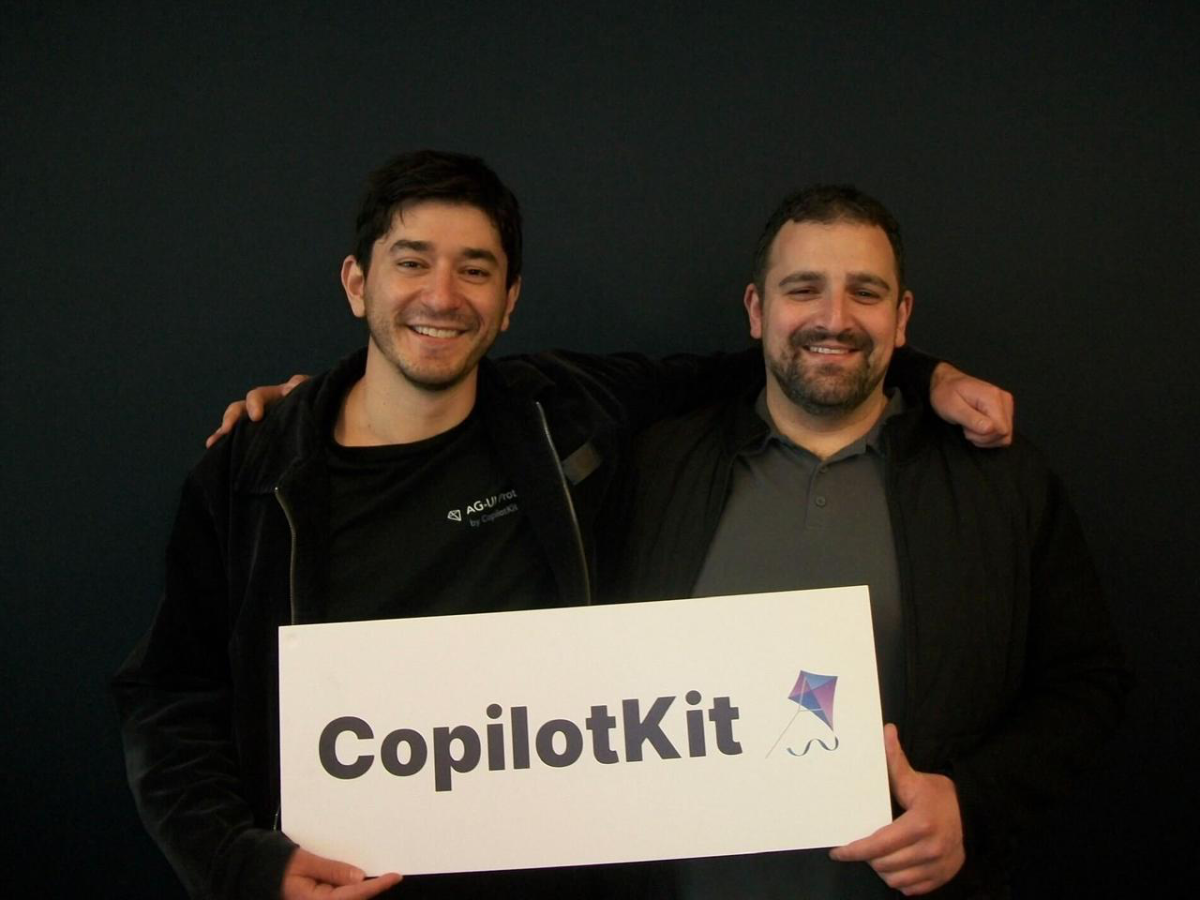
According to CopilotKit’s founders, that approach doesn’t take full advantage of the capabilities of AI agents and LLM. The company’s co-founders, Atai Barkai (pictured above, right) and Uli Barkai (pictured above, left), believe that the way forward is for agents to reside within the application, understand what the user is doing, take action, and present a useful interface rather than just returning a long block of text.
The company’s popular AG-UI protocol targets the first part of its solution. Widely adopted open-source protocols standardize how AI agents connect and communicate with user interfaces (such as web browsers and apps), providing capabilities such as streaming chat, invoking front-end tools, and state sharing to enable human-involved functionality. Essentially, AG-UI provides developers with the framework and tools they need to deploy AI agents within their apps.
CopilotKit is also building an enterprise toolkit on top of AG-UI, adding support, self-hosted deployment capabilities, and other must-have products for companies looking to incorporate agents into their products. To bring its toolkit to market, the Seattle-based startup has raised $27 million in a Series A round led by Glilot Capital, NFX and SignalFire, TechCrunch has learned exclusively.
The flexible user interface is a particular selling point. CEO Atai Barkai told TechCrunch that developers can use the startup’s framework to provide specifications and building blocks for dynamic user interfaces, which the AI agent can then use to generate UIs tailored to the context.
“Agents can respond not only with blocks of text, but also with an interactive UI defined by the company,” Atai explained. “For example, if a user asks for a breakdown of revenue by category, instead of showing these big, hard-to-understand paragraphs, they see a pie chart. This is a unique pie chart design that the user can interact with (…) So any agent can very easily talk to the UI and use a catalog of these components to display it to the user.”
Atai also said that CopilotKit’s toolkit gives developers full control over how much the AI agent can change the UI, choosing whether to make the interface “pixel perfect” or just provide a wide range of building blocks that the AI can combine as needed.
tech crunch event
San Francisco, California
|
October 13-15, 2026
This funding comes after a period of strong adoption for both AG-UI and CopilotKit. The protocol works in parallel with the widely adopted Model Context Protocol (MCP) and Agent2Agent (A2A) protocols and is currently supported by major AI infrastructure providers such as Google, Microsoft, Amazon, and Oracle, as well as popular frameworks such as LangChain, Mastra, PydanticAI, and Agno.
Atai said CopilotKit and AG-UI (the company’s strongest claims for ecosystem relevance) are installed millions of times a week, and the majority of Fortune 500 companies use the protocol and the startup’s tools in production. CopilotKit, on the other hand, counts enterprise giants such as Deutsche Telekom, DocuSign, Cisco, and S&P Global among its enterprise customers.
To capitalize on this increased interest, the company is also launching CopilotKit Enterprise Intelligence, a self-hosted product that bundles a number of infrastructure features to fully deploy agents within apps.
CopilotKit faces intense competition in the enterprise agent tools market. Cloud platform Vercel’s open-source AI SDK helps developers build AI applications with similar functionality, and Assistant-ui provides components for building AI chat interfaces. On the other hand, OpenAI’s Apps SDK is also an option for building richer interfaces, albeit only within ChatGPT.
Atai argues that CopilotKit is different from these products because it takes a horizontal enterprise approach rather than a vertically integrated approach. Rather than providing a full-stack AI platform, CopilotKit aims to support the agent frameworks, cloud providers, and backends that enterprises are already using.
“If there are two things you hear in almost every conversation in enterprises, they want optionality and they want self-hosting,” he said. “Maybe they’re already using a Google, Amazon, Oracle, Microsoft, LangChain, Mastra stack. They want optionality, they want self-hosting, and those two things you don’t really get with the Vercel stack.”
Maintaining this open positioning will be important. Companies that build on their own open source infrastructure often face the tension of wanting their technology to remain standard-neutral, but needing to build their business on top of it. But Atai said AG-UI is a completely open protocol, and CopilotKit’s commercial products are meant to enhance, not replace, open source stacks for enterprises.
“They are very complementary. Our strategy is to become the default choice in the ecosystem and then monetize the top companies,” added Uri, the startup’s head of growth. “So it’s really interesting to us that open source is the best thing out there and that 95% of users can just build and start using it without paying anyone or consulting anyone.”
The company currently has approximately 25 employees and plans to use the new funding to grow its team.
If you buy through links in our articles, we may earn a small commission. This does not affect editorial independence.
