

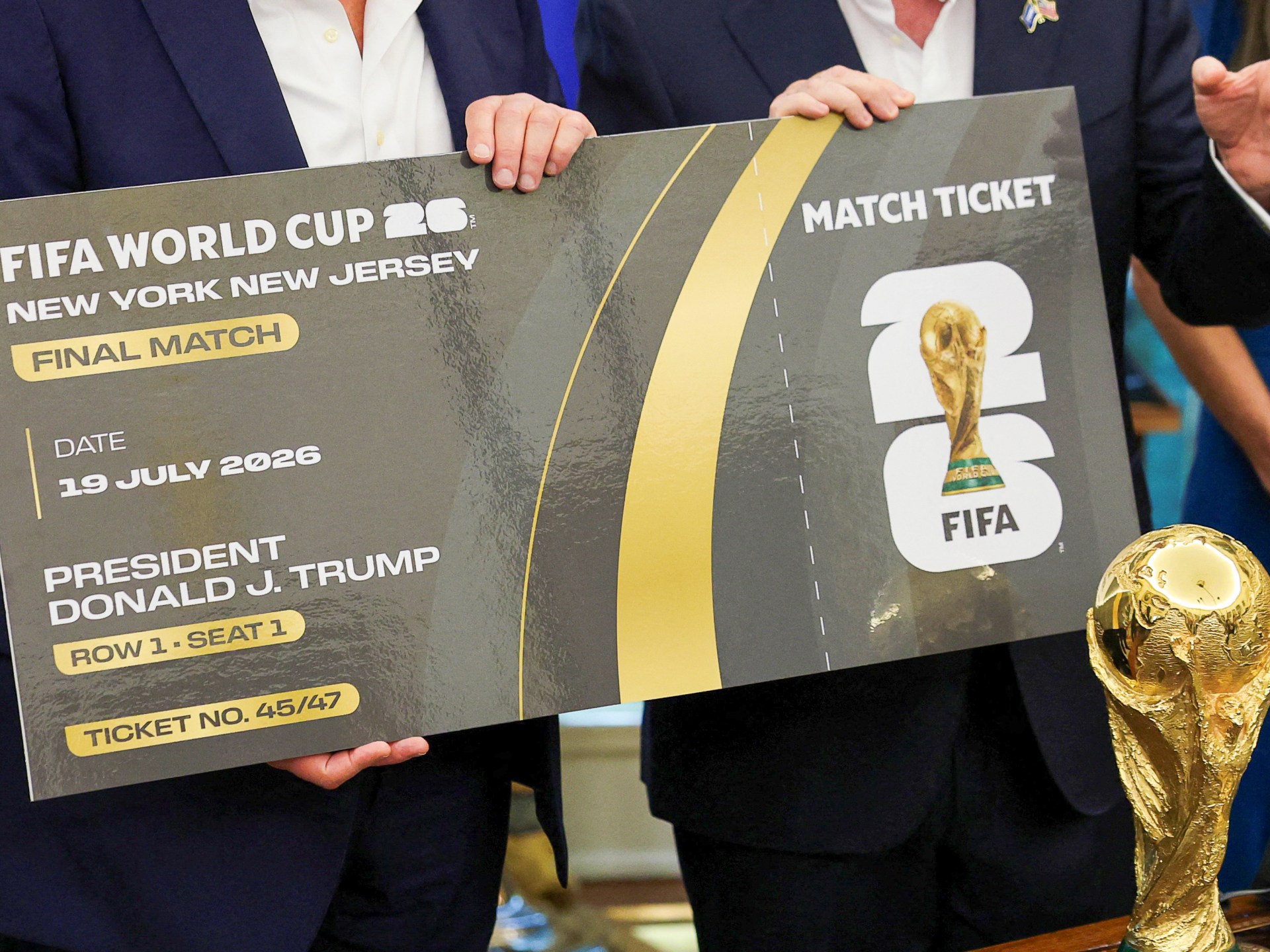
FIFA’s decision to release the latest tranche of World Cup tickets to coincide with the 50-day countdown mark to the tournament has left fans more frustrated than excited ahead of the world’s biggest sporting event.
Football’s world governing body announced yet another “final stage of ticketing” on Wednesday, with tickets for all 104 games available on a first-come, first-served basis. Tickets are also available for purchase in the three previously published categories, as well as a new “Front Category” pricing added this month.
Recommended stories
list of 3 itemsend of list
Fans have expressed anger at the exorbitant prices for matches (the most expensive ticket for the final is around $11,000) since the first phase of ticket sales in December, and the latest round has left them questioning whether FIFA’s “dynamic ticket sales” are to blame for pricing and seat availability at the most popular sporting event.
Here’s what we know about ticket prices for the World Cup, co-hosted by Canada, Mexico and the United States.
Why has FIFA restarted World Cup ticket sales?
Ostensibly, FIFA has a large amount of unsold tickets in the bank despite the past four sales periods and is hoping those tickets will be sold out between now and match day.
The international body has repeatedly maintained that the record of 3.5 million cumulative attendance set at the 1994 World Cup, hosted by the United States, is likely to be surpassed during this year’s tournament, but unplanned stage five ticket sales appear to suggest otherwise.
The unexpected release calls into question its ticket sales strategy, as FIFA previously said the April 1 phase would be the “fourth and final” phase and would remain open until the end of the tournament.
However, a FIFA spokesperson said in a comment to Al Jazeera: “This ticket sale is part of an ongoing last-minute sales phase that will continue until the end of the tournament and will allow the public to purchase tickets on a first-come, first-served basis through FIFA.com/tickets.”
“In addition to this set of tickets, additional tickets will also be continuously made available to the public until the final on Sunday, July 19 (subject to availability),” a spokesperson told Al Jazeera.
Why is FIFA struggling to sell tickets?
The most obvious answer would be that fans aren’t buying tickets because they’re significantly more expensive than promised.
Football Supporters Europe (FSE) announced last month that its bid in North America initially promised tickets from as low as $21. Instead, the cheapest tickets, priced at $60, are limited. These tickets are allocated to a small percentage of tournament venues, and new price tiers were introduced in December following an immediate backlash against the high prices.
FIFA dismissed suggestions that lack of interest and “pricing” were to blame for the poor sales.
“Ticket sales for the FIFA World Cup continue to be strong, with high interest in all matches,” the spokesperson said.

What is the price range for World Cup tickets?
When tickets first went on sale in December, prices ranged from $140 for Category 3 to $8,680 for the final.
When sales resumed on April 1, the price was increased to up to $10,990, nearly seven times the $1,550 maximum price originally set when North America bid for the rights to host the tournament.
Why are tickets for this World Cup so expensive?
Experts have linked pricing to multiple factors, the biggest being the fact that 78 of the 104 games have been allocated to the United States.
“One of the main reasons the World Cup is held in the United States is because it offers a potential revenue-generating opportunity,” Simon Chadwick, professor of African and Eurasian sports at Emlion Business School in Shanghai, explained to Al Jazeera.
FIFA is tapping into what Chadwick calls a “mature” market, where “consumers are more likely to spend on sports, and premium pricing and enterprise segments are part of that.”
Sports industry experts believe that FIFA is utilizing a “dynamic ticket pricing model” that has been used in the United States for several years.
“(U.S.) sports consumers are accustomed to real-time adjustments in ticket prices, which can result in admission prices rising or falling,” he said.
Chadwick explained, “When used in conjunction with a premium pricing strategy, dynamic ticket sales are clearly a revenue-generating attempt as FIFA looks to maximize revenue from this summer’s tournaments.”
“The problem is that such an approach may exclude some fans from the market, which in turn attracts fans with more affluent socio-demographics.”
Features. “
What is World Cup Dynamic Ticketing?
Dynamic ticketing (also known as dynamic pricing) is a sales strategy where ticket prices are not fixed. Rather, it fluctuates in real time based on demand, supply, and timing.
There has been a lot of criticism about ticket prices, and a group of U.S. lawmakers last month called on FIFA to lower costs, saying the use of dynamic pricing makes the World Cup an exclusionary operation at the expense of fans, according to Reuters.
According to Reuters, FIFA also said it is using variable pricing, which adjusts ticket prices based on reviews of demand and availability, rather than dynamic pricing, which changes ticket prices automatically.
The variable pricing method was used in the first two stages of the sale: the Visa presale lottery and the early lottery. It was not used for the third stage random draw and PMA ticket sales, but is now being used again for the last minute sales stage.
Will FIFA be able to sell out all World Cup tickets?
Chadwick, who has written several books on the economics and politics of sports, believes sold-out tickets may not be a problem for FIFA.
“In theory, there should be no unsold tickets, because the logic of real-time dynamic pricing is that market conditions would require a price reduction, which would result in all tickets being sold,” he said.
“However, the reality may actually be somewhat different. Markets don’t always work in a perfect and predictable manner. In fact, some fans may become exasperated by the initial premium pricing strategy and withdraw from the market altogether.”
“In this regard, FIFA has rolled the dice on the effectiveness of dynamic ticket pricing, a bet that the organization does not necessarily win.”
How does the price compare to past World Cups?
Ticket prices for the Qatar 2022 World Cup finals were around $1,604 for the most expensive seats, 46% higher than the $1,100 price tag for the 2018 Russia finals. Ticket prices for this year’s finals are approximately $11,000, an astronomical increase compared to the previous two.
The cheapest seats on general sale for overseas fans attending the 2022 World Cup opener against Qatar are $302, up from $220 in Russia. By comparison, FIFA’s December ticket sales list prices for the U.S. opener against Paraguay on June 12 as $1,120, $1,940 and $2,735.
Despite the game being touted as the third-expensive game of the tournament, ticket sales are lagging behind the game in Inglewood, California, The Athletic reported Tuesday.
According to the paper, a document dated April 10 distributed to local organizers said 40,934 tickets had been purchased for the April 15 game between the United States and Paraguay, and 50,661 tickets had been purchased for the game between Iran and New Zealand.
What does FIFA say about ticket prices?
FIFA president Gianni Infantino has defended the high ticket prices for this year’s World Cup, saying the event is FIFA’s only quadrennial source of income.
He also reiterated that FIFA is a non-profit organization with 211 member countries and is supported by the revenue FIFA generates from such tournaments.
What are fans saying about ticket prices?
Fans have taken to social media to air their frustrations over pricing as well as technical issues with FIFA’s official ticketing platform. Potential buyers said they waited in line for hours before being met with error messages or being told tickets were sold out.
Some have accused FIFA of “ruining the sport” by “buying off many genuine fans for a price”.
One user, who appears to be from the US, compared the price of a ticket to the World Cup to flying all the way to Europe to watch a Premier League game.
