

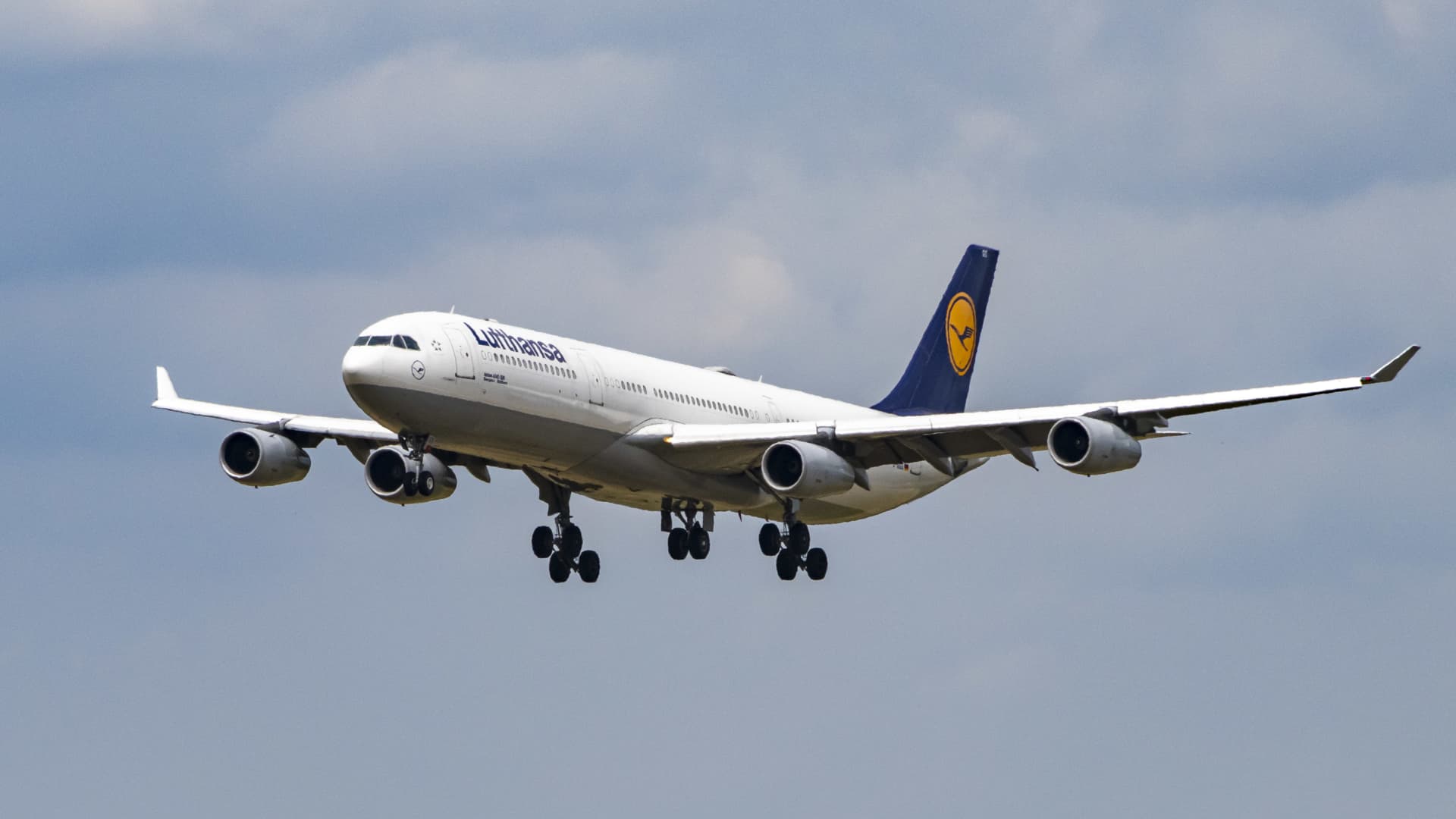
A Lufthansa Airbus A340 passenger plane lands at Eindhoven Airport EIN on a rare charter flight arriving from Athens, Greece.
Nicholas Economou | Null Photo | Getty Images
Europe’s airport industry has warned that a jet fuel shortage could occur within three weeks, disrupting summer travel and having a “significant” negative impact on Europe’s economy.
ACI Europe, which represents airports across the European Union, said on Thursday that the supply shortage was disrupting airport operations and air connectivity.
In a letter to the EU’s Sustainable Transport and Tourism Commissioner Apostolos Tsitzikostas, shared with CNBC, the industry group warned of the “harsh economic impact” of fuel shortages on Europe’s economy.
“At this stage, we understand that unless there is a significant and stable resumption of navigation in the Strait of Hormuz within the next three weeks, a general jet fuel shortage will become a reality for the EU,” the letter said.
ACI Europe said the potential shortage was particularly concerning ahead of the “summer peak season” when many EU countries rely on economic stimulus from increased air travel. The group says air connectivity generates 851 billion euros (about $1 trillion) in GDP for the European economy and supports 14 million jobs.
“As a result, it is imperative that the EU prioritizes the availability and security of jet fuel supplies as part of its response to the oil and energy crisis triggered by the Middle East conflict,” it added.

The war between the United States and Israel against Iran, which began on February 28, has virtually halted traffic in the Strait of Hormuz, pushed oil prices to more than $100 per barrel, and increased energy costs.
Airlines were immediately affected by the jump in jet fuel prices, which rose 103% month-over-month in March, according to the International Air Transport Association.
The price of jet fuel in the United States nearly doubled from $2.50 per gallon on February 27th to $4.88 per gallon on April 2nd.
The United States on Tuesday reached a two-week cease-fire deal with Iran in exchange for Iran allowing shipping through the Strait of Hormuz, but the vital passage remains effectively closed. Before the war began, about 20% of the world’s oil passed through the Strait.
U.S. West Texas Intermediate crude rose 0.4% to $98.27 per barrel after rising above $100 in early trade, while Brent crude was nearly flat at $96.02 per barrel.
Airlines have implemented several measures to combat rising jet fuel costs. Lufthansa’s Chief Executive Carsten Spohr told employees last week that the German airline was forming a team to create a contingency plan for the Middle East war. This may include grounding some aircraft.
Scandinavian airline SAS will cancel 1,000 flights in April, while Ryanair chief executive Michael O’Leary said the Irish carrier would have to consider canceling some flights and reducing capacity over the summer if fuel shortages continued.
