

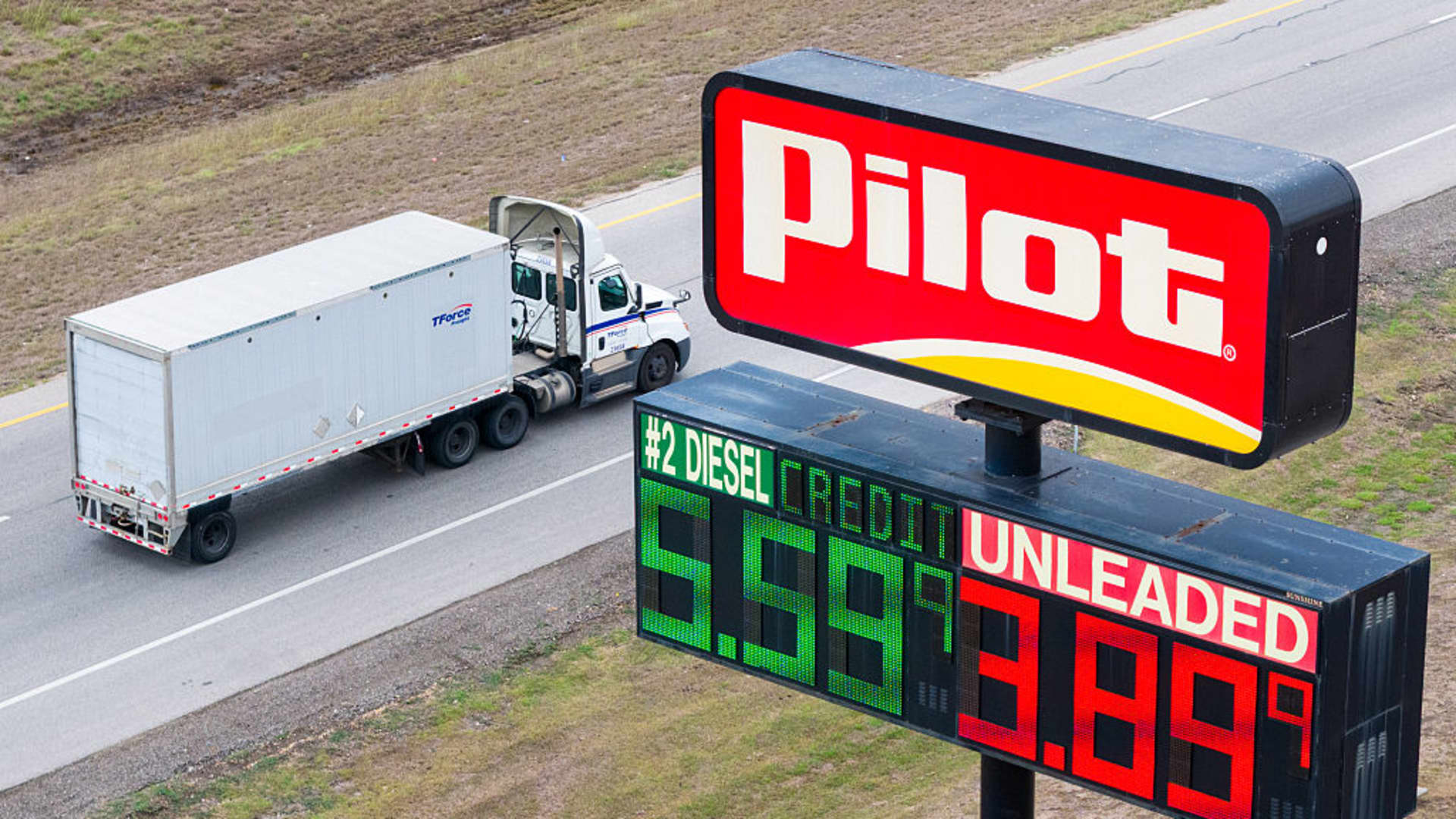
Pilot Travel Center Gas and Diesel prices near Highways in Lockhart, TX on April 2, 2026. oil
Brandon Bell | Getty Images News | Getty Images
Nick Friedman, co-founder of Tampa-based College Hunks Hauling Junk and Moving, says his business faces multiple headwinds. High mortgage rates are slowing the real estate market, while rising insurance premiums are putting pressure on operating costs. Currently, the war between the US and Iran and soaring diesel fuel prices are putting pressure on profit margins. But he doesn’t feel he can raise prices.
“We’re in a bit of a Catch-22,” Friedman said. “Our concern is that if we start raising prices, we’re going to hurt our customers.”
He said larger companies could probably get away with adding fees. Rapidly rising fuel costs are rippled through the American economy, and that’s exactly what some people are doing.
United Airlines and JetBlue increased baggage fees this week. Amazon has announced that it will impose a 3.5% “fuel surcharge” on sellers.
Amazon said in a statement to CNBC that the surcharge is “significantly lower” than the surcharges applied by other major carriers. JetBlue said that as operating costs rise, it “regularly evaluates ways to manage these costs while keeping our base fares competitive and continuing to invest in experiences that drive value for our customers.”
For Friedman, that assessment is not easy. “If you have to fly, you have to fly,” he said.
But while Friedman’s moving company is considering raising prices, “I don’t know if we can afford that luxury,” he said. Customers can choose to trade down to a cheaper and perhaps less protected moving service, or they can round up buddies with pickup trucks to help with the move, leaving Hank’s 2,000-truck fleet increasingly idle. But filling up your truck with gas is also expensive.
Historically, fuel costs accounted for 3% to 5% of revenue as an expense item, Friedman said, but since the war began, that has doubled to 6% to 10%. “From a business perspective, it’s very difficult,” Friedman said. Hunks operates on a franchise model with over 200 stores, leaving many franchisees in a precarious position.

WTI crude oil price from 2026 to present.
Friedman’s business is exposed to a unique war because it relies on trucking, but rising prices for diesel and jet fuel are about to hit even more companies.
“Discretionary spending is typically the beginning of the cycle. Consumers exit discretionary spending first,” said Daken Vanderburgh, chief investment officer at MassMutual Wealth.
Vanderburgh said higher energy prices affect so many goods and services that they act as a tax on consumers. If the war and its disruptions are short-lived, consumers will dip into their savings and ride out the high costs. However, if the dispute drags on, consumers will likely refrain from taking action. “It slows growth and hurts spending, but the impact is very quick,” Vanderburgh said.
Many market participants had hoped that President Donald Trump’s address to the nation earlier this week would outline an end to the war, but the president’s comments left the timeline uncertain, and markets were spooked.
Unlike past economic shocks to the system, such as the Great Recession or the coronavirus, governments will have fewer tools available to cushion the blow to businesses and consumers. “Policy is unlikely to be as supportive as it was during the coronavirus era,” Vanderburgh said.
The Fed is in its own quandary. The central bank has not indicated it is any more likely to cut interest rates to stimulate the economy, given the risk of pushing up inflation. In fact, the market has recently been expecting the Fed to be more likely to raise interest rates given the rise in oil prices. But Fed Chairman Jerome Powell also said this week that he saw no reason to consider raising rates, noting that short-term oil shocks are a factor that central banks typically avoid when analyzing inflation, and that longer-term inflation expectations remain firmly stable.
full price shock
The U.S. economy is supported more by consumer spending than the economies of many other countries, with nearly two-thirds of the economy supported by consumers. Where those dollars go will determine the fate of the economy, Vanderburgh said. Although the economy was slowing before the war started, there is one buffer for American consumers, who are far less reliant on imported oil than they were during the oil crisis of the 1970s, he said. But the cushion only cushions the impact, he added.
“This is heading for continued and worsening cost pressures across all fuel-related industries, virtually all industries,” said Herman Neuwort, president of IFS Energy & Resources.
Nieuwoudt says what we’re seeing now is not a single price shock.
“This is the result of six years of structural instability, combined with the largest energy supply disruption in modern history,” he said. “These disruptions will cascade through manufacturing, packaging, agriculture, transportation and retail, and will take months to fully materialize,” he added.

Costs will rise across the board, but companies that can foresee upcoming disruptions, adapt their operations in real time, and make faster decisions about where to allocate resources will weather this situation much better than those still running quarterly planning cycles. But he added that companies that rely purely on surcharges without addressing their own operational efficiencies are probably taking advantage of borrowed time two or three quarters before customers or competitors force them to do the math.
Pump pain is the first thing for consumers, but that’s just the beginning, Nieuwout said. There will be gradual increases in costs such as airfare, food, transportation, and manufactured goods.
Economists say the existing K-shaped economy is on the cusp of a twin phenomenon, with consumer staples (airlines, auto repair) and big companies (JetBlue, Amazon) gaining more freedom to raise prices, while small businesses and discretionary services are caught between raising prices, losing customers, or sacrificing profits to keep prices down.
The rise in airfares is not surprising. Delta CEO Ed Bastian told CNBC a few weeks ago that given current demand, the airline has room to raise fares in response to rising oil prices if necessary. “Despite the war continuing, our revenue and bookings are up 25% year over year,” Bastian said. In early March, United Airlines CEO Scott Kirby told CNBC that airfares would likely rise to compensate for rising fuel costs.

“U.S. consumers are resilient, and the current situation is no different,” said Federico Bandi, a professor of economics and finance at Johns Hopkins Carey Business School.
Other brands may not be as fortunate in demand and pricing momentum as airlines. Mr. Bundy said there has been a shift from discretionary spending to essentials, and even among essentials, the shift from branded to generic products is accelerating.
“A prolonged period of equilibrium in which companies seek to pass on abnormally high energy costs (or prevailing tariffs) to consumers is not sustainable. The persistence of the current shock, and the readiness of companies to readjust prices when costs return to some degree of normality, will be central to consumer confidence and future decision-making,” he said.
Fernando Lozano, an economics professor at Pomona College, concluded that “patience is very short” and consumers will have little tolerance for new rates, citing economic vulnerabilities due to import tariffs, government shutdowns and rising health care costs.
The economic climate of the shipping industry could be a big test, and consumers may have to choose which is more important: paying more for faster service or waiting for orders and saving money.
“We see the end of the ‘fast and free’ shipping era as the default expectation. The current disruption is forcing a reset, and what is emerging is a model based on choice and value,” said Josh Steinitz, chief strategy officer at shipping and fulfillment software company Auctane. Steinitz says the current crisis is prompting both businesses and consumers to rethink the true cost and value of getting products delivered to their doorsteps.
The United States Postal Service required an 8% surcharge for parcel and expedited delivery.
According to Steinitz, the best way to think of fuel surcharges is as a “floating tax” on shipping.
“This helps carriers manage unpredictable oil prices, but for small businesses it feels like every package they send creates a new, unavoidable cost,” Steinitz said. In contrast to the stability it provides carriers, “when small business owners look at the charges on their bills, it feels less like a shock absorber and more like a direct financial impact that they can’t control,” he said.
This leaves business owners and consumers in a bind.
Friedman thinks wistfully of the days when he and his friends started Hanks in an old cargo van at the dawn of the Great Recession. “At that point, we were a scrappy startup, so we had to be resourceful and gritty,” Friedman said. He said the company will have to rely on some of the same spirit going forward, but that things feel different at the moment because 2,000 trucks need to be refueled and there is less room to change margins and pricing. “It’s putting everyone in a pinch,” he said.
