

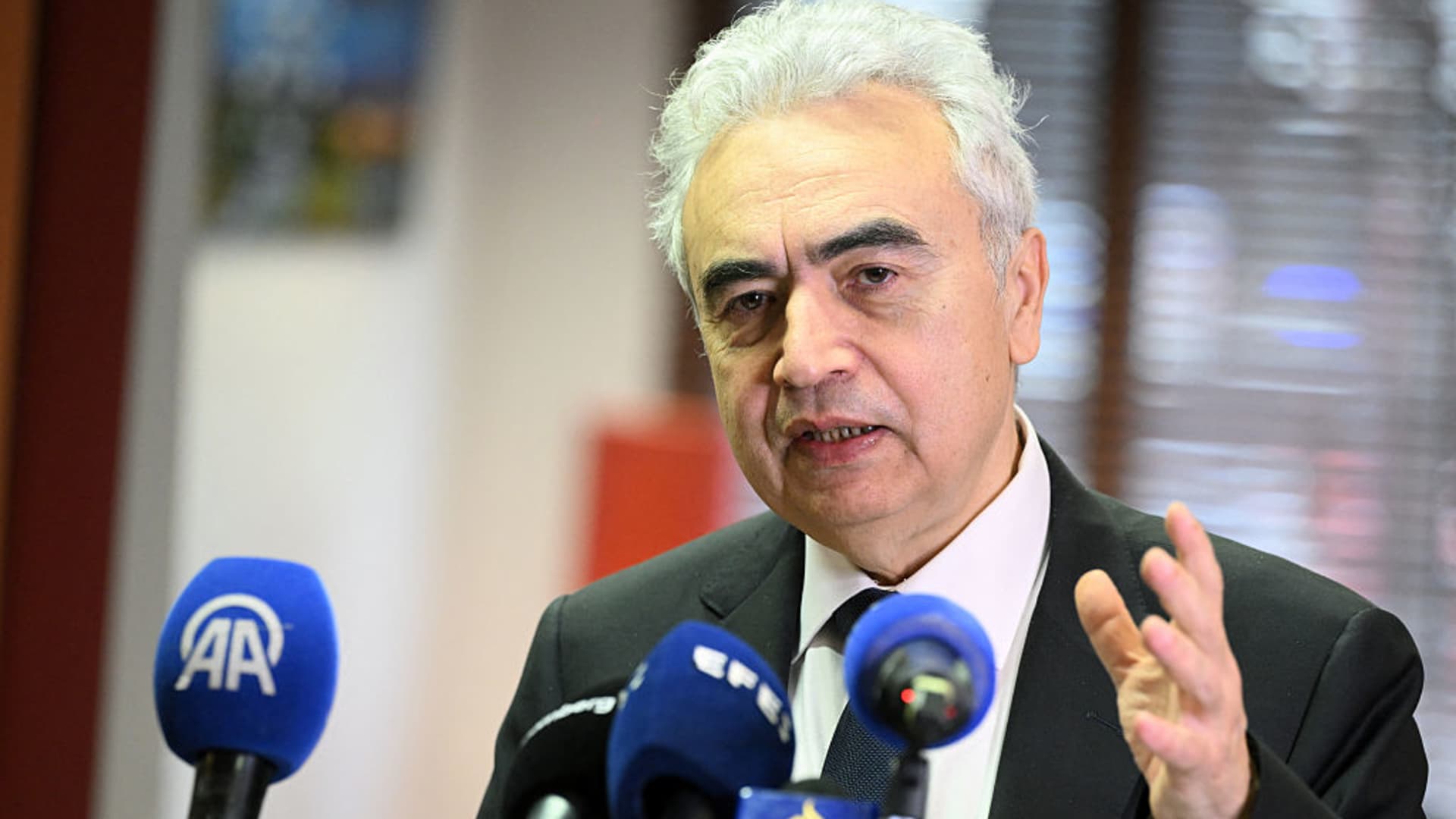
Fatih Birol, Director-General of the International Energy Agency (IEA), speaks at a press conference in Brussels on March 6, 2026.
Nicholas Tucat | AFP | Getty Images
Oil supply constraints that have sent prices soaring since the start of the Iran war are likely to tighten further next month, according to the head of the International Energy Agency.
Speaking on the podcast “In Good Company” hosted by Norges Bank Investment Management CEO Nikolaj Tangen, Birol said the energy crisis caused by the war between the United States and Iran was the worst in history.
“Next April will be even worse than March,” he said. He explained that cargo ships carrying oil and gas were already passing through the Strait of Hormuz in March, before the war broke out.
“They’re still coming to the port, bringing oil and energy and other things,” he said. “There’s nothing for April. Oil losses in April will be double the oil losses in March. On top of that, there’s LNG, etc. I think that will affect inflation and hurt economic growth in many countries, especially in emerging countries. We may soon see energy rationing in many countries.”
US President Donald Trump said on Tuesday that US troops would be leaving Iran “within two to three weeks,” sparking a widespread rally of relief across financial markets.
But Birol said the war, now in its fifth week, has already created a crisis worse than those seen in previous crises, including those in the 1970s and after Russia’s full-scale invasion of Ukraine in 2022.

“If you look at[1973and1979]in both eras we lost about 5 million barrels of oil a day. These oil crises caused a global recession in many countries,” he told Tangen. “Today we lost 12 million barrels a day, more than the two oil crises combined.”
He added that the amount of gas supplies lost due to the conflict and the blockage of the Strait of Hormuz, a key shipping route, was even greater than what was lost to the market when Russian gas flows were disrupted four years ago.
“The current crisis is more than the sum of these three. And on top of this, there are many critical commodities such as petrochemicals, fertilizers and sulfur that are critical to global supply chains,” he said. “We are headed for the largest mass disruption in history.”
IEA considers further release of reserves
Birol also said the IEA is considering re-releasing strategic oil reserves as conflicts in the Middle East drag on.
“We evaluate the market every day, if not hourly, 24 hours a day, 365 days a year, and there is a good chance that we will propose (additional release of reserves) if we think it is necessary,” Birol said. “The biggest problem today is the shortage of jet fuel and diesel. Those are the main challenges, and we’re already seeing that in Asia, but soon, in April, maybe the beginning of May, we’re going to see that in Europe as well.”
Earlier this month, 32 IEA member states agreed to release a record 400 million barrels of oil from emergency stockpiles to offset some of the supply disruptions caused by the Iran war.
Birol added on Thursday’s podcast episode that “when the time is right, we will make a decision to present it to the government,” but said releasing more reserves would not end the energy market’s problems.
“This is only pain relief, not a cure,” he explained. “The cure is to open the Strait of Hormuz. We have some time, but I’m not claiming that this is the solution, it’s our stock release.”
Oil prices have soared since the United States and Israel launched attacks on Iran on February 28, prompting retaliatory strikes from Tehran across the Gulf. Global benchmarks during March brent crude oil Oil prices rose more than 60%, marking the largest monthly price increase since records began in the 1980s.
In recent weeks, the IEA has published a list of recommendations to cushion the impact of the global energy crisis. This includes lowering vehicle speed limits, working from home and reducing the use of gas ovens.
Correction: This article has been updated to reflect that there are supply constraints in the oil market.
