

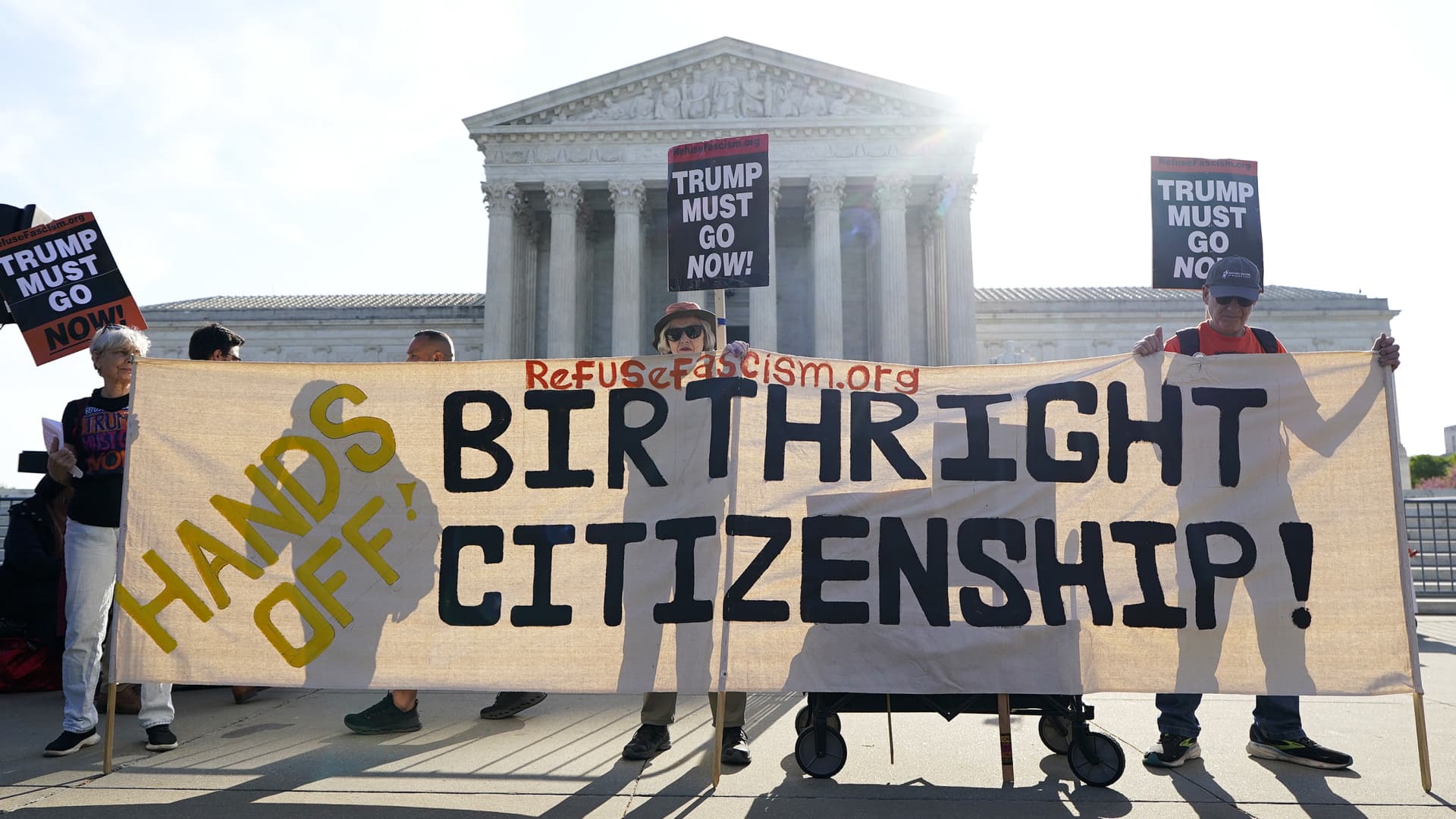
People demonstrate outside the U.S. Supreme Court ahead of U.S. President Donald Trump’s scheduled arrival in Washington, D.C., on April 1, 2026.
Al Drago | Getty Images
The Supreme Court heard oral arguments Wednesday over whether President Donald Trump’s executive order can overturn longstanding constitutional guarantees of citizenship for people born in the United States, regardless of their parents’ immigration status.
Trump is in court for arguments in the birthright citizenship case known as Trump v. Barbara, the first time a sitting president has appeared before such a courtroom.
President Trump stayed for more than an hour to hear a presentation from Attorney General D. John Sauer, who defended the executive order, but left after less than 15 minutes after an American Civil Liberties Union lawyer argued against the order.
“We are the only country in the world stupid enough to recognize ‘natural-born’ citizenship!” Trump wrote in a post on Truth Social after leaving office.
If President Trump’s order is upheld, tens of thousands of babies born in the United States every month will be left with illegal immigrants and non-citizen visitors.
On his first day back in the White House, on January 20, 2025, President Trump signed an executive order stating that, 30 days after the effective date, infants born in the United States are not entitled to citizenship documents if their parents are in the country illegally or are undocumented workers.
Sauer told the judge that automatically granting citizenship to people born in the United States “is an affront to the precious and profound gift of American citizenship.”
“This acts as a powerful draw for illegal immigrants, rewarding illegal aliens who not only violate immigration laws but also jump in front of those who follow the rules,” Sauer said.
“In recent decades, countless foreign nationals from potentially hostile countries have flocked to give birth in the United States, creating an entire generation of Americans overseas with no meaningful ties to the United States, creating a sprawling industry of birth tourism,” Sauer said.
“As Justice (Samuel) Alito pointed out, we are now in a new world, where 8 billion people are just a plane ride away from giving birth to the children of American citizens,” Sauer said.
Chief Justice John Roberts questioned Sauer’s argument that children of illegal immigrants are not eligible for citizenship under the Constitution.
“You put a lot of weight on the subject matter of jurisdiction, referring to the argument that children born in the United States are subject to the laws of the country of their birth parents,” Roberts said.
“But the examples you give in support strike me as very strange,” the Chief Justice continued.
“The children of ambassadors, the children of our enemies during hostile invasions, the children aboard warships. And we extend that to the entire class of illegal aliens in this country,” Roberts said. “I don’t really understand how you can get from such a small, singular group to that large group.”
People demonstrate outside the U.S. Supreme Court ahead of U.S. President Donald Trump’s scheduled arrival in Washington, D.C., on April 1, 2026.
Al Drago | Getty Images
Cecila Wang, an attorney with the American Civil Liberties Union, opposed Trump’s order.
Wang herself is a beneficiary of birthright citizenship, having been born in Oregon to parents from Taiwan who were in the country on student visas, The New York Times reported Wednesday.
“If you ask Americans what the citizenship rules are, they will tell you that everyone born here is a citizen,” Wang argued.
“This rule was established in the 14th Amendment to ensure that no government official could override it when the government sought to strip Mr. Wong Kim Ark of his citizenship on much the same grounds raised today,” Wang said, referring to the San Francisco man born to Chinese parents who was the subject of an 1898 Supreme Court case that upheld the concept of birthright citizenship.
President Trump’s executive order contradicted more than 150 years of legal interpretation of the 14th Amendment to the U.S. Constitution, which grants automatic citizenship to babies born in the country, regardless of the status of their parents.
That amendment reads, “All persons born or naturalized in the United States, and all persons to whom the following conditions apply.”
That jurisdiction rests with U.S. citizens. ”
Multiple federal judges have ruled that President Trump’s order is unconstitutional. Two federal circuit courts then upheld injunctions blocking the orders from taking effect.
