


A war with Iran could disrupt fertilizer shipments through one of the world’s most important trade routes and raise global food prices.
While energy markets are focused on oil supply risks, analysts say threats to the fertilizer supply chain through the Strait of Hormuz could also pose long-term economic problems through food inflation.
“Beyond energy, another risk that has received less attention is the potential spillover to food prices as fertilizer shortages increase agricultural costs,” Stephanie Ross, chief economist at Wolf Research, said in a note Tuesday.
Ross estimates that the disruption could cause inflation for eating-at-home prices to rise by about 2 percentage points, adding to the roughly 0.40 percentage point increase for energy and the overall U.S. inflation rate by about 0.15 percentage points.
These potential price increases come as U.S. consumers face continued soaring prices for food, housing, and energy. Household food inflation rose 2.4% in February from a year earlier, the U.S. Department of Labor’s Bureau of Labor Statistics said Wednesday.
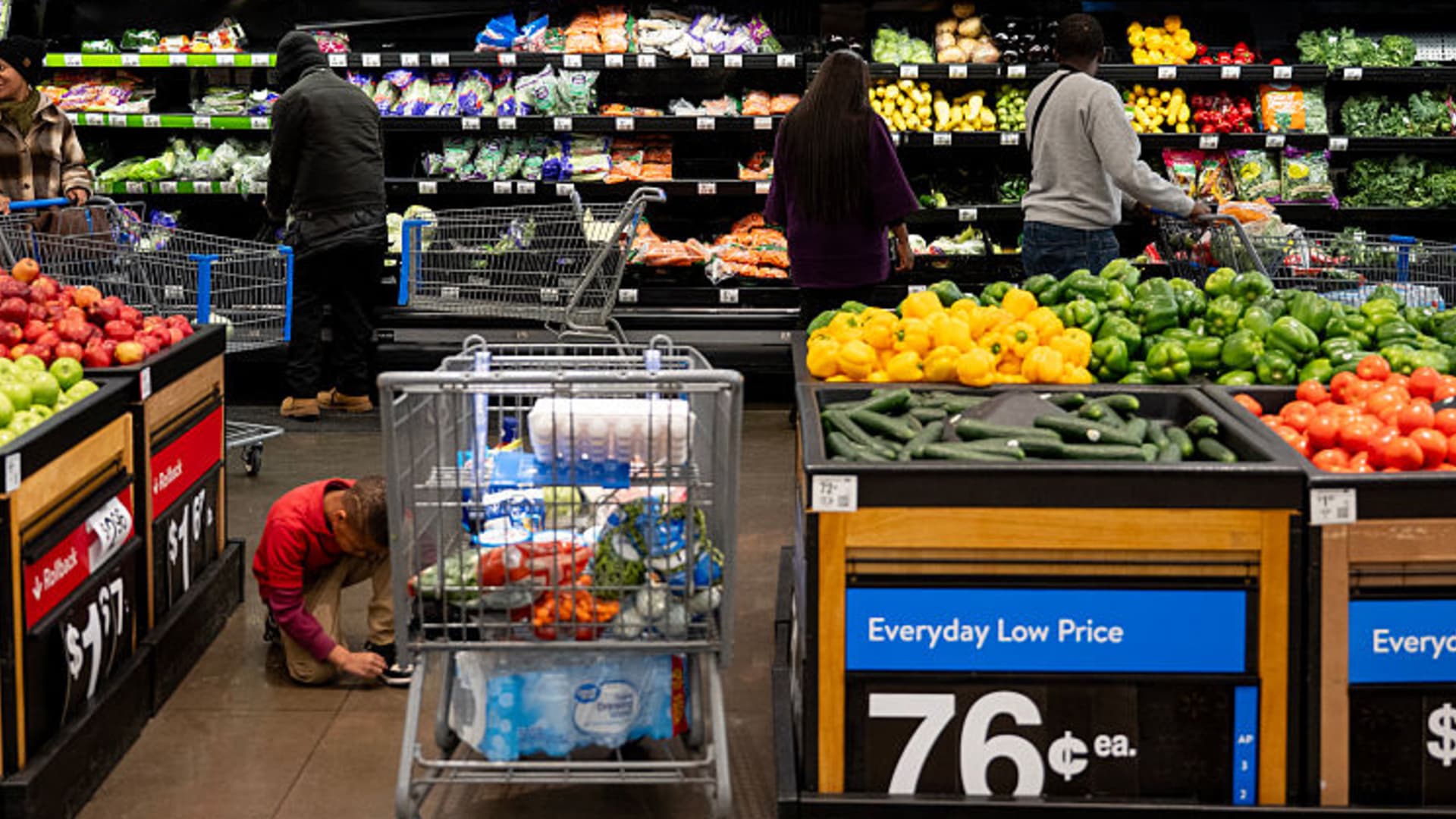
A customer shops at Walmart on January 22, 2026 in Little Rock, Arkansas.
Will Newton | Getty Images
More than a third of the fertilizer traded around the world passes through the Strait of Hormuz, making it a key artery for agricultural supply chains. Commercial traffic along the route has largely come to a standstill since the war began late last month, disrupting shipments just as farmers in the Northern Hemisphere are preparing fields for spring planting.
Timing is very important because fertilizers are applied early in the crop cycle and help determine yield later in the year.
“If fertilizer supplies become tight during this time of year, farmers may reduce application rates,” Ross said in the memo. This could reduce yields of crops such as corn, soybeans, wheat and rice, and raise agricultural costs.
Fertilizer industry economists are similarly concerned, saying prices are already rising.
In the weeks between February 27 and March 6, including the start of the war, the price per short ton of U.S. urea fertilizer imports rose 30%, according to data collected by the Fertilizer Association, an industry advocacy group.
Urea, a nitrogen-based fertilizer widely used to increase crop yields, is one of the most heavily traded fertilizers in the region.
Veronica Nye, chief economist at the Fertilizer Research Institute, said if trade disruptions persist, higher fertilizer prices for farmers and retailers could ultimately push up food costs for consumers.
“This is a global impact on fertilizer costs,” Nye said. “I think in this scenario, those costs will be further passed on to consumers, which is something we haven’t seen before.”
The United States relies on the global fertilizer market, importing about 20% of its total usage, but nitrogen fertilizers such as urea come from a broader group of suppliers, including Canada, Trinidad and Tobago, Russia, and others.
The ripple effects can extend beyond the product and around the world. Asia and Africa are particularly dependent on fertilizer exports from the Gulf region. Countries such as India rely heavily on supplies from the Gulf, while several African economies rely on imported raw materials used to produce fertilizers.
Disruptions to fertilizer shipments could reduce crop yields for farmers and increase household costs, but fertilizer producers could benefit.
CF Industries The stock hit a record high on Monday, and the stock has risen nearly 10% over the past week, the company’s biggest multi-day gain since 2022.
Correction: This article has been corrected to reflect that the Iranian conflict has disrupted fertilizer shipments through the Strait of Hormuz. A previous version misspelled the name of the body of water between the Persian Gulf and the Gulf of Oman.
