

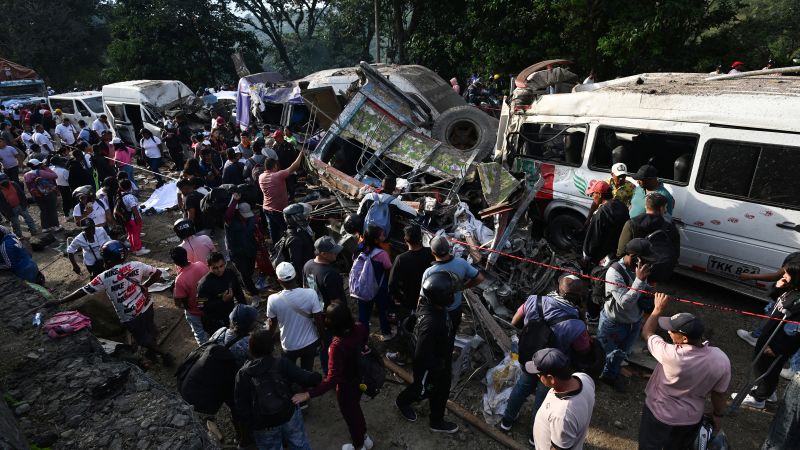
A bomb destroyed a busy road in southwestern Colombia, killing at least 14 people and injuring at least 38 others, including five children, local authorities said.
Colombian officials also said the incident was part of a “wave” of terrorist attacks this weekend, amid a resurgence of deadly violence in the country.
“An explosive was detonated on the Pan-American Highway in the El Tunel district of Cajibio, resulting in an indiscriminate attack on civilians,” Octavio Guzmán, the governor of Cauca state, said in a post on X.
Guzmán later added in an update that Colombian Defense Minister Pedro Sánchez was at the explosion site to help “coordinate rescue operations.” The governor said authorities were “setting up a national security council to deal with this serious situation.”
Videos posted on social media showed the aftermath of the explosion, which blew a deep crater in the middle of the road. Mangled cars, trucks and buses lay with the bodies of the victims covered in dust and debris around the explosion site.
“We are facing an escalation in terrorism, which requires immediate action,” Guzman said, calling on authorities in all countries with “urgency” to ensure security.

Authorities also received reports of violence in other locations, including El Tunel, El Tambo, Caloto, Popayan, Guachene, Mercadores and Miranda, in what Hugo Alejandro López Barreto, the commander-in-chief of Colombia’s military, described as a “wave of attacks.”
Colombia’s military blames the highway bombing on dissidents from the now defunct left-wing extremist group the Revolutionary Armed Forces of Colombia (FARC), led by extremist leader Nestor Gregorio Vera Fernández, better known as Iván Mordisco.
The FARC laid down its arms in 2016 and finally disbanded after a peace deal ended more than 50 years of war with the Colombian government, a conflict that killed more than 220,000 people and displaced about 5 million Colombians.
However, some members of extremist groups refused to participate in the peace process from the beginning. These opposition fighters, some of whom are internal splinter groups, continue to wage a low-level insurgency in some rural areas of Colombia.
López Barreto told a news conference that a “series of attacks” had taken place in the provinces of Cauca and Valle del Cauca on Saturday, and blamed the “criminal organization” of the FARC rebel group led by “Iván Mordisco.”
“In the last two days, 26 terrorist acts have occurred in the provinces of Cauca and Valle del Cauca, affecting our civilian population,” López said, adding that the series of attacks was a response to the “sustained pressure” exerted by the Colombian government against the criminal activities of these groups.
Colombian President Gustavo Petro called for “the maximum global pursuit of this narco-terrorist organization” and linked it to “Iván Mordisco.”
“Those who attacked and killed seven civilians in Qazibio and injured 17 more, many of them indigenous, are terrorists, fascists and drug traffickers,” Petro wrote to X.
The attack came hours after President Petro visited Venezuela with top Colombian military officials. There, President Petro and Acting President Delcy Rodriguez announced that the two countries had agreed to jointly fight criminal gangs along their shared border. Its border is one of the longest in the region, spanning more than 1,370 miles.
