

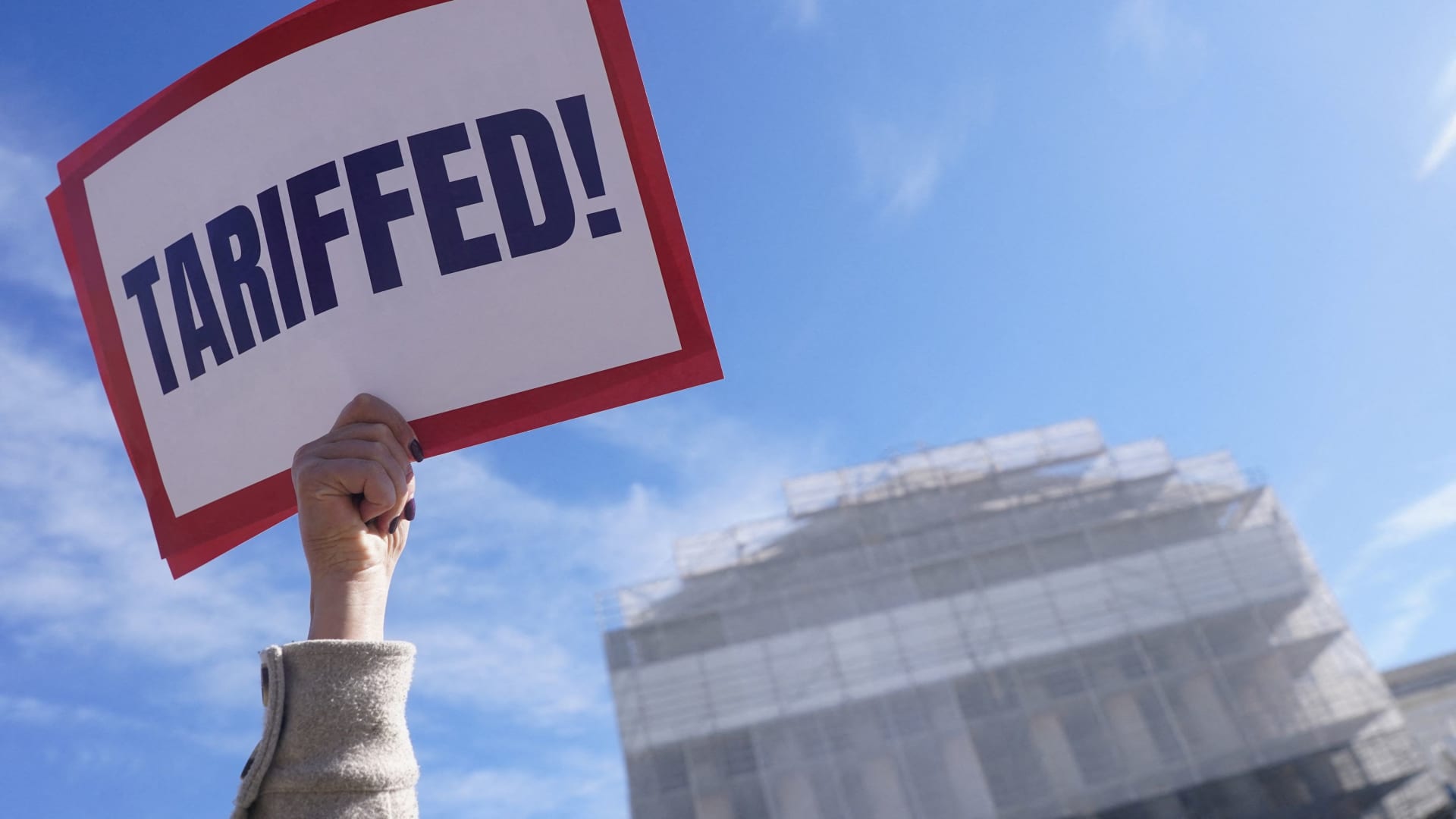
A Main Street Alliance participant holds a sign outside the U.S. Supreme Court as oral arguments are scheduled for President Donald Trump’s proposal to maintain significant tariffs after a lower court ruled that the president overstepped his authority, November 5, 2025, in Washington, DC.
Nathan Howard | Reuters
U.S. importers say if the Supreme Court rules that they must return the money they paid for President Donald Trump’s tariffs, it would be relatively easy and not be as “messy” as some have claimed.
Importers pointed to U.S. Customs documents that clearly detail the duties to be paid on goods brought into the United States.
During oral arguments last Wednesday in a case that will decide the fate of President Trump’s tariffs, most Supreme Court justices expressed skepticism about whether the tariffs are legal.
But some justices questioned what would happen if they ruled that President Trump did not have the authority to unilaterally impose these tariffs.
Judge Amy Coney Barrett said it would be “difficult” for the US to repay the billions of dollars in tariffs it has collected since they took effect earlier this year.
Neal Katyal, a lawyer representing small business organizations challenging the tariffs, acknowledged that repaying the tariffs would be “very complex.”
But Rick Muscat, CEO of Dearstags, a third-generation family-owned shoe company, told CNBC that “I disagree with the concern that tariff repayments will be disrupted.”
“Every time we enter customs, we detail certain items that indicate the duty rate we are paying,” Muscat said.
In the customs summary, the importer identifies the specific product code, country of origin, and type of duty payable.
Muscat provided CNBC with a customs summary of recent shipments received by DeerStags from China.
One of the codes in that document classified the 6% duty on items based on name, use, and material. Muscat said this obligation has been in place for many years.
The second levy was a 20% fentanyl tariff that President Trump imposed on Canada, China, and Mexico for failing to stem the flow of opioids into the United States.
The third line showed the 10% “reciprocal” tariff that President Trump imposed by invoking the International Emergency Economic Powers Act. President Trump is the first president to use IEEPA to unilaterally impose tariffs.
Muscat has paid more than $1 million in tariffs since President Trump announced a raft of them in early April, which he called “Liberation Day.”
“U.S. Customs has been able to add these additional items to the entry summary each time the president changes tariffs,” Muscat said.
“It should therefore be easier for importers to apply for refunds based on this tariff schedule,” he said.
Muscat added, “The IRS has no problem issuing refunds for overpaid taxes, and this is no exception.”
Greenbar Distillery, a small business in Los Angeles that bottles cocktails and liqueurs, paid more than $50,000 (10% of its profits) in additional taxes under President Trump’s trade policy.
“In terms of getting the customs money back, logistically, technically and theoretically, it should be easy because they’re all clearly marked and they have items,” said Melkon Kosrovyan, co-founder of Greenbar and a spirits maker.
“However, we really don’t know,” Kosrovian said. “This administration has been very creative in finding ways to do whatever it wants with tariffs.”
He added: “If we could get a lump sum, that would be great. Or if we could get a credit for future imports, I would be fine with that. But I have strong concerns that we won’t get a penny.”
Treasury Secretary Scott Bessent said in a Supreme Court filing in September that if the court waits until next summer to rule that tariffs must be returned, the amount returned could range from $750 billion to $1 trillion. “Unraveling them could cause significant disruption,” Bessent told the high court.
The company plans to begin automating functions in 2026 to reduce some employees as a cost-cutting measure to help pay for President Trump’s new tariffs.
“Automation was the only way to overcome tariffs,” he said. “Our wholesalers and retailers won’t accept price increases. We can’t live with lower profit margins. We have to do something, and that was automation.”
Both Khosrovya and Muscat, along with more than 700 other U.S. small businesses, signed an amicus brief before the Supreme Court opposing the tariffs. These companies are part of the We Pay the Tariffs coalition.
“There have been over 40 changes to tariff law this year alone,” said Dan Anthony, executive director of We Pay the Tariffs.
“The unpredictability is crippling and the cost increases are staggering, creating a huge burden on small business owners trying to run and grow their companies,” Anthony said.
U.S. importers and customs brokers said a Supreme Court ruling ordering the tariffs back would be difficult to enforce only if the Trump administration does so.
“The Supreme Court will determine the legality of the tariffs, and if they are illegal, the International Trade Court will decide how that money will be returned to the U.S. importer,” said Lori Mullins, director of operations at Rogers & Brown Custom Brokers.
Mullins said that if the tariffs are determined to be illegal, refunds should be as simple as U.S. Customs automatically reimbursing U.S. importers for generalized preferential tariffs on eligible U.S. imports between January 1, 2018 and April 21, 2018.
“With GSP, it was a simple process where imported goods were submitted in a certain way and Customs sent the money back to the importer,” Mullins said.
He added that since IEEPA duties are submitted itemized, the refund process would be similar and, in theory, faster.

“However, our understanding is that it can be a little more complicated if repayments are required,” Mullins said. “The federal government may require the importer to take back the funds because it claims they are so important to U.S. coffers.”
The only way to do that, Mullins said, is for customs brokers to complete a post-summary amendment, which would only be filed for the specific tariffs being eliminated. The document will be sent to customs, who will examine and approve it.
In her opinion, the real complexity lies in how customs brokers, already dealing with a shortage of experienced personnel, will cope with the expected increase in the number of declarations.
“They are avoiding new trade relief tariffs like 301 and 232, along with the addition of 232 new derivatives that keep getting added every 90 days,” Mullins warned.
The federal government collects approximately $195 billion in customs revenue from fiscal year 2025 through September 30, 2025. Tariff collection continues as the Supreme Court considers the decision.
Trade lawyers have warned that if the Supreme Court decides whether some tariffs are legal and others are not, the amount of paperwork customs will have to file will increase.
That could make lifting tariffs even more time-consuming and difficult for U.S. companies.
“This is going to be a huge administrative burden for businesses,” said Joyce Adetutu, a partner at law firm Vinson & Elkins.
“Paperwork is done on an item-by-item basis, but within these shipments are thousands of products, some covered by IEEPA and some not,” Adetutu said.
“Tariff rates have also changed many times,” she said. “It would take a significant amount of time and administrative burden to resolve all of this.”
“Therefore, we believe that Customs and Border Protection will at least need a significant amount of time to be able to issue refunds to U.S. importers,” Adetutu added.
