

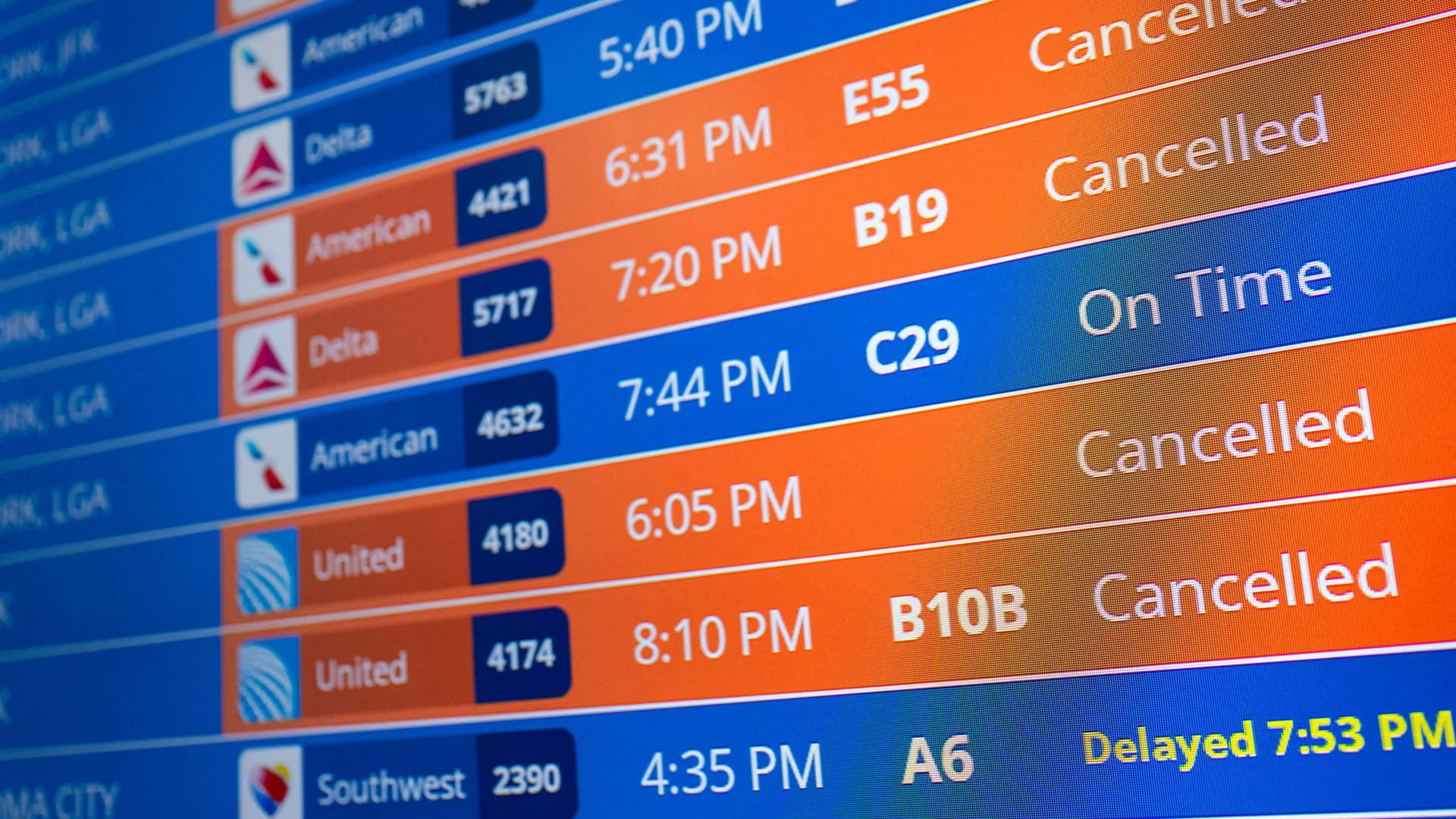
Flight schedules and cancellations are displayed on a departure board at Ronald Reagan Washington National Airport in Arlington, Virginia, on November 9, 2025, one month into the U.S. government shutdown.
Annabelle Gordon Reuter
An air traffic controller shortage exacerbated by the longest U.S. government shutdown in history has disrupted flight traffic, and flight cancellations rose again on Monday as President Donald Trump threatened to cut pay if air traffic controllers were absent.
Aviation data firm Cirium said 1,623 of 25,735 scheduled U.S. flights were canceled on Monday, or about 6.3% of the day’s schedule, but on-time departures were better than average, a positive sign after days of travel turmoil.
Citing the burden on air traffic controllers, the Trump administration last week ordered airlines to cut their flight costs by 10% by next Friday, Nov. 14, starting with a 4% cut starting last Friday.
“All air traffic controllers must get back to work now!!!,” President Trump said in a post on Truth Social, adding that he would recommend a $10,000 bonus for air traffic controllers who did not take vacation during the shutdown. He said those who do not return to work immediately “will be fired.”
In response, the National Air Traffic Controllers Association said air traffic controllers are “the unsung heroes responsible for safely guiding our nation’s passengers and cargo to their destinations.” The group said they were “commendable” and “certainly worthy of praise.”
The weekend disruptions included 18,576 delayed flights and 4,519 canceled flights, according to FlightAware. The cancellations spread from regional short-haul jets, on which the nation’s largest airline relies for about half its domestic flights, to mainline flights.
united airlines and delta airlines The airlines paid extra fees to flight attendants to pick up and drop off flights, according to company messages seen by CNBC. United also offered pilots extra pay for more flights than usual, according to an airline spokesperson. Such additional pay is common during storms and other disruptions.
american airlines Chief Operating Officer David Seymour said on Monday that 250,000 of its customers were affected by the weekend disruptions, with 1,400 cancellations by air traffic control.
“This is completely unacceptable, and everyone deserves better. Our air traffic controllers deserve to be paid, and our airlines need to be able to operate with a level of predictability and reliability that the major airlines were unable to provide to air passengers this weekend,” he said in a memo to staff seen by CNBC.
Airlines were waiving change fees and, in some cases, fare differences depending on when customers could rebook their trips. Customers can also request a full refund for the missed flight.
In a sign of how severe the disruption to air travel has become during the government shutdown, 2,631 U.S. flights were canceled on Sunday, 10% of the day’s schedule, making it the fourth worst day since January 2024, Cirium said.
By comparison, the airline ranked 72nd in cancellations since early last year as of Friday morning, when flight reductions ordered by the Trump administration took effect.
The disruption disrupted travel plans and forced hundreds of thousands of travelers to find alternative transportation. rental car company hertz An increase in one-way demand was reported last week. Demand for private jet flights has also increased in recent days, said the CEO of charter and fractional ownership company Flexjet.
The Federal Aviation Administration on Monday began restricting commercial airline operations at more than a dozen U.S. airports, although the Trump administration’s order did not initially require commercial airlines to make the same cuts as commercial airlines. But many private jet operators don’t use the busiest commercial airports, according to the National Business Aviation Association.
Increased burden
Air traffic controllers missed their second paycheck due to Monday’s shutdown, but are still required to work. According to government and labor union officials, some of them are taking up side jobs to make ends meet.
A passenger plane takes off past the air traffic control tower at San Diego International Airport on the first day of the partial U.S. government shutdown on October 1, 2025 in San Diego, California, USA.
Mike Blake | Reuters
Nick Daniels, president of the National Air Traffic Controllers Association, said at a press conference on Monday: “We must now focus on child care, not traffic flow. Family meals, not runway separation.” “Increased stress leads to fatigue, and that fatigue compromises safety, and prolonging this closure increases daily risk.”
The Senate made progress overnight on a deal that could end the government shutdown, but the funding bill has yet to be approved.
Daniels said it’s not yet clear how long it will take for air traffic controllers to receive back pay for their work. The shutdown, which ended in 2019, took about two and a half months for workers to fully recover.
President Trump’s comments about air traffic controllers on Monday drew criticism from Rep. Rick Larsen (D-Wash.), ranking member of the House Transportation and Infrastructure Committee, who called the remarks “crazy!” And he said this goes against Transport Secretary Sean Duffy’s calls for support for aviation workers.
“The men and women who work long hours in air traffic control towers to keep our aviation systems running deserve our gratitude and recognition, not a gratuitous attack on their patriotism,” Larsen said.
Just because the shutdown is lifted doesn’t mean flight restrictions will be lifted immediately. The FAA announced last week that it would decide whether to expand or narrow flight restrictions based on safety data.
Airlines had little time to make last-minute schedule changes when last week’s order was issued, but they will need time to adjust schedules, sell seats and staff planes and crews to resume operations.
