

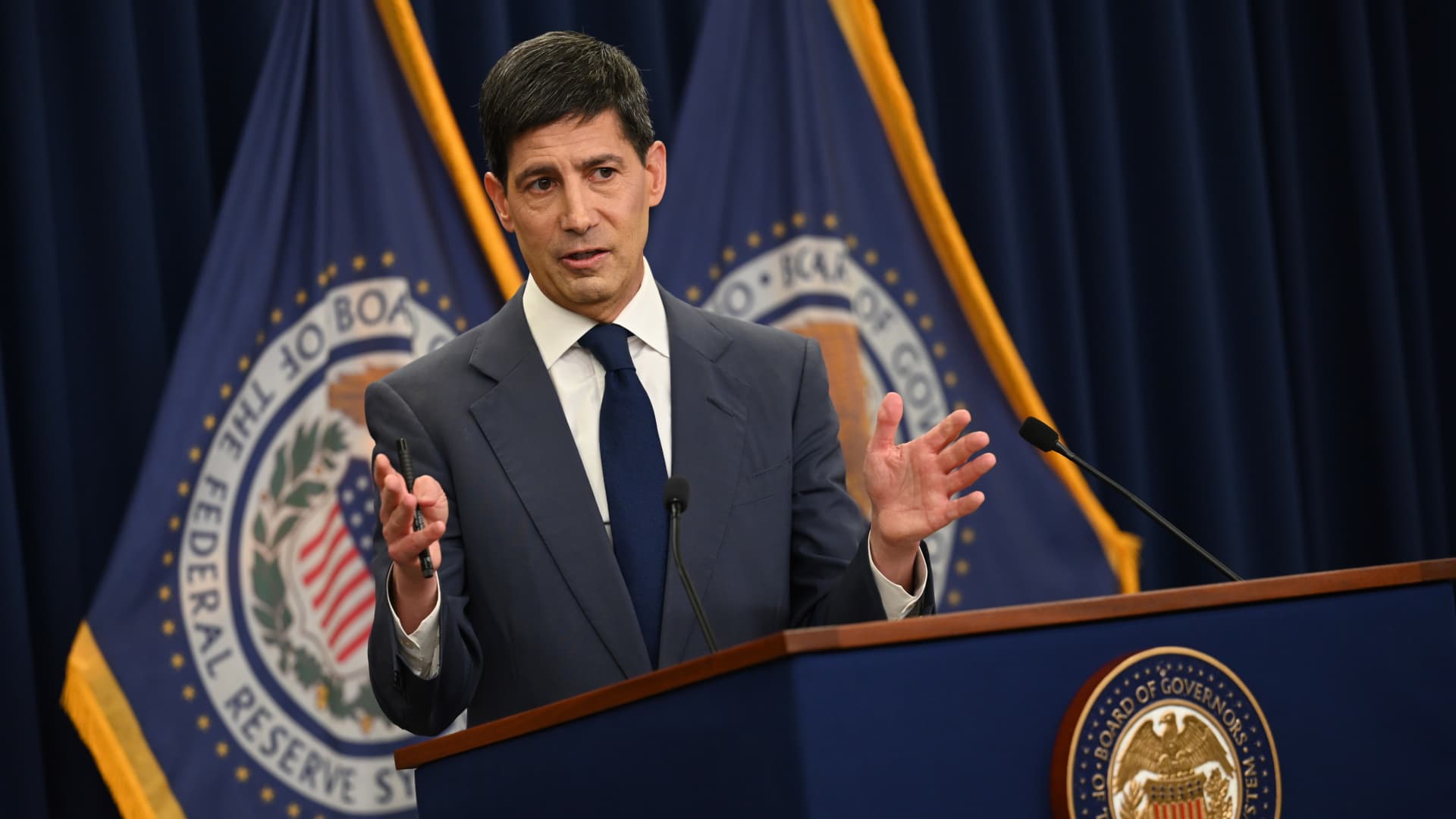
Federal Reserve Chairman Kevin Warsh spoke at his first press conference since taking the helm of the central bank on June 17, 2026 in Washington, DC.
Chen Mengtong | China News Service | Getty Images
U.S. Treasury yields rose on Monday, with the two-year bond yield at its highest level since early last year, as investors focused on key inflation data to be released Thursday and weighed the latest developments in U.S.-Iran war talks.
The yield on the two-year Treasury note, which is closely linked to the Federal Reserve’s short-term interest rate policy, rose more than 5 basis points to 4.232%. The yield was the highest since February 21, 2025, when it reached 4.275%.
The yield on the 10-year Treasury note, a key benchmark used to price mortgages, auto loans and credit card debt, rose more than 5 basis points to 4.509%. The yield on the 30-year Treasury note rose more than 4 basis points to 4.946%.
One basis point equals 0.01%, and yields and prices move in opposite directions.
Bond prices fell after the United States and Iran agreed to a roadmap to end the war within 60 days. But Trump also claimed that Iran had re-closed the Strait of Hormuz and threatened further military action against Iran.
Oil prices were volatile, with Brent crude trading 3.31% lower, giving up earlier gains and settling at $77.90 per barrel. WTI futures fell 2.32% to $74.82 per barrel.
A key test for the bond market will come later this week, when May data on the Consumer Expenditure Price Index, the Fed’s preferred inflation measure, will be released on Thursday. Excluding volatile food and energy prices, core PCE is expected to rise starting in April, according to economists compiled by FactSet.
Last week’s Fed meeting turned out to be more hawkish than many market participants expected, potentially pushing interest rate hike expectations to September at the earliest.
Last Wednesday, Kevin Warsh’s first meeting as Federal Reserve Chairman ended with the Federal Open Market Committee’s 12 voting members showing a more hawkish bias on interest rates and agreeing on the possibility of future rate hikes. At the meeting, the committee removed key language from a much shorter policy statement that had previously indicated a bias toward future rate cuts.
The Fed last week kept the benchmark federal funds rate unchanged at 3.5% to 3.75%.
