

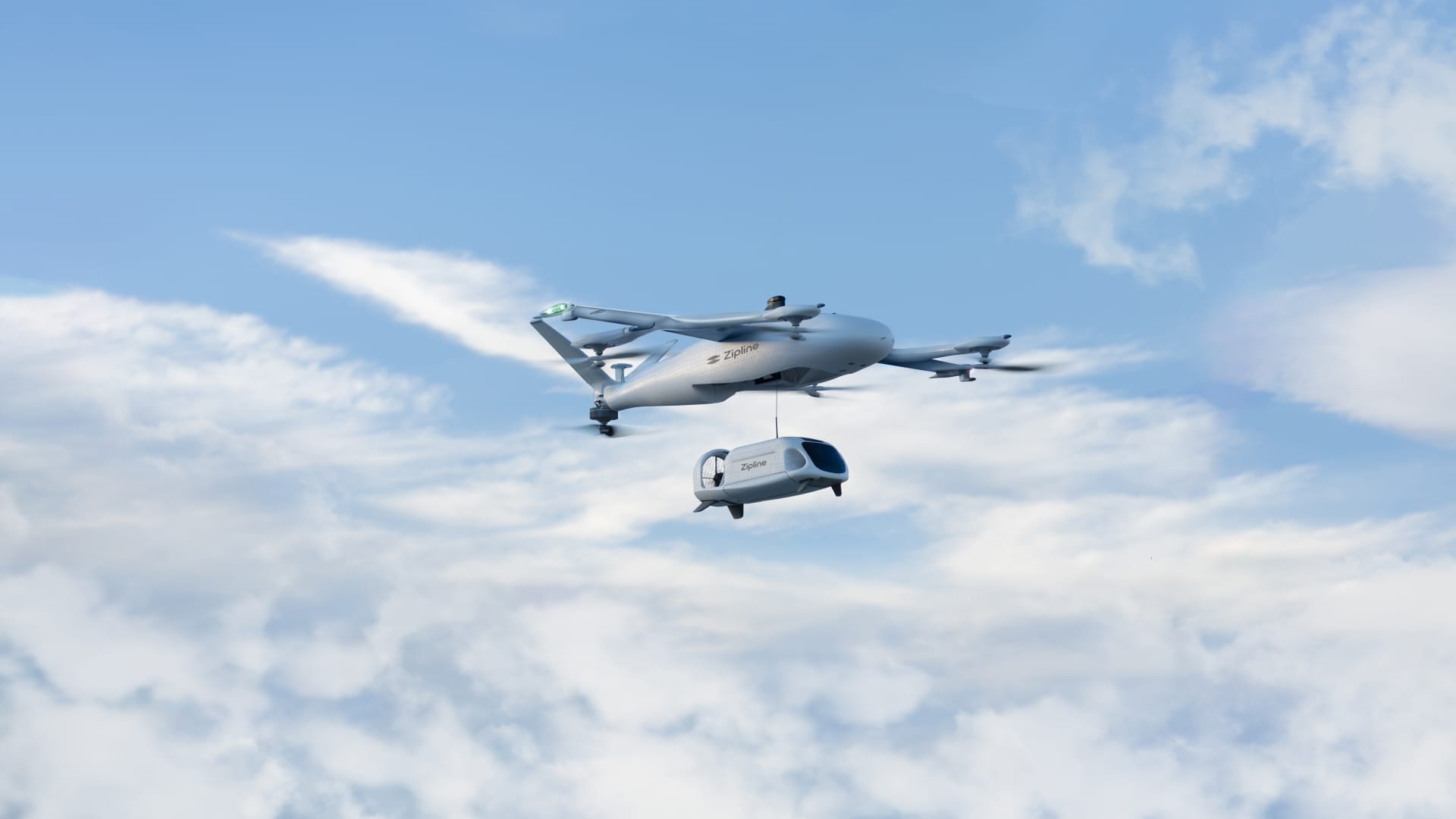
A zipline precision drone with a delivery pod underneath.
zip line
South San Francisco startup Zipline is expanding its drone delivery service into new U.S. and international markets, adding former Tesla and Waymo executives to its executive ranks and bringing in a former Uber executive to lead commercial expansion.
Since Zipline was founded nearly 12 years ago, its fully electric autonomous drones have been used to make more than 2.5 million commercial deliveries. The drone can carry items weighing up to 8 pounds. They have been used to deliver everything from administering life-saving vaccines, blood and anti-venom to burritos and personalized pizzas. Customers typically order through Zipline’s app.
Little Caesars, Chipotle and Cleveland Clinic are among the U.S. companies Zipline currently works with, along with retail partners like Walmart and more than 100 small businesses.
Keller Rinaudo, the company’s CEO and co-founder, estimates that Zipline now makes one drone delivery every 20 seconds, up from one every minute in early 2025, when Zipline ranked 46th on CNBC’s annual Disruptor 50 list.
The company said 1 million of its deliveries to date have taken place within the past 12 months, and about 70% of its daily deliveries are made within the United States.
This is a big change from Zipline’s early days, when the company focused on drone deliveries of medical supplies and humanitarian aid to clinics and farms in Rwanda and Ghana. Rinaudo said zipline business in Africa is also growing, with development contracts and expansion underway, some with support from the U.S. State Department.

Rinaudo likes to say that ziplines make ordering delivery as easy as “teleportation.” For some orders in Dallas, the fastest time from order to delivery was about 5 minutes.
Zipline is teaming up with its newest healthcare partner, the Cleveland Clinic, to offer a “healthcare delivery service” in the greater Cleveland area this month, allowing patients to have their prescriptions mailed to their home with no additional startup costs.
Former Tesla vice president of finance Sendhil Palani joined the venture-backed startup this month as its new chief financial officer.
Palani, who has worked for Elon Musk’s electric vehicle maker for about 17 years, told CNBC that he sees Zipline as a similarly mission-driven organization, with related tasks ranging from precision manufacturing to maintaining charging infrastructure.
Palani said ziplines have the potential to eliminate traffic congestion and pollution associated with traditional air and ground deliveries, while also allowing faster delivery on roads damaged by extreme weather or other disasters, saving human and animal lives.
Currently, Zipline has the capacity to manufacture 24,000 drones per year at its South San Francisco factory. Palani, who joined Tesla when it was building just one all-electric car a day, sees similarities to the years when Tesla began mass producing its entry-level Model 3 sedan.
(Zipline’s former CFO is fellow Tesla finance leader Deepak Ahuja, who still advises the drone business and personally recommended Palani as his successor.)
Zipline’s South San Francisco facility.
zip line
In addition to hiring a new CFO, Zipline is also hiring Kevin Boesen as chief legal officer. He joins after a stint at agricultural biotech company Ohalo and a seven-year tenure as chief legal officer at Waymo, Alphabet’s self-driving car venture.
Rinaudo said the strengthening of the leadership team should help Zipline expand service across the U.S. after gaining momentum in its first metropolitan area in Dallas, Texas, last year.
The startup also hired Allen Penn as head of commercialization and markets. Mr. Penn previously served as vice president of Uber Eats, where he helped build the company’s food delivery and international ride-hailing businesses.
Zipline will begin operations soon in Austin, Houston and Cleveland, but has not yet announced its next U.S. market. “We expect our U.S. operations alone to grow another 15x this year,” Rinaudo said, adding in 2027, “dozens of metros across the U.S. and several new large international markets.”
Zipline has had the most traction in the U.S. so far, but it faces competition from Alphabet Inc.’s drone arm Wing, fellow startups like Flytrex and Matternet, and other companies developing cargo-carrying drones for military use.
PwC researchers estimate that the U.S. drone market will grow 65% annually from 2024 to 2034, with deliveries increasing from about 13 million this year to more than 800 million by 2034.
“It’s at a crazy tipping point,” Rinaudo said. “This thing that we’ve been working on for 12 years, which everyone thought was completely weird and would never work, is now becoming completely normal. Everyone is starting to realize that it doesn’t make sense to have a 3,000-pound gas-powered internal combustion engine vehicle and a person delivering something that weighs 5 pounds to their home.”
