

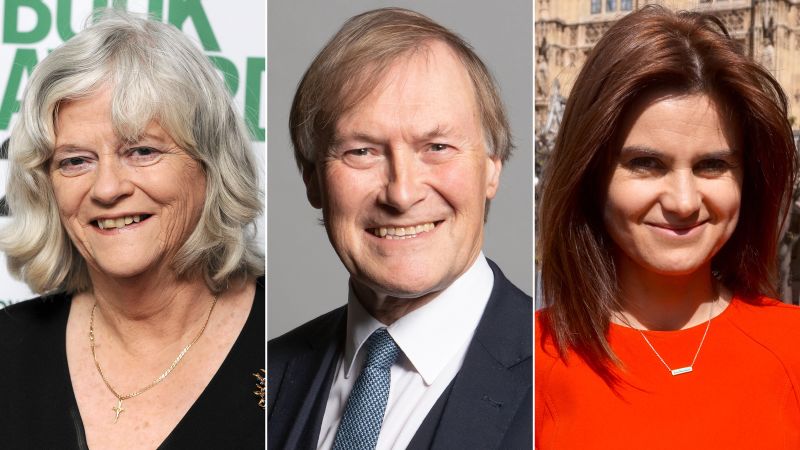
For the third time in more than a decade, British MPs rose one by one in Parliament on Monday to pay their respects to murdered politicians and express mutual concern over rising violence in politics.
The country’s interior minister, Shabana Mahmoud, sought to reassure parliamentarians of their safety, saying, “Politics is our calling here, but it must not be dangerous.” “We must remain vigilant and respond to changing threats.”
Last week’s murder of former MP Ann Widecombe, following the murders of sitting MPs Jo Cox and David Amess in 2016 and 2021 respectively, underlines once again that the past decade has been one of the most dangerous for British politicians in British history.
Not since “The Troubles”, which was used to describe the sectarian violence that occurred in Northern Ireland from the late 1960s until the 1998 Good Friday Agreement, have so many politicians been killed in such a short period of time. Meanwhile, between 1979 and 1990, four MPs were murdered by Irish republican militants.
However, unlike then, there was no active conflict within the country’s borders during this round of violence. Police launched an investigation after Mr Widecombe, a former Conservative MP and then immigration spokesperson for the right-wing populist party Reform UK, was found dead at his home with “serious injuries” last week.
Police initially said there was no information to suggest her killing was politically motivated, but later announced that anti-terrorism police were leading the investigation. An unnamed 28-year-old white British man was first arrested on suspicion of murder and then on suspicion of “committing, preparing or inciting an act of terrorism”.
On Tuesday, the force announced that Mr Widecombe had been killed in a “targeted attack”. They gave no indication of a motive, but said one “part of the investigation” was whether the suspects were targeting Reform UK figures.

The murders of Cox and Ames were driven by completely different motives. Mr Cox, a centre-left Labor Party member, was murdered by a man with far-right views and a large collection of Nazi memorabilia. Meanwhile, a “fanatic Islamist” inspired by the Islamic State group was found guilty of murdering center-right Conservative Party leader Ames. So, rather than a unified ideology driving the increase in violence, as was the case in the 1980s, these cases appear more disparate.
Alan Renwick, professor of political science and head of the university’s constitutional law unit at University College London, warns against “associating the very extreme actions of a few individuals with wider trends in society”.
But he acknowledged that the level of threat facing politicians has increased in recent years and warned of the impact on Britain’s democracy.
“At the same time, it’s clear that members of Congress and other people in public life face numerous threats on an almost daily basis,” he told CNN. “This is a change from the past and seriously undermines our democracy.”

The Times revealed in March that the annual number of crimes against MPs reported to police will reach nearly 1,000 in 2025, almost double from 2022. And according to a parliamentary report, this figure is a tenfold increase from the 151 crimes reported by MPs in 2017.
This significant increase came after Cox’s murder, which occurred just days before Britain voted to leave the European Union. It comes after a virulent campaign that upended British politics and ushered in a period of political instability, the aftershocks of which are still being felt.
On Tuesday, widower Brendan Cox said she feels “much less optimistic” about the state of political discourse than she did then.
“I think in the immediate aftermath of Joe’s murder there was real shock and horror across the political spectrum, and the whole country came together for a moment to say this is not the way we want politics to be run,” he told Sky News. “But over the next few years, I think we progressed into our own tribe.”
For him, “the Wild West culture we have online” is the main driver of this violence, amplifying and legitimizing it.
“Unless we do something about the information environment that justifies violence as a political tool, I think we’re going to keep going back to this situation,” he said. “My frustration is not with the people, but with the ecosystem that allows regulators and politics to consistently promote the most extreme content, often violent content, on social media.”
The role of social media in fostering more violent political debate has been cited numerous times in parliamentary reports and by countless MPs.
“We have to recognize that the rise of online activism has made things even worse,” said Diane Abbott, the first black woman elected to parliament, who has suffered far more abuse than many of her colleagues.
At the same time, crime rates against individuals and households in the UK have generally fallen over the past decade.

The rise in political violence is not unique to the UK, but the number of killings of MPs is unusual compared to other European countries where attacks targeting politicians are rare. Elsewhere in Europe, there has also been a significant increase in verbal attacks, harassment, threats and intimidation against politicians, which the European Parliament has blamed on “increasing political polarization”.
In the UK, these growing threats are having an impact on relationships with voters, with one in three MPs taking part in a parliamentary inquiry considering not standing for re-election.
When Mahmoud, the first Muslim woman to serve as interior minister (minister of the interior), was first elected to parliament in 2010, she held drop-in sessions where voters could easily attend and share their issues with her.
Such meetings, known as constituency surgeries, are common in British politics and form an important link between the public and their elected representatives. But it’s also where Cox and Ames were both murdered. It has fundamentally changed their nature, especially for the country’s most prominent politicians.
Mahmoud told parliament on Monday that such informal, public sessions “are no longer possible and that has had to change in recent years.”
“I still offer surgical advice, but the conditions are very different to when I first became an MP. This is a big change and it is entirely a result of what happened to Jo Cox and Sir David Amess. This is a tragedy because it changes the way we engage with our constituents.”
