

Employees work on core components of wind turbine circuit breakers at Siemens Energy’s Hangzhou factory in Hangzhou, Zhejiang Province, China, February 28, 2026.
China News Service | China News Service | Getty Images
The Iran war appears to have accelerated the transition to clean energy, serving as a catalyst for wind power giants as countries reassess the role of renewables in strengthening energy security.
Danish wind turbine maker Vestas on Wednesday reported an unexpectedly strong first-quarter profit increase, citing improved performance in its onshore and offshore operations despite heightened political uncertainty.
Danish utility Orsted also posted better-than-expected profits through the first three months of the year. EquinorThe oil and gas major told CNBC that the Middle East crisis will boost earnings in its clean technology division.
Torgrim Reitan, Equinor’s chief financial officer, said that amid the Iran war, the drivers of the energy transition have clearly shifted, moving from a focus on decarbonization to issues such as energy security, self-sufficiency and independence.
“In Europe, you can clearly see there’s a lot of momentum behind it,” Reitan told CNBC’s “European Early Edition.”
Equinor, which posted its best quarterly profit in three years on Wednesday, has three large offshore wind developments in the United States, Poland and the United Kingdom, the latter of which is set to become the world’s largest offshore wind farm once it begins production.

The oil and gas giant has benefited from soaring fossil fuel prices since the U.S.-Israel-led war against Iran began on February 28, joining industry rivals in reporting strong first-quarter results.
Analysts expect the fallout from the energy shock from the Iran war to prompt countries to direct more investment into clean energy resources, a trend likely to benefit companies working on green technology.
“Our priority is to deliver the projects that are in development, and beyond that, obviously we need to make sure that we can get a good return from the business before we invest, but we believe that what’s happening now will actually benefit our interests in certain transition industries,” Equinor’s Reitan said.
energy transition
Denmark’s Ørsted said events in the Middle East reaffirmed the need to accelerate Europe’s energy transition, highlighting in particular the role of offshore wind power as a key element in this transition.
“Looking at what’s happening around the world, there’s no reason not to shift gears in Europe’s energy transition to renewables. Europe spends billions of dollars every week importing fossil fuels, but that doesn’t have to be the case,” Orsted CEO Rasmus Arbaugh said in a statement.
“Offshore wind and other renewable energies can provide safe, green energy and, when deployed at scale, can significantly reduce total system costs for households and businesses,” he added.
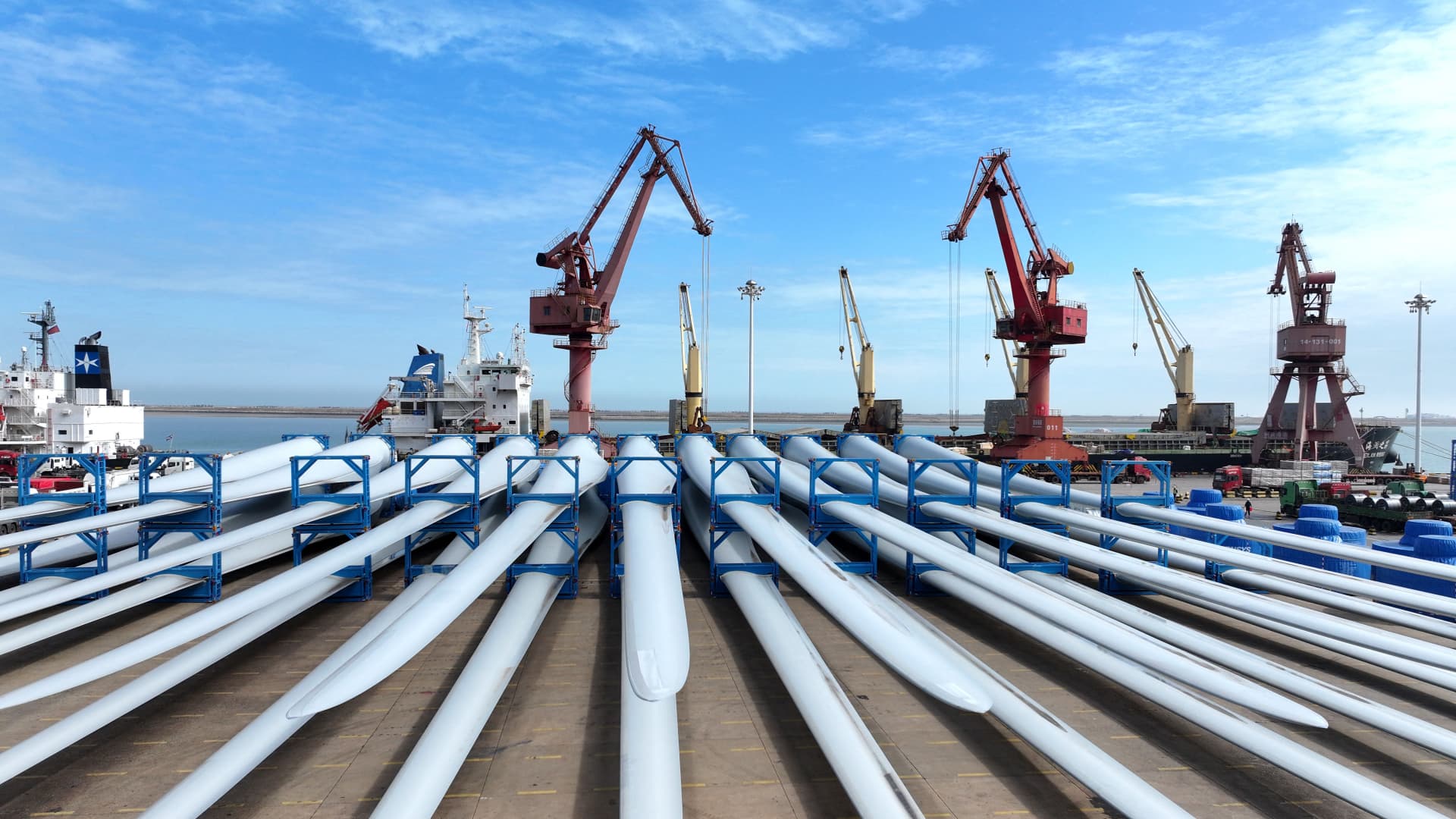
Wind turbine equipment is seen before being shipped overseas on April 14, 2026, at Lianyungang Port in Lianyungang City, Jiangsu Province, eastern China.
– | AFP | Getty Images
Orsted has struggled in recent years with rising costs and supply chain disruptions, but is doubling down on its European operations in response to White House resistance to U.S. wind power.
US President Donald Trump has a long history of deriding wind power, and at the World Economic Forum earlier this year he took aim at the European Union’s energy policies, claiming that wind turbines destroy land and cost profits.
At the time, EU climate commissioner Wopke Hoekstra dismissed Trump’s criticism as “nothing new” and said the region had a “fundamentally different view” on the transition away from fossil fuels.
data center
Vestas CEO Henrik Andersen on Wednesday hailed the company’s best first-quarter profit since 2018, saying the better-than-expected results bode well for the rest of the year.
“We’re in a much better place than we probably expected a few months ago,” Andersen told CNBC’s “Squawk Box Europe” before highlighting the benefits of grid electrification.

When asked about whether the company was meeting with data center builders about how renewable power could support building AI, Vestas’ CEO said he was traveling to the United States over the weekend and said, “Not surprisingly, that’s part of the journey.”
In what appeared to be a thinly veiled reference to Trump, Andersen said, “Just because one person in the world has a false sense of what reality is, that doesn’t mean the rest of the community is off base. So things keep moving.”
Not everyone is convinced that investors will buy into the idea that recent geopolitical tensions could significantly accelerate the renewable energy investment cycle.
“Overall, energy security concerns may strengthen the long-term case for renewables, but there is limited evidence that the Iran conflict is causing a significant change in fundamentals in the near term,” Tancrede Fulop, senior equity analyst at Morningstar, told CNBC in an email.
“Of the two companies, Vestas appears to be better positioned to benefit from accelerated renewable energy deployment, while Orsted remains focused on executing its existing project pipeline,” he added.
