

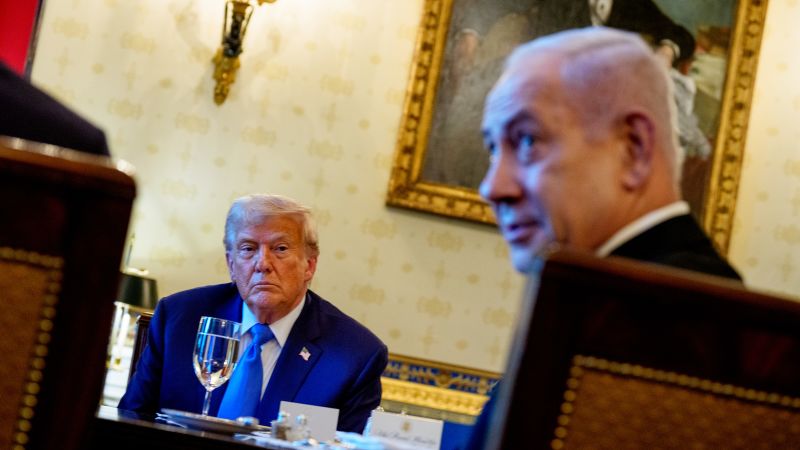
For years, Israeli Prime Minister Benjamin Netanyahu’s trip to Washington to meet with U.S. President Donald Trump has followed a script of red carpets, warm handshakes and shared messages about the closeness of the Israel-U.S. alliance.
But their relationship has changed markedly since they last met five months ago. The close cooperation and glowing praise since the start of the Iran war has given way to expletive-filled rants directed at President Trump’s most vocal international defenders.
This is Netanyahu’s seventh visit to the United States since President Trump returned to power, more than any other world leader. But this time, he arrives in Washington as a leader seeking re-election and seeking to stabilize relations that have become visibly strained.
Prime Minister Benjamin Netanyahu has been trying for weeks to secure an invitation to the White House to discuss developments in the Iran war and warn President Trump of diplomatic concessions, U.S. and Israeli officials said.
President Trump has resisted the talks, and some White House officials are unhappy with Israel’s efforts to “make the talks happen,” a U.S. official said, seeing them as trying to make the talks happen through media leaks. Sen. Lindsey Graham’s funeral this week provided an opportunity for a sit-in, albeit secondary to large-scale events.
A senior U.S. official said Trump has a “strong relationship” with Prime Minister Benjamin Netanyahu and that Israel has no “greater friend” than the U.S. president. “The United States and our allies around the world are already safer because of Israel’s bold actions to deny the United States and the Iranian regime the ability to develop nuclear weapons,” the official told CNN.
The two leaders last met in February, laying the groundwork for what would become a joint military operation against Iran. The war’s opening attack was a showcase of unprecedented military coordination, which both Prime Minister Netanyahu and President Trump enthusiastically promoted and praised. However, as the war dragged on without achieving the overly optimistic goal of overthrowing the Iranian regime, the rift between the two sides became clear. Prime Minister Netanyahu wanted to keep up the pressure, while President Trump wanted to withdraw.
Before the war began, President Trump was assured by prime ministers that the conflict would subside and last several weeks. Months later, U.S. officials say, his anger at the current situation of an uneasy and deadly stalemate led to private meetings filled with expletives and an outburst at the regime in Tehran, which has not come to terms in the way he once expected.
Israeli officials said Prime Minister Benjamin Netanyahu intends to present Trump with new information on the status of Iran’s nuclear and military reconstruction, but said Israel assessed that “President Trump has little interest in resuming full-scale war, at least before the US elections in November.”
The Israeli leader has avoided publicly confronting Trump over the surprise ceasefire in April, but his political allies have denounced the deal with Iran and the pro-Netanyahu press has publicly targeted the deal’s architects, Vice President J.D. Vance, Jared Kushner and Steve Witkoff. Mr. Vance, in turn, accused Prime Minister Netanyahu’s cabinet of sabotaging Iran negotiations and working to sway U.S. public opinion against the deal, warning that Israel was alienating its “only remaining strong ally.”

Officials said Trump is acutely aware of the political pressure Netanyahu faces ahead of Israel’s national elections in October and knows that his support for him could be important. Recognizing that influence, President Trump has shown selective support, including last week when he said Netanyahu would not be arrested if he traveled to the United States, after New York Mayor Zoran Mamdani initially refused to back away from his campaign promise.
President Trump has not blamed Netanyahu for the predicament, at least not in public. But he criticized him for continuing a bombing campaign in Lebanon that threatens to disrupt the ceasefire, calling him “insane” and “cranky.” He then accused President Trump in a phone call of deviating from his war objectives.
The difference in objectives extends beyond Iran.
Lebanon has become a new point of friction as President Trump presses Prime Minister Benjamin Netanyahu to stop fighting Hezbollah. “Everyone hates you now…everyone hates Israel because of this,” Netanyahu said in a phone call in early June reported by Axios.
Israel finally agreed to a trilateral agreement with Lebanon a month ago, but it refuses to completely withdraw from southern Lebanon without first disarming Hezbollah. Prime Minister Benjamin Netanyahu told security ministers on Sunday that the Trump administration wants to withdraw Israeli troops from positions in Lebanon, Gaza and Syria, according to an Israeli official briefed on the talks.
Prime Minister Benjamin Netanyahu told CNN he would oppose the idea.
In addition to long-standing regional conflicts, two additional issues have emerged in recent weeks. President Trump’s possible sale of advanced stealth F-35 fighter jets to Turkey and the U.S.-Saudi civil nuclear agreement. Israeli officials worry that the former could undermine the country’s qualitative military advantage and that the latter could spark a regional nuclear arms race. President Trump has publicly linked the deal with Saudi Arabia to normalization with Israel and the expansion of the Abraham Accords, but Riyadh has neither recognized nor accepted such a link.
Asked on Monday about the possible sale of fighter jets to Turkey and Prime Minister Benjamin Netanyahu’s opposition to such a deal, President Trump said “nobody” would decide on the sale but himself and called Turkey a “strong ally.”
Ahead of his departure on Monday, Prime Minister Netanyahu said: “We will discuss all the issues on the agenda, first and foremost Iran. Of course, our goal is to protect our security and also to spread a circle of peace around us.”
The Israeli official said Netanyahu would seek assurances that arms sales to Turkey and nuclear cooperation with Saudi Arabia would not undermine Israel’s military advantages, as well as progress on a new long-term U.S.-Israel defense pact to replace an expiring Obama-era memorandum of understanding.
“Prime Minister Netanyahu wants to move on from the war to other things, such as a security agreement and perhaps normalization with Saudi Arabia, and he wants to make sure he works with President Trump on things that could be leveraged in the election,” the source said. The official told CNN that he believes direct engagement with Trump will help avoid disagreements within the administration.
Prime Minister Benjamin Netanyahu dismissed the friction as a “tactical” disagreement and insisted relations were closer than ever. However, Israeli officials said it took time to arrange a meeting with Trump and that they were initially “blocked,” although it was unclear who did it. The meeting was first confirmed after Netanyahu announced he would attend Graham’s funeral.
The stakes for Prime Minister Netanyahu have never been higher. Latest polls show he falls well short of the majority needed for re-election in October’s election. Trump has long been one of his most valuable campaign assets, and it is important for Netanyahu to continue to demonstrate his influence in Washington, where he remains hopeful of welcoming him to Israel for a pre-election visit.
Please note that there are currently no public photo opportunities scheduled for this meeting. However, due to careful pre-war military planning, the February meeting between the two sides was also not captured on camera. The latest ruling could mask tensions over the next operation against Iran or the next ceasefire.
