

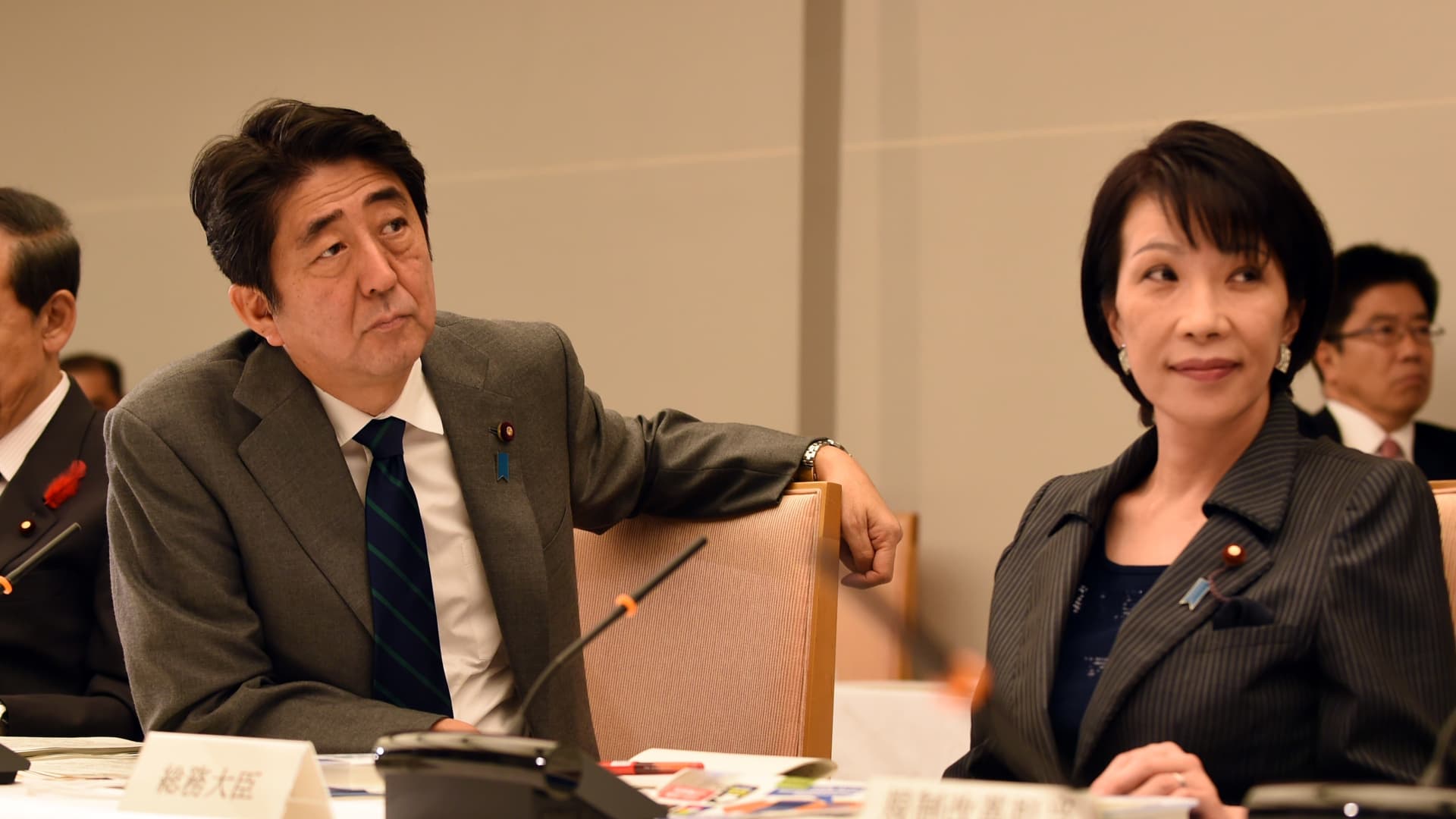
The late Shinzo Abe (left) and Sanae Takaichi (right) attended the Science, Technology and Innovation Conference held in Tokyo on October 22, 2014.
Toshifumi Kitamura | AFP | Getty Images
US President Donald Trump has long accused Japan of engaging in “unfair trade practices,” a criticism dating back to his days as a real estate mogul.
In March, President Trump again singled out Japan, claiming that Tokyo had devalued its currency to gain an unfair trade advantage. “I called the Japanese leaders and told them that we cannot continue to devalue and collapse our currency,” he said.
Then-Prime Minister Shigeru Ishiba reportedly told Japan’s parliament that Japan was not pursuing a so-called “currency devaluation policy,” a point that his predecessors, including the late Shinzo Abe, had emphasized in their meetings with Trump.
Now, as Prime Minister Abe’s protégé, Sanae Takaichi, seeks to take the helm of the world’s fourth-largest economy, the same concerns may be rearing its ugly head again.
Takaichi has been widely labeled as an apostle of Prime Minister Abe’s economic strategy, Abenomics, which believes in easy monetary policy, fiscal spending and structural reforms.
During last year’s Liberal Democratic Party presidential election, she criticized the Bank of Japan’s plans to raise interest rates and eventually strengthen the yen.
The market reacted with a so-called “high market trade”; Nikkei Stock Average It hit a new record high, and the yen depreciated by more than 150 yen against the dollar.

The 150 yen level is sensitive both psychologically and politically. Japanese officials have previously warned or intervened in foreign exchange markets, saying that if the yen depreciated beyond that point, import costs would rise and households’ cost of living would become tighter.
The weaker yen also revives one of President Trump’s favorite talking points: that Japan benefits from the undervaluation of its currency at the expense of the United States.
But analysts say Mr. Takaichi is likely to pursue economic policy cautiously to avoid straining relations with the U.S. government.
Hirofumi Suzuki, chief foreign exchange strategist at Sumitomo Mitsui Banking Corporation, said the dollar-yen exchange rate has remained within a range since the beginning of the year, and the yen has not depreciated.
“The so-called ‘high market trade’ is currently trending toward a weaker yen in the early stages, but it is not expected to last more than about a month and is considered temporary at this stage,” he said.

Suzuki added that no impact on relations is expected at this time. However, if the yen’s depreciation continues in the medium to long term, it is expected to have an impact on Japan-U.S. trade relations, he said.
Tohide Kiuchi, a former Bank of Japan policy committee member, believes that the Trump administration is already wary of a weaker yen.
“I don’t think this will invalidate the Japan-U.S. agreement, but there is a possibility that the Trump administration will ask Japan to correct the yen’s depreciation,” said Kiuchi, executive economist at Nomura Research Institute.
Walking the tightrope of currency
A weaker yen is good for exporters (which make up a large portion of the Nikkei Stock Average and is a major driver of Japan’s GDP growth), but it also raises import prices and could increase domestic import inflation.
Last year, Japan’s currency hit a 34-year low of $161.96 to the dollar, despite repeated intervention by authorities. Before Takaichi was elected president of the Liberal Democratic Party, the yen had appreciated by about 6% against the dollar since the beginning of the year, to 147.44 yen. It then fell to 152 on Thursday, narrowing the year-to-date gain to 2.77%.
Norihiko Yamaguchi, chief Japan economist at Oxford Economics, said concerns about imported inflation would prevent Takaichi from implementing policies that would encourage a weaker yen.
He therefore believes future prime ministers will have to be “more pragmatic” in their policy stances.
Despite Takaichi’s opposition to rate hikes, Yamaguchi expects the Bank of Japan to raise rates once in December and again in mid-2026, predicting that market pressures, particularly the weaker yen, will force the bank to accept some rate hikes.
Experts told CNBC that this is because interest rates will need to be raised to curb inflation, which has been above the Bank of Japan’s 2% target for more than three years in a row. Japan’s latest headline inflation rate for August was 2.7%.
“Inflation will determine whether she has a job in 12 months,” William Pesek, author of “Japanification: What the World Can Learn from Japan’s Lost Decade,” told CNBC’s “Squawk Box Asia” on Monday.
Jesper Coll, specialist director at Monex Group, agreed, and Takaichi said a stronger yen would ultimately be needed to curb inflation. “The loss of people’s purchasing power is the biggest reason for the Liberal Democratic Party’s unpopularity.”
