

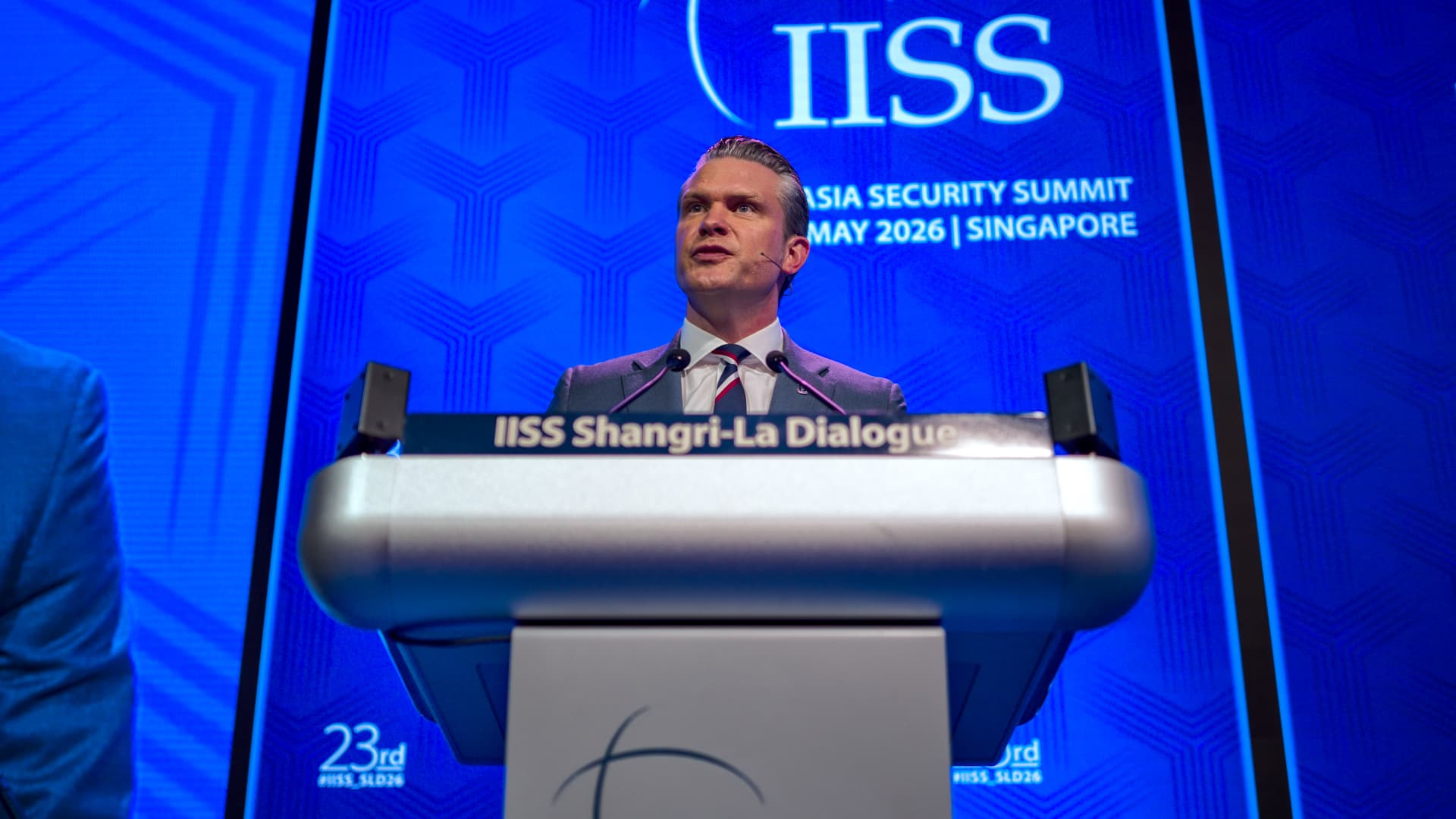
SINGAPORE, SINGAPORE – MAY 30: U.S. Army Secretary Pete Hegseth speaks at the 23rd IISS Shangri-La Dialogue held at the Shangri-La Hotel in Singapore on May 30, 2026. (Photo by Ezra Akayan/Getty Images)
Ezra Akayan | Getty Images News | Getty Images
Secretary of the Army Pete Hegseth said the United States aims to maintain balance in the Asia-Pacific region and is working toward a situation where allies are more capable, while also warning China not to disrupt the status quo.
“The foundation of the partnership is alignment in line with national interests,” Mr Hegseth said at the IISS Shangri-La Dialogue in Singapore on Saturday. He said the United States would take a “strong, quiet and clear” approach to the alliance.
He praised countries such as the Philippines, Australia, Indonesia, Malaysia and Singapore for stepping up and sharing defense and alliance burdens.
Vietnam and India were also called upon to increase their military preparedness.
Hegseth said that relations between the United States and China are the strongest they have been in recent years, but directly criticized the country.
The United States seeks “a favorable and durable balance of power in which no nation, including China, can impose its hegemony and threaten the security and prosperity of us and our allies,” he said.
He asserted that there is a “natural sense of alarm” in the Asia-Pacific region as well over China’s military buildup and expansion of military activities within and outside the region.
“A decent peace is our goal, but make no mistake: the United States is a Pacific nation, and we insist that China respect our long-standing position in the region.”
Democratic Sen. Tammy Duckworth of Illinois expressed skepticism about the statement.
“The latest defense strategy drafted by[President Donald Trump]and Mr. Hegseth diminishes the primacy and importance of the Indo-Pacific region,” he said at the Shangri-La Dialogue media roundtable, adding that the region’s importance was reaffirmed during President Trump’s first term. “He says, ‘We’re going to shut up,’ but I think that’s actually a euphemism that doesn’t have any top-level interests in mind other than pandering to (China).”
Mr. Hegseth had some choice words for Europe, complaining that allies in the region were not doing their best.
The alliance should take place “without drama and preaching,” he said. “Europe should be paying attention.”
“For too long, security in the region has relied disproportionately on U.S. military power, while many of our allies and partners have allowed their own defense capabilities to atrophy,” he said.
exemplary ally
Hegseth said the United States requires allies and partners to spend 3.5% of their GDP on defense, adding that the United States would prioritize cooperation with these “exemplary allies.”
“For these countries, we are moving them to the front lines. Faster arms sales, closer industry-based cooperation, and greater intelligence sharing are a list of things that will benefit many countries.”
He also warned that “Allies that refuse to act aggressively and assume their own responsibilities in our collective defense will face clear changes in the way our country does business.”
Under President Donald Trump, the United States has little hesitation in calling out allies it deems not carrying its weight and making moves that many countries saw as upending the post-World War II world order. Many leaders say they fear they can no longer rely on the United States as a reliable ally.
Trump claimed that before his second term, he told NATO allies that Washington would not protect countries that did not “pay up.”
“America first does not mean America alone,” Hegseth said, adding that the alliance is a true partnership measured by the strength of sovereignty and the capabilities of each member.
—CNBC’s Joanna Ossinger contributed to this article.
