

A woman walks past war-themed graffiti and murals painted on walls along a street in the capital, Tehran, July 22, 2026, as daily life continues under the shadow of rising military tensions between the United States and Iran and as air defense systems are activated at night.
Fatemeh Bahrami | Anadolu | Getty Images
There appeared to be a temporary respite in hostilities between the United States and Iran on Monday, although Tehran denied media reports that it had agreed to a 10-day ceasefire.
Nevertheless, oil prices plummeted in response to the move, and stock markets soared on the move, but the gains narrowed as the days went by.
The suspension followed reports that a decline in the United States’ stockpile of key ammunition was being factored into military decision-making. President Donald Trump told Axios on Friday that he was considering a “massive attack” on Iran, but later set aside those plans over concerns about such stockpiles, The New York Times reported.
President Trump insisted on Monday that the United States has “enough” weapons.
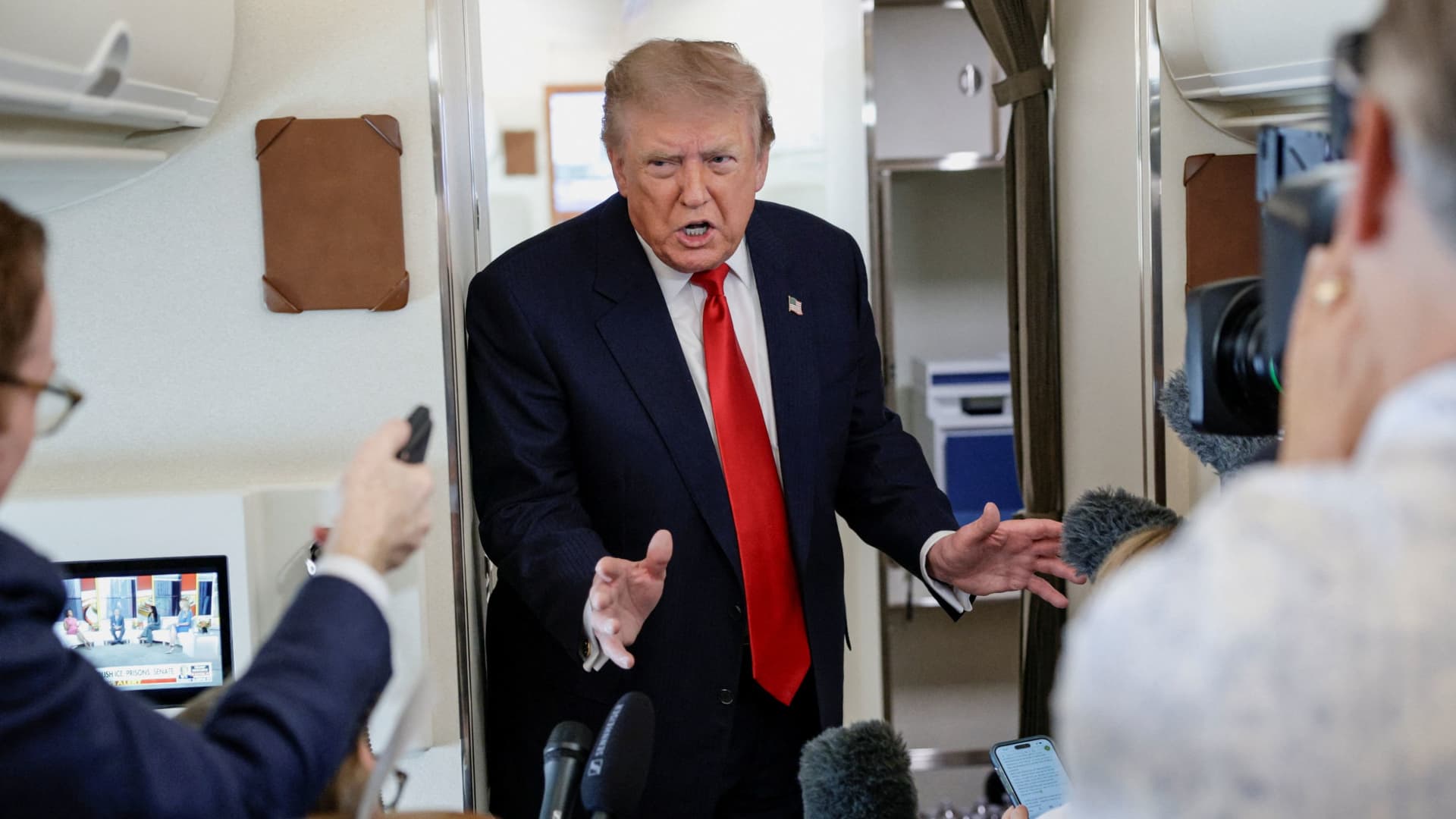
“We have a lot of different types of ammunition,” he told reporters aboard Air Force One en route to Michigan.
President Trump also blamed former President Joe Biden, saying the former president “gave so much to Ukraine that we are piling on it, but we have so much more.”
“We also have a lot of mid-level talent,” Trump added. “I mean, no matter what I do, I can’t use it all up.”
Trump was also scheduled to meet with Israeli Prime Minister Benjamin Netanyahu, with whom he co-launched the war against Iran about five months ago.
Prime Minister Benjamin Netanyahu told XPost on Monday morning that the two leaders would primarily discuss Iran. “Our goal is clear: to protect Israel’s security, strengthen its power and expand a circle of peace around us,” Netanyahu said.
The cessation of fighting began on Friday after the United States attacked Iran for nearly two weeks in retaliation for attacks on ships in the Strait of Hormuz, tearing apart a temporary ceasefire that had already been undermined multiple times.
The suspension comes as diplomats were trying to give “some space” to peace talks. Iran has also refrained from military operations against regional targets in recent days, but said it would retaliate in response to a Chinese-led move to restart stalled diplomatic efforts in Pakistan.
Iranian Foreign Ministry Spokesman Esmail Baghaei said on Monday that Iran is “currently not holding negotiations with the United States” and reiterated that official talks are only being held with Oman regarding the future of the Strait of Hormuz.
Although the United States and Iran suspended hostilities, other parties also carried out military operations related to the conflict over the weekend, highlighting the risk of further escalation and the complex challenges facing negotiators.
Saudi forces have carried out strikes on Iranian-backed Houthi targets in Yemen following rebel attacks on ships in the Red Sea in recent days.
Meanwhile, Ukrainian forces reportedly collided with an Iranian merchant ship in the Caspian Sea, killing one sailor and injuring another. Kiev said the ship was being used to transport munitions in support of Russia’s invasion of the country, while Tehran condemned the attack as a “hostile and criminal act.”
Investors nevertheless rejoiced at the pause in hostilities, not long after the White House was said to be considering a “massive attack” on Iran. Oil prices fell more than 7% early Monday as futures markets showed solid performance on Wall Street.

Challenges facing negotiators
But experts warn that prospects for durable peace face serious challenges. The United States and Iran are not currently in direct formal talks, but are negotiating through intermediaries.
If direct talks are possible, negotiators would need to agree on controversial topics such as the future of Iran’s nuclear program, sanctions relief and Iran’s support for proxies in the Middle East.
From an economic perspective, the most important negotiating points will be guarantees of maritime security and the return and normalization of free two-way traffic flows through the strategically important Strait of Hormuz.
The strait, through which a fifth of the world’s oil supplies flowed before the conflict, remains under a U.S. blockade.
Iran’s Baghai said on Monday that the situation in the Strait of Hormuz “has not changed and remains closed.”
Oman, located on the opposite side of the strait from Iran, has emerged as a key negotiating power. An Omani delegation reportedly visited Tehran on Friday and Saturday to try to negotiate an interim agreement to control shipping through the waterway.
Bagai described Friday and Saturday’s meetings as “useful discussions.”
Oman also said the talks were constructive, but analysts warned that traffic is unlikely to normalize in the short term.
“The main market risks remain on the energy and shipping side,” Deutsche Bank analysts said in a note on Monday. “Traffic through Hormuz remains severely disrupted and the conflict has extended to the Red Sea.”
“This raises the possibility that both Gulf and Red Sea export routes will be disrupted at the same time. The suspension of key actors is therefore a welcome but vulnerable one, especially as side battles are still ongoing.”
