

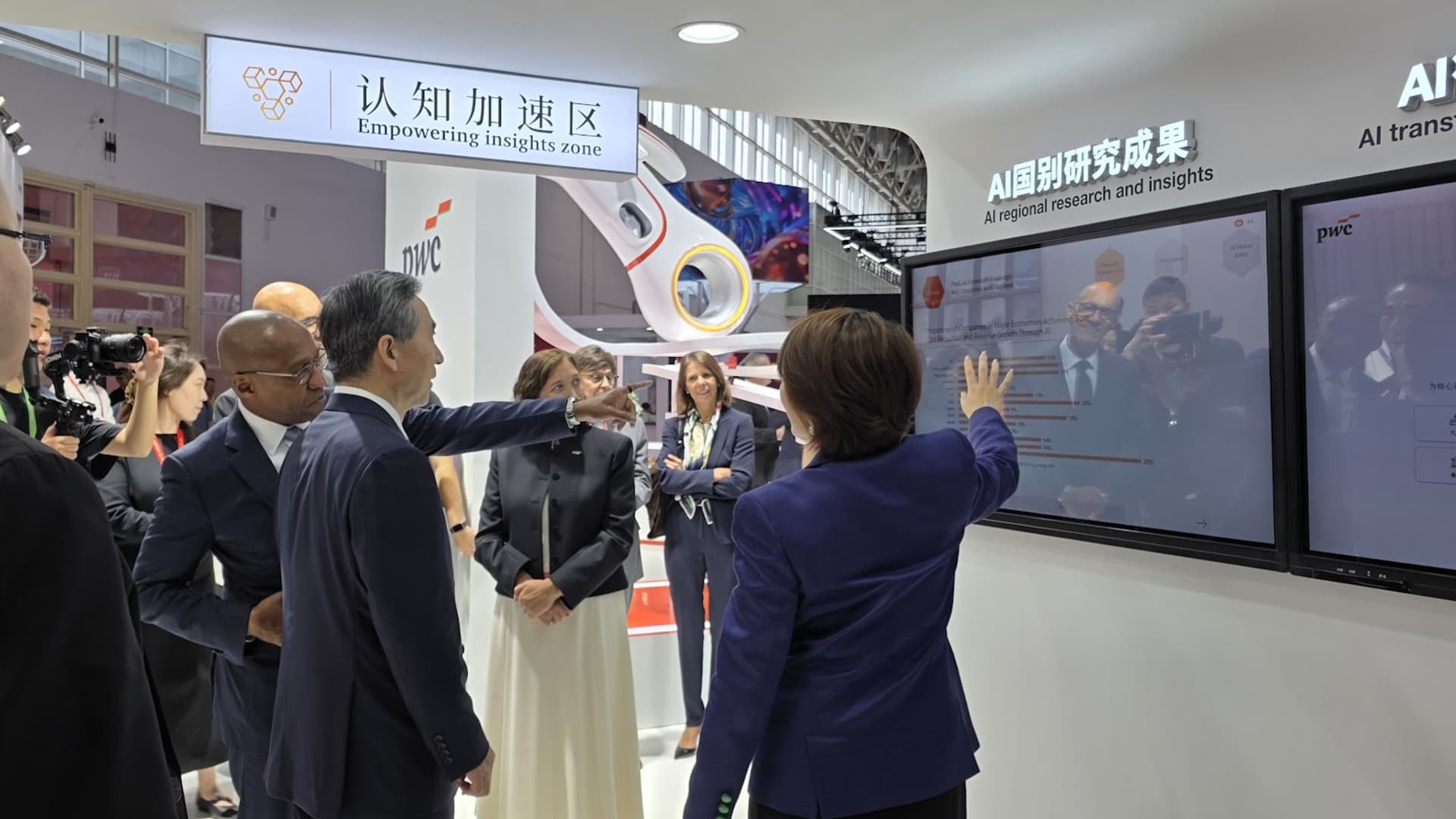
Mohamed Khande, Chairman of PwC Global, shows Ren Hongbin, Chairman of the China Council for the Promotion of International Trade (CCPIT), around the company’s booth at the Supply Chain Expo held in Beijing on June 24, 2026.
CNBC | Evelyn Chen
Hello, I’m Evelyn. I am writing to you from Beijing. Welcome to the latest edition of The China Connection. This is a snapshot of what I’ve seen and heard from local businesses.
Competition with the United States has entered a new phase as more Chinese tech companies set their sights on global users.
big story
Just as American companies compete for similar businesses, from data centers to artificial intelligence applications, Chinese companies are rapidly expanding outside their home market.
“U.S. tech investors need to pay close attention to increased competition from Chinese tech companies, because as we’ve seen, many Chinese companies are prioritizing market share over profit margins,” market strategist Peter Boockvar said on June 24.
Launching a low-cost AI model with capabilities comparable to those made in the U.S. was just the first step.
Next is industrial integration. This is a sign that price and functionality will become increasingly important as economic competition increases globally, and the events of the past week clearly demonstrate that.
PwC Global Chairman Mohamed Khande said Wednesday during a panel discussion at the state-sponsored China International Supply Chain Expo in Beijing that the use of AI in manufacturing will “create more jobs and opportunities, not only here in China, but also outside China, where many companies will leverage Chinese technology.”
Although China has served as the world’s manufacturing hub for decades, the supply chain expo itself only began in 2023 following a call by Chinese President Xi Jinping to strengthen industrial security.
The same morning, Chinese Premier Li Qiang referenced the Expo at the World Economic Forum’s Summer Davos event in Dalian, highlighting how innovation can offset global economic headwinds.
He touted that China’s open source AI models have been downloaded 10 billion times worldwide.
“China will integrate more actively into the global innovation and industrial chain,” he said, according to the official English translation.
PwC said in a report released to coincide with the opening of the Supply Chain Expo that Chinese companies are leveraging AI for cross-industry collaboration far more than companies in other countries, especially those in the United States. Kande and PwC declined further comment.
us playbook
The United States will not remain silent.
The State Department last week signed new European participants to the Pax Silica initiative to secure global technology supply chains and called on countries to rally behind American technology rather than develop competing systems.
Following the two-day Pax Silica Summit, which concluded in Washington, DC, on Friday, the US has launched an advanced manufacturing program with Stanford University.
And in Beijing, I shared the stage with Mr. Kande from PwC. boeing Chinese President Landon Loomis also serves as the U.S. representative on the APEC Business Advisory Council.
Loomis emphasized that APEC’s Digital Week, to be held in Chengdu next month, is an “important opportunity” for member countries to discuss AI governance and “technology operability.”
The event, which will be held in China, will include U.S. technology companies and hold workshops to promote U.S. AI capabilities, a U.S. official previously told CNBC.
On the other hand, American companies expanding into China are taking a middle path.
honeywell China used the expo to announce a partnership to integrate manufacturing management systems and AI capabilities with ByteDance’s enterprise software Lark. The system will allow Honeywell customers to increase their revenue by three to five times, claimed William Yu, president of Honeywell China, during a panel discussion at the expo.
Nvidia’s Jensen Huang sent a video message after attending in person last year, but Apple’s chief operating officer Sabi Khan attended for the first time this year, according to expo organizers. The iPhone maker did not respond to CNBC’s request for comment.
next battlefield
As Chinese companies expand further overseas, particularly in cloud computing infrastructure, U.S. companies are trying to maintain a foothold in China.
Earlier this month, Alibaba announced its third European data center in France, following facilities in the UK and Germany.
S&P Global Ratings analyst Aras Poon said the move “underscores Alibaba’s global cloud ambitions.”
“The French site will likely bring data closer to local customers, reducing latency and improving reliability, allowing Alibaba to handle more complex and time-sensitive workloads,” Poon said.
Alibaba and ByteDance are also investing heavily in data centers in Asia, and Amazon, Google, Microsoft and Oracle are making similar expansions. McKinsey said in a report last week that the Asia-Pacific region could account for approximately 34% of global data center demand by 2030, compared with North America’s projected share of 46%.
It is clear that the global AI race is no longer just about who builds the smartest models, but is now about ecosystems.
need to know
Morgan Stanley doubles China’s humanoid robot shipment forecast as commercialization accelerates
The investment bank now expects 50,000 Chinese-made humanoids to be shipped this year, higher than expectations of 28,000 and 14,000 made earlier this year. Based in Shenzhen Lingyi ITECThe company, which went public in Hong Kong on Friday, told CNBC’s Emily Tan that it makes humanoid robots for both Chinese and American companies.
Tencent tests AI assistant on China’s most popular apps to catch up with rivals
Tencent said in a statement translated by CNBC that its “native AI assistant” Xiaowei is being tested “on a small scale” on Weixin, China’s version of WeChat.
Second worker dies at BYD’s Hungarian factory, already under scrutiny for labor practices
The fatal accident follows a fatal accident at the site in February and comes after BYD Executive Vice President Stella Li denied allegations of labor abuse at the site earlier this month. The automaker did not respond to requests for comment on the recent fatal crash.
US competes with Brazil over China’s huge soybean market
Jim Sutter, CEO of the U.S. Soybean Export Council, told CNBC that China has purchased all 12 million tons of U.S. soybeans it agreed to buy in the marketing year ending in August 2026, and nearly all of that has been shipped. Purchases for the next 25 million tons have begun, he said.
very soon
June 30: China’s official manufacturing PMI for June
July 1: 105th anniversary of the founding of the Communist Party of China (CPC)
July 1: New rules on Chinese outward investment come into effect
July 1: RatingDog China June Manufacturing PMI
July 3: RatingDog China releases June PMI
July 2-5: Global Digital Economy Conference in Beijing
