

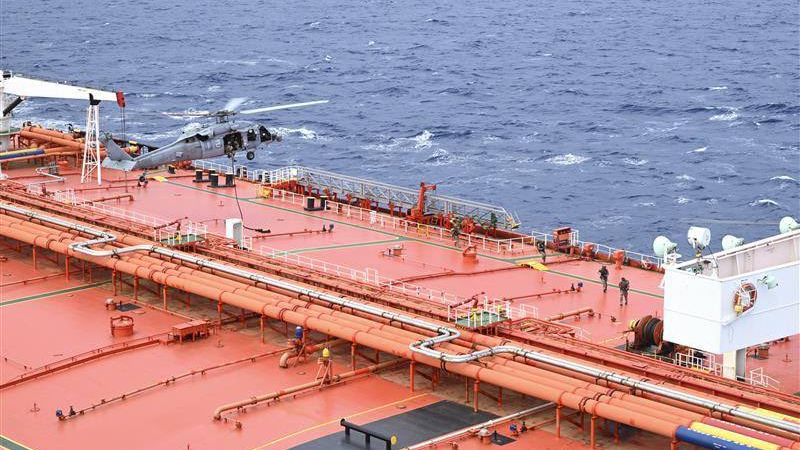
The U.S. boarding of an oil tanker in the Indian Ocean on Tuesday shows the United States is following through on its pledge to pursue Iranian-linked vessels anywhere in the world and is an extension of the Iranian port blockade that increases pressure on Iran.
But the expansion of the disputed region, thousands of miles from the Persian Gulf, could create even wider gaps for peace talks to overcome.
Adm. Dan Cain, chairman of the U.S. Joint Chiefs of Staff, emphasized last week that it would be difficult for Iranian-linked ships to circumvent the U.S. Navy’s global influence. He specifically mentioned the region overseen by the U.S. Indo-Pacific Command (INDOPACOM).
According to marine tracking data, the tanker M/T Tiffani (International Maritime Organization vessel number 9273337), capable of transporting 2 million barrels of crude oil, was stopped between Sri Lanka and Indonesia in the Indopacom jurisdiction, more than 3,000 miles from the Persian Gulf.
Satellite images taken by CNN showed the plane headed for the Strait of Malacca and was at Iran’s Kharg Island oil terminal in the Gulf on April 6.

Maritime traffic data showed it was heading southeast in the Gulf of Oman, outside the Strait of Hormuz, on April 10.
On April 21, shortly after passing Sri Lanka, the tanker suddenly changed course. First we made a sharp 90-degree turn to the south, then another 90-degree turn to the east.
Shortly after, the United States announced its boarding.
Video released by the Pentagon on social media showed soldiers boarding a helicopter from a US Navy warship and landing on a tanker.
Its warship, the Expeditionary Sea Base USS Miguel Keith, is about the size of an aircraft carrier and can support helicopters and special forces.
Its use in boarding operations on the high seas of the Indian Ocean shows that the U.S. Navy has vast resources to enforce blockades and sanctions.
Miguel Keith is one of five ships of its type in the U.S. fleet. The weekend interdiction of the Iranian cargo ship M/V Touska was carried out by guided missile destroyers (the Navy has 74 of them) and amphibious assault ships, essentially Marines from small aircraft carriers. The Navy has nine of them and 11 aircraft carriers, but not all of them are combat-ready at all times.
The impounded vessels are part of a “dark fleet” that helps Iran transport oil and other goods (including for military use) around the world.
“As we have made clear, we will pursue global maritime enforcement efforts to disrupt illicit networks and interdict sanctioned vessels providing material support to Iran wherever they operate,” the Pentagon’s social media said Tuesday.
“The high seas are not a haven for sanctioned vessels,” it added.
Analysts also say the open ocean is a safe place for the U.S. Navy to conduct interdiction because there are fewer neutral ships nearby and no land to limit maneuverability or hide enemies, as is the case in and around the Persian Gulf.
The blue-water tactic mirrors what the United States used earlier this year when it pursued a tanker with ties to Venezuela, ultimately seizing President Nicolas Maduro in a raid and ending the conflict between the two countries.
Tracking data seen by CNN shows the Tiffany has been circling the ocean near where it came to rest since boarding.
What will happen to it and the oil it contains remains to be seen.
The ship is subject to sanctions by the U.S. Treasury Department’s Office of Foreign Assets Control.
In February, the U.S. Department of Justice filed a motion demanding that the U.S. military seize a Venezuelan oil tanker linked to Iran and forfeit the 1.8 million barrels of oil it was carrying.
After the Touska was seized on Sunday, analysts said it would be searched and its cargo inspected. Analysts said the ship and its cargo could become the property of the U.S. government if it is ultimately determined to be the “spoils of war” of war.
Regardless of what happens with the Tiffani and Towska, for now, this tactic does not appear to be bringing Iran any closer to the negotiating table.
Iran’s Foreign Ministry claimed on Monday that the US action against Iranian vessels was a violation of the ceasefire that took effect on April 8.
Since then, Iran has refused to send a delegation to new peace talks in Pakistan.
Expanding the war zone with more deep-sea interdiction would likely harden Iran’s position.
CNN’s Isaac Yee and Teele Rebane contributed to this report.
