

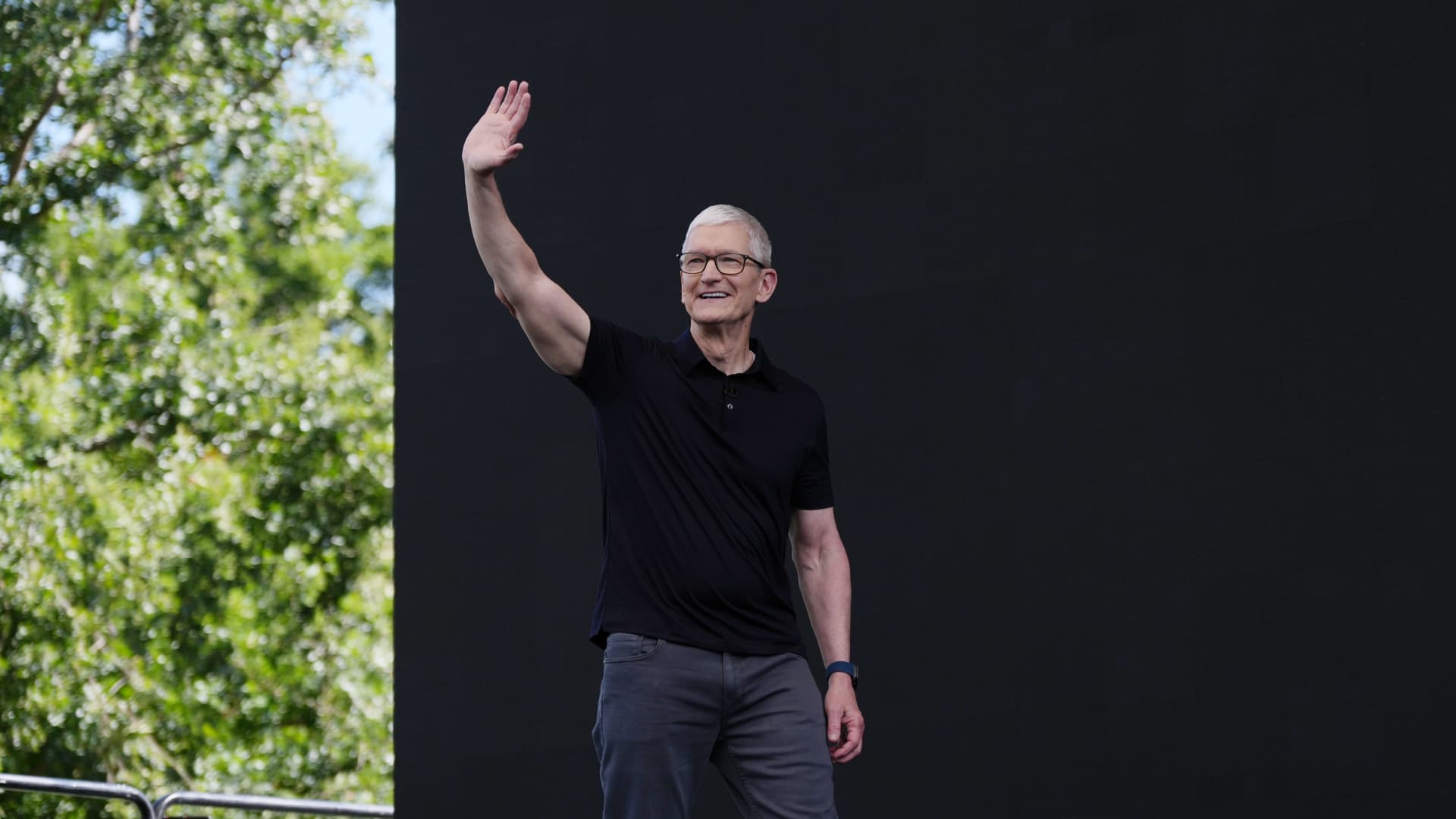
Apple Inc. Chief Executive Officer Tim Cook attends the Apple Worldwide Developers Conference (WWDC) held at the Apple Park campus in Cupertino, California, United States, on Monday, June 8, 2026.
David Paul Morris | Bloomberg | Getty Images
Hello, my name is Hui Jie from Singapore. Welcome to another edition of CNBC’s Daily Open.
Tim Cook attended his final Worldwide Developers Conference as CEO and shed tears while Apple did what seems to be trending these days: slap an AI label on Siri.
Tensions in the Middle East remain simmering, with Israeli Prime Minister Benjamin Netanyahu warning that the war is “not over yet” following the cessation of hostilities between Tehran and Tel Aviv.
What you need to know today
An emotional Tim Cook signed off on his final WWDC as Apple CEO, saying the company would rebrand its virtual assistant and chatbot as Siri AI, making it an “even more capable assistant.”
Apple also revealed further customization options for its widely popular Liquid Glass interface, saying users will be able to adjust settings such as transparency, text labels, and toolbars.
Elsewhere in the tech world, OpenAI quietly filed for an IPO with the Securities and Exchange Commission, following rival Anthropic’s move last week and Elon Musk’s SpaceX to go public.
The artificial intelligence company, which has a market capitalization of more than $850 billion, is preparing to go public as early as the fourth quarter of this year.
While the tech industry appears to be providing an optimistic outlook, helping to keep the S&P 500 and Nasdaq Composite Index up on Monday, geopolitical realities remain uncertain for investors.
On Monday, Iran told CNBC that it had stopped attacking Israel but would resume hostilities if the IDF continued its attacks on Lebanon. Tel Aviv has upped the ante, with Prime Minister Benjamin Netanyahu saying the war against Iran and its Lebanon-based proxy Hezbollah is “not over yet.”
These developments pushed oil prices higher, with international benchmark Brent crude rising 1.25% to $94.25 per barrel on Monday, and U.S. West Texas Intermediate futures rising slightly to $91.34 in early Tuesday trading.
Analysts said China is the main factor behind oil prices below $100, and a rapid decline in crude oil imports from China is helping to curb price increases. The Chinese government’s measures to reduce crude oil imports from 11.7 million barrels per day in February to just under 9 million barrels per day by the end of May reduced demand and helped ease the supply shock in the Strait of Hormuz.
In Asia, Chinese companies face increased scrutiny from the US as the US government expands the list of companies believed to be supporting the Chinese military, including tech giant Alibaba, automaker BYD and internet search provider Baidu.
Inclusion on the list means the U.S. military will no longer contract directly with, or purchase services or products from, the designated companies after 2027.
— Lim Huijie
And finally…
Airline profits expected to halve this year as fuel costs soar by $100 billion – IATA
The International Air Transport Association has warned that global airlines are expected to see their profits halved in 2026 as rising jet fuel prices continue to weigh on the industry.
Willie Walsh, IATA’s outgoing executive director, said oil prices have soared since the U.S.-Iran conflict began on February 28, driving up jet fuel costs and adding to the challenges airlines have faced in recent years, from the coronavirus pandemic to the war in Ukraine.
“As a result, we expect average jet fuel prices to rise 70% year-on-year,” Walsh said in a report on the state of the global air transport industry published Sunday. “This will increase our bulk fuel bill by $100 billion this year.”
— Sauda Baimiya
