

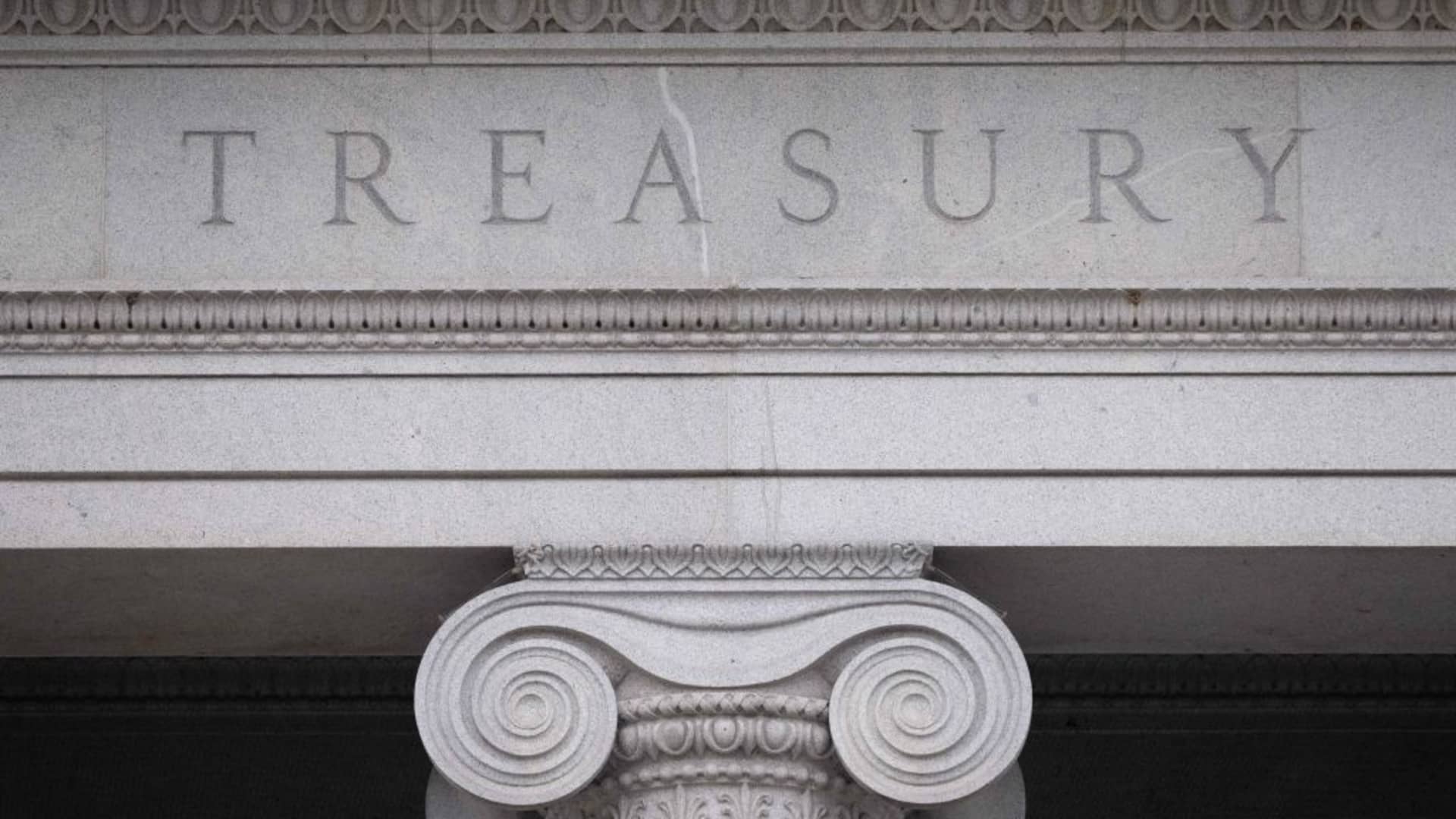
The US Treasury building in Washington.
Saul Loeb | AFP | Getty Images
Foreign governments slashed U.S. debt in March to protect local currencies from an energy shock that caused exchange rates to collapse as Middle East wars forced central banks to draw down dollar reserves.
China cut its holdings to $652.3 billion, down about 6% from February and the lowest level since September 2008, according to U.S. Treasury data released late Monday.
Japan, the single largest foreign holder of U.S. government debt, reduced its debt by about $47 billion to $1.191 trillion. Overall overseas holdings totaled $9.25 trillion in March, down from $9.49 trillion in February.
The selling was triggered by the depreciation of the yen and other Asian currencies due to the outbreak of conflict between the United States and Iran and the resulting rise in oil prices. Regional economies dependent on Gulf oil imports, including Japan, faced the biggest energy shock in decades, prompting policymakers to sell some dollar-denominated assets to finance currency interventions.
“Given the increased financial volatility since the start of the Gulf War and the resulting pressure on exchange rates, particularly in Asia, it is not surprising that central banks’ holdings of U.S. Treasuries have declined,” said Frederick Newman, chief Asia economist at HSBC.
“Currency market intervention to support local currencies will cause some central banks to sell their holdings in US Treasuries.”
April statistics due next month may show how far central banks are willing to go to stabilize their currencies.
Policymakers also tend to rebalance portfolios during times of market stress, with some selling reflecting tactical concerns about rising inflation and falling bond prices, with investments in cash-like assets to provide liquidity should the need for intervention increase, Newman said.
Treasuries have come under intense pressure as yields soared as conflicts in the Middle East stoked inflation concerns and investors demanded higher compensation for holding U.S. debt.
The sale of foreign holdings also reflects a decline in bond prices, as foreign investors booked $142.1 billion in write-downs on long-term government bond holdings in March alone.
Bucking this trend, the UK added about $29.6 billion to its holdings in March to $926.9 billion as several smaller holders exited.
“Shadow Holdings”
China has gradually reduced its direct exposure to the Treasury since holdings peaked at about $1.3 trillion in 2013, but analysts have long argued that official statistics underestimate China’s actual performance in the U.S. bond market. Storage centers like Belgium and Luxembourg are widely seen as pipelines for China’s sovereign wealth and state-related investments.
Tiancheng Xu, senior economist at the Economist Intelligence Unit, said the total appears to be relatively stable when these “shadow holdings” are included. Belgium held $454 billion in U.S. Treasuries in March, about the same level as February, while Luxembourg’s holdings have remained stable over the past year at about $439.4 billion.
“While China’s overall UST holdings have remained largely stable for the time being, short-term market volatility has been a key factor driving the decline in short-term holdings,” said Becky Liu, managing director of global research at Standard Chartered.
For Japan, the question of whether the Japanese government will rely on sustained Treasury liquidations to fund its yen intervention has also gained attention in Washington in recent weeks.
The Bank of Japan is reported to have intervened in the foreign exchange market from late March to early April after Japan’s current account deficit widened due to soaring oil import costs and concerns about the yen’s depreciation spiraled, causing the yen to depreciate beyond the politically sensitive 160 yen level.
Vikas Pershad, a portfolio manager at M&G Investments, told CNBC earlier this month that it was clear that U.S. policymakers wanted “the preferred policy option (for Japan) to be not to sell U.S. Treasuries.” He cited trade deals in critical minerals, advanced technology and defense as alternative opportunities to help ease pressure on Japan’s foreign exchange reserves.
Correction: Becky Liu is Managing Director of Global Research at Standard Chartered. Previous versions incorrectly listed the company name.
