

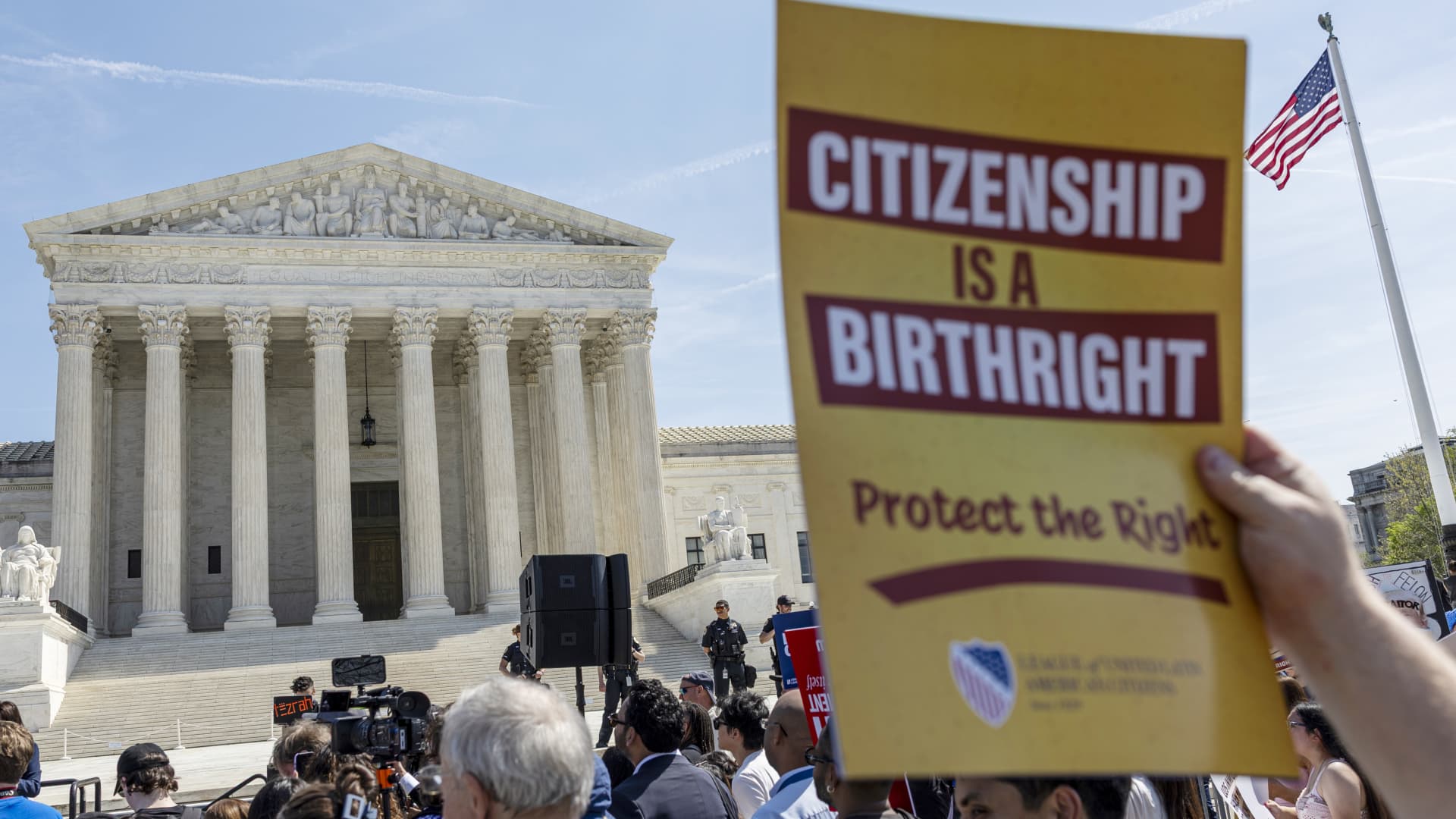

The Supreme Court on Tuesday struck down President Donald Trump’s executive order that upheld citizenship rights for people born in the United States and sought to override long-standing constitutional principles for children born to many immigrants.
The majority decision, written by Chief Justice John Roberts, stated that “children born in the United States to illegally or temporarily present parents are subject to the ‘jurisdiction’ of the United States and are citizens at birth under the Citizenship Clause of the Fourteenth Amendment.”
The Citizenship Clause of the Fourteenth Amendment to the United States Constitution, adopted in 1868, states that “all persons born or naturalized in the United States, and subject to the jurisdiction thereof, shall be citizens of the United States and of the States in which they reside.”
Roberts joined fellow conservative Justice Amy Coney Barrett and three liberal justices, Elena Kagan, Sonia Sotomayor and Ketanji Brown Jackson, in the majority opinion on the 14th Amendment’s basis.
Another conservative judge, Brett Kavanaugh, wrote that while he did not believe Trump’s executive order violated the 14th Amendment, it did “violate the federal law established in 1940 that governs citizenship for people born in the United States.”
Three other conservatives on the court, Clarence Thomas, Samuel Alito, and Neil Gorsuch, all wrote dissenting opinions.
“The court made a grave error,” Alito wrote in his dissent to the ruling in the case, known as Trump v. Barbara.
During oral arguments in April, the justices on the court indicated they would affirm that non-Americans born in the United States are automatically granted citizenship.
Trump was the first sitting president to attend oral arguments.
If President Trump’s orders had been followed, tens of thousands of babies would have been left behind.
People born in the United States each month by illegal immigrants or visitors who are not American citizens.
“The Supreme Court upheld birthright citizenship. This is too bad for our country,” President Trump said in a post on Truth Social following the ruling.
“But with the president’s support, Congress can easily offset any legislation decided through this process,” Trump said. “We don’t need a long and unwieldy constitutional amendment! Congress should start working today to end costly and unfair birthright citizenship for our country. They’ll have my full and total support!”
“This victory belongs to all of us, to the American people,” Cecilia Wang, national legal director for the American Civil Liberties Union, which opposed Trump’s order to the Supreme Court, said in an interview with MS NOW’s “On the Line.”
“We’ve already heard from three clients who are representatives of the class here, and they’re all saying, like your friends, they’ve been under this cloud where the president of the United States is trying to revoke this fundamental right that all Americans have relied on for 150 years,” said Wang, who is also a birthright citizen.
“And all of them are happy with this decision. I want to once again congratulate everyone in our class and the plaintiff class and all the Americans who stood up in support of birthright citizenship,” Wang said.
On his first day back at the White House on January 20, 2025, President Trump signed an executive order revoking birthright citizenship.
The order stated that after 30 days from its effective date, infants born in the United States would not be entitled to citizenship documents if their parents were in the country illegally or were undocumented workers.
On April 1, 2026, demonstrators in support of birthright citizenship gather in front of the U.S. Supreme Court in Washington, DC.
Mehmet Ethel | Anadolu | Getty Images
